





By Kristina Braly, MD — Founder, AEMBR
When I'm asked why AEMBR makes a phthalate free laundry detergent, my answer is the same one I'd give a patient asking why I'm recommending they avoid a particular medication class: the mechanism of harm is well-documented, the exposure is avoidable, and the risk-to-benefit calculation doesn't hold up. Phthalates aren't a speculative concern. They are a class of chemicals with a substantial body of toxicological and epidemiological evidence pointing toward real biological effects — particularly in the endocrine system.

The challenge with phthalates in laundry detergent is that most consumers don't know they're there. Phthalates are used as fragrance fixatives — compounds that help scent last longer on fabric. They're included as part of the "fragrance" ingredient, which US law doesn't require to be disclosed in detail. You won't see "phthalates" on a detergent label. You'll see "fragrance" — and that word may contain them.
Here's what I think every household should understand about this ingredient class.
What Phthalates Actually Are
Phthalates (pronounced THAL-ates) are a family of diester compounds derived from phthalic acid. They've been used industrially since the 1920s, primarily as plasticizers — compounds that make plastics more flexible and durable. PVC plastic, food packaging, vinyl flooring, medical tubing — phthalates are used widely across industries.
In consumer products, phthalates serve a different function: as fragrance fixatives and solvents. They help fragrance compounds bind to surfaces and extend their longevity. This makes them particularly useful in fabric-care products where "long-lasting freshness" is a marketing priority. The longer a scent lingers on clothing, the more likely phthalates are involved in achieving that effect.
Expert guidance on clean ingredients, home fragrance, and living well — from our physician-authored blog.
The most commonly used phthalates in fragrance applications include:
- Diethyl phthalate (DEP) — the most widely used fragrance phthalate; found in perfumes, personal care products, and laundry products
- Dibutyl phthalate (DBP) — used in fragrance and nail products; classified as a reproductive toxicant in the EU
- Di(2-ethylhexyl) phthalate (DEHP) — primarily a plasticizer but found in some fragrance applications; designated a reproductive toxicant and probable human carcinogen by multiple regulatory bodies
- Dimethyl phthalate (DMP) — used in insect repellents and some fragrance formulas
- Benzyl butyl phthalate (BBP) — reproductive toxicant; restricted in toys and childcare articles in the EU and US
The Fragrance Loophole: Why Phthalates Stay Hidden
Under the US Fair Packaging and Labeling Act, manufacturers are required to list ingredients on product labels — but fragrance formulas are protected as trade secrets. This means a manufacturer can list "fragrance" as a single ingredient, and the dozens or hundreds of individual compounds that make up that fragrance — including phthalates — are not required to be disclosed.
This is not a technicality. It is a structural gap in consumer protection that has been acknowledged by the FDA and has remained unaddressed for decades. The fragrance industry's trade group, the International Fragrance Association (IFRA), maintains a list of restricted and prohibited compounds — but IFRA standards are voluntary, industry-set guidelines, not enforceable regulations. There is no independent verification mechanism for compliance.
In practical terms: if a laundry detergent label says "fragrance" and the manufacturer has not voluntarily disclosed that they use no phthalates, you have no way of knowing whether phthalates are present. Third-party testing — like that conducted by the EWG (Environmental Working Group) or investigative journalism projects — is the only external check that exists. And that testing has found phthalates in numerous widely-sold laundry products.
How Phthalates Enter the Body Through Laundry Products
The exposure pathway for laundry detergent phthalates is primarily dermal: compounds deposited on fabric are in direct, prolonged contact with skin. For the general adult population, wearing clothing for 14–16 hours a day creates sustained low-level exposure. For infants and young children who are held against fabric surfaces — or who mouth fabric items — the exposure dynamic is more significant.
Studies have detected phthalate metabolites in urine samples following exposure to scented fabric-care products, confirming dermal absorption does occur. The biomonitoring data is clear: people who use heavily fragranced laundry products show higher urinary phthalate metabolite levels than those who use unscented products.
Inhalation is a secondary pathway. Volatile phthalate compounds can off-gas from freshly laundered fabrics, particularly when warm (just out of the dryer). Anyone folding laundry or sleeping on recently washed bedding is inhaling these compounds at low levels.
The Endocrine Disruption Mechanism: What the Research Shows
Phthalates are classified as endocrine-disrupting chemicals (EDCs) — compounds that interfere with the body's hormonal signaling systems. The primary mechanism involves phthalate metabolites binding to or blocking hormone receptors, particularly androgen receptors. This anti-androgenic activity is the basis for the most concerning human health associations in the literature. For a full breakdown of what else is in your detergent, see our guide to laundry detergent ingredients.
The endocrine system isn't a simple on/off switch. It's a finely calibrated feedback network, and disruption at one point — particularly during windows of developmental vulnerability — can have downstream effects that aren't apparent until years or decades later. This is the nature of endocrine disruption: the exposure and the consequence are often separated by time.
Key findings from the research literature:
- Reproductive effects in males: Multiple studies have linked higher prenatal phthalate exposure (measured through maternal urinary metabolites) to altered anogenital distance in male infants — a marker of androgenic activity during fetal development. Lower testosterone levels and reduced sperm quality have been associated with phthalate exposure in adult men.
- Thyroid disruption: Several phthalates — particularly DEHP and DBP — have been associated with altered thyroid hormone levels in both animal and human studies. Thyroid hormones are critical for neurological development in the fetus.
- Early puberty in girls: Epidemiological studies have found associations between higher phthalate exposure and earlier onset of puberty in girls, though causality is complex in population studies.
- Metabolic effects: Emerging research suggests links between phthalate exposure and insulin resistance, though this area requires more human data.
It's important to be precise about what this evidence does and doesn't show. Most human studies are observational and cannot prove causality in the way a randomized controlled trial would. Confounding is always a concern in environmental epidemiology. But the mechanistic data from in vitro and animal studies, combined with consistent associations in human observational research, builds a coherent picture of biological plausibility — and that picture has moved regulatory bodies in the EU, Canada, and elsewhere to restrict phthalate use well beyond what the US has done.
Where US Regulation Currently Stands
The US regulatory picture on phthalates is a patchwork. Under the Consumer Product Safety Improvement Act (CPSIA), certain phthalates (DEHP, DBP, BBP, and others) are restricted in children's toys and childcare articles above 0.1% concentration. The FDA has restricted eight phthalates from nail care products. California's Prop 65 lists several phthalates as known reproductive toxicants.
What is not restricted: phthalates in fragrance compounds used in household products, including laundry detergent. The fragrance loophole means these compounds can be present in products used on clothing and bedding without any disclosure requirement.
By contrast, the EU has restricted DEHP, DBP, BBP, and DIBP from cosmetics and has flagged DEP for further assessment. Canada has taken action on DEHP across multiple product categories. The US lags significantly.
Phthalate Risk Profile by Compound
| Phthalate | Primary Use in Consumer Products | Classification | Key Concerns | EU Status | US Status |
|---|---|---|---|---|---|
| DEP (Diethyl phthalate) | Fragrance fixative in detergents, perfumes, personal care | Endocrine disruptor (suspected) | Thyroid disruption; anti-estrogenic activity in some studies | Under assessment; not banned in cosmetics | Permitted; no disclosure required in fragrance |
| DBP (Dibutyl phthalate) | Fragrance, nail products | Reproductive toxicant Cat. 1B (EU) | Anti-androgenic; prenatal exposure linked to male reproductive effects | Banned in cosmetics | Restricted in toys; permitted in fragranced household products |
| DEHP (Di(2-ethylhexyl) phthalate) | Plasticizer; some fragrance use | Probable human carcinogen (EPA); Repr. Tox. 1B (EU) | Strong anti-androgenic effects; linked to male fertility impacts | Banned in cosmetics and childcare articles | Restricted in children's products; no restriction in fragrance |
| BBP (Benzyl butyl phthalate) | Fragrance, plasticizer | Reproductive toxicant Cat. 1B (EU) | Anti-androgenic; estrogen receptor binding activity | Banned in cosmetics | Restricted in children's products only |
| DMP (Dimethyl phthalate) | Insect repellent, fragrance | Limited data; not currently classified | Lower potency than other phthalates but still an EDC suspect | Not currently restricted | Permitted; no disclosure required |
How to Identify a Truly Phthalate Free Laundry Detergent: What to Look For
Because phthalates don't appear on detergent labels by name, identifying their presence requires indirect signals and, where possible, third-party testing data.
Red flags that suggest a product may contain phthalates:
- The word "fragrance" or "parfum" on the label without further disclosure
- Marketing language emphasizing "long-lasting freshness" or "extended scent" — these effects are achieved partly through fixatives like phthalates
- No third-party certification (EWG Verified, MADE SAFE) that specifically tests for phthalates
- No published fragrance ingredient disclosure policy from the manufacturer
- No public response to direct questions about phthalate use
Phthalate-Free Detergent Checklist
- ☐ Label says "fragrance-free" — not "unscented" (unscented may still use masking fragrances)
- ☐ If scented, fragrance is disclosed — individual aroma compounds listed or manufacturer commits publicly to no phthalates
- ☐ No "fragrance" or "parfum" in ingredient list without full disclosure
- ☐ EWG Verified or MADE SAFE certified — both require phthalate testing
- ☐ Manufacturer has a fragrance disclosure policy you can find and read
- ☐ No language claiming "extended freshness" or "long-lasting scent" without ingredient transparency
- ☐ Not relying on "natural" labeling alone — natural fragrances can also contain or be contaminated with phthalates
A Note on "Fragrance-Free" vs. "Unscented"
This distinction matters and is frequently misunderstood. "Fragrance-free" means no fragrance compounds were added to the formulation. "Unscented" means the product has no perceivable scent — but it may achieve that by using masking fragrances to neutralize the natural odor of the base ingredients. Those masking fragrances are still subject to the fragrance loophole and may contain phthalates.
If phthalate avoidance is your goal, "fragrance-free" is the more precise and reliable claim. When combined with a fully disclosed ingredient list, it's the clearest indication that no undisclosed compounds are present.
Why I Formulated AEMBR Laundry Powder Without Any Fragrance
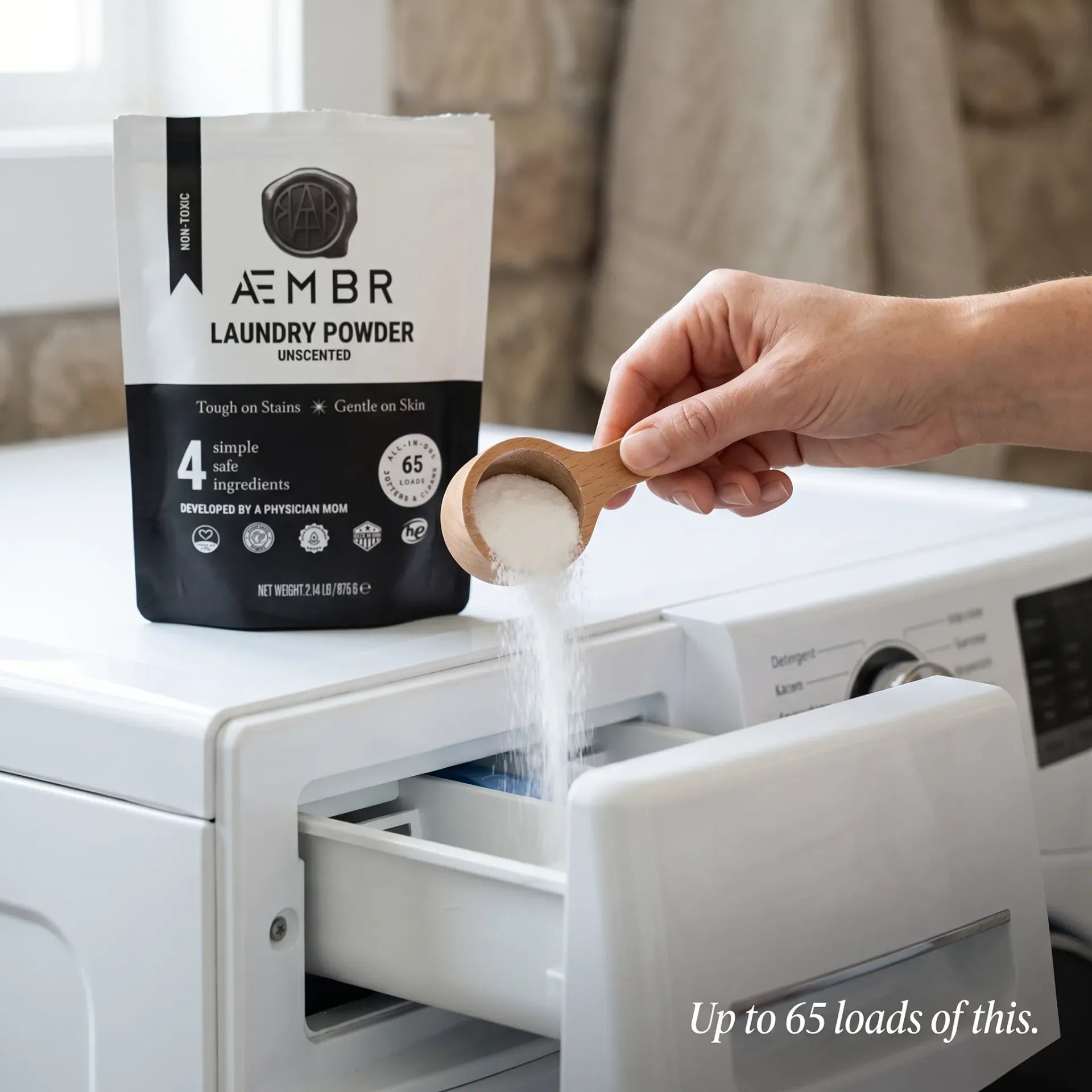
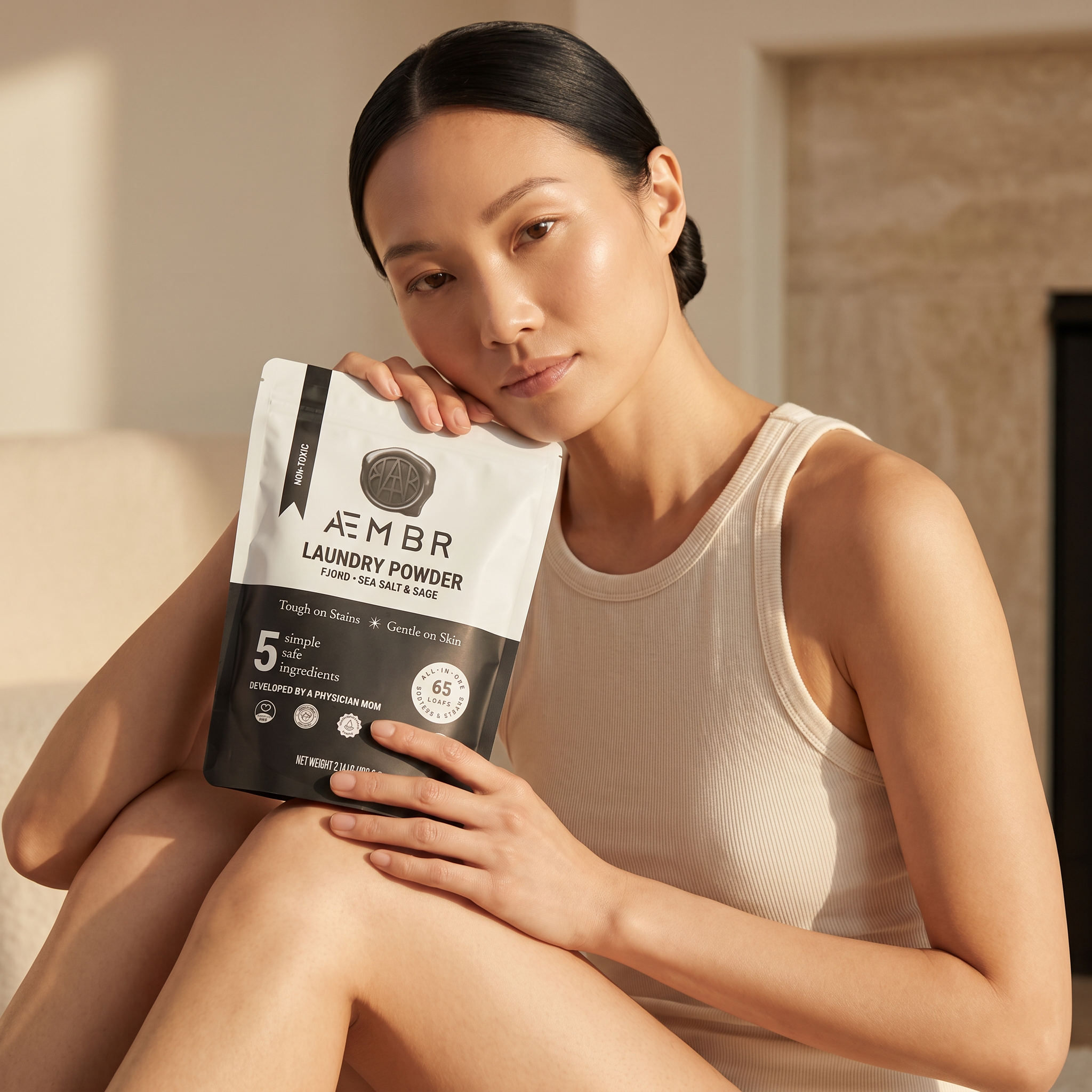
When I developed AEMBR's Laundry Powder, I made a deliberate choice not to add any fragrance — not even a clean, phthalate-free one. My reasoning was two-fold. First, I wanted the product to be usable by people with fragrance sensitivities, asthma, and eczema — a significant portion of the population for whom even "clean" fragrances can be triggering. Second, and more personally: I was formulating something that would go on my children's clothes. The benefit of added scent didn't outweigh the complexity it introduced.
The result is a powder that cleans exceptionally well, rinses completely, and leaves fabric smelling like nothing — which, for me, is the cleanest possible outcome.
Formulated without fragrance, phthalates, or any of the compounds that belong on this list. AEMBR Laundry Powder is fully ingredient-transparent — every compound disclosed, nothing hidden behind a trade secret designation.
Also in this series: Baby Safe Laundry Detergent: What Pediatricians Recommend and The Best Non-Toxic Laundry Detergents of 2026.
By Kristina Braly, MD — Founder, AEMBR


