




By Kristina Braly, MD — Founder, AEMBR
You pull a load out of the washing machine expecting clean. Instead you get something closer to damp gym bag. Why does laundry smell bad after washing, even when you followed every instruction on the label? As someone who formulates laundry products for a living, I can tell you: the answer is almost never "you used the wrong detergent." It's almost always a systems problem — the machine, the cycle, the load size, and the detergent working against each other in a way that nobody on the back of a Tide bottle is going to explain to you.

Here is the actual diagnosis.
The Short Answer: Microbial Growth, Not Dirt
Clean laundry that smells bad after washing isn't dirty in the traditional sense. It doesn't have food residue or visible soil. What it has is microbial activity — specifically, anaerobic bacteria and mold that produce volatile organic compounds (VOCs) as metabolic byproducts. Those VOCs are what your nose detects as "musty" or "sour."
The key distinction: washing removes most surface soil, but if conditions in the drum favor microbial growth during or after the cycle, the smell comes back. The laundry never fully crosses into "clean" because the biology wasn't addressed — only the dirt was.
Cause #1 — Biofilm in the Washing Machine Drum
This is the most underdiagnosed cause, and it's the one I covered in depth in my post on how to clean a top-loading washing machine. Biofilm is a structured community of microorganisms — primarily bacteria and mold — embedded in a self-produced polysaccharide matrix. It coats the drum interior, rubber gasket, detergent drawer, and water inlet ports.
Expert guidance on clean ingredients, home fragrance, and living well — from our physician-authored blog.
When you run a load, water flows through biofilm before it ever touches your clothes. The clothes pick up microbial load from the machine itself. No matter how good your detergent is, it can't fully compensate for a contaminated water source inside the drum. The machine is reinfecting the laundry mid-cycle.
Fix: Clean your machine monthly. Hot cycle with citric acid or oxygen bleach. See the linked post for a full protocol. No other intervention will solve persistent smell if the drum is the source.
Cause #2 — Over-Sudsing and Detergent Residue
Too much detergent is one of the most common laundry mistakes, and it works in the opposite direction from what most people expect. More detergent does not mean cleaner clothes. It means more suds than the rinse cycle can fully remove.
That residue stays in the fabric. Trapped surfactant and fragrance chemicals create a film that, over time, becomes a food source for bacteria. The residue holds moisture after drying, and moisture plus organic substrate equals microbial growth. The result: clothes that smell fine when they come out of the dryer, then develop a sour odor after a few hours of being worn or stored.
High-efficiency front-loaders are especially prone to this because they use dramatically less water than top-loaders. The standard "fill to the line" dosing on most conventional detergents is calibrated for a top-loader. Apply that same dose to a front-loader and you're using two to three times more detergent than the machine can rinse out.
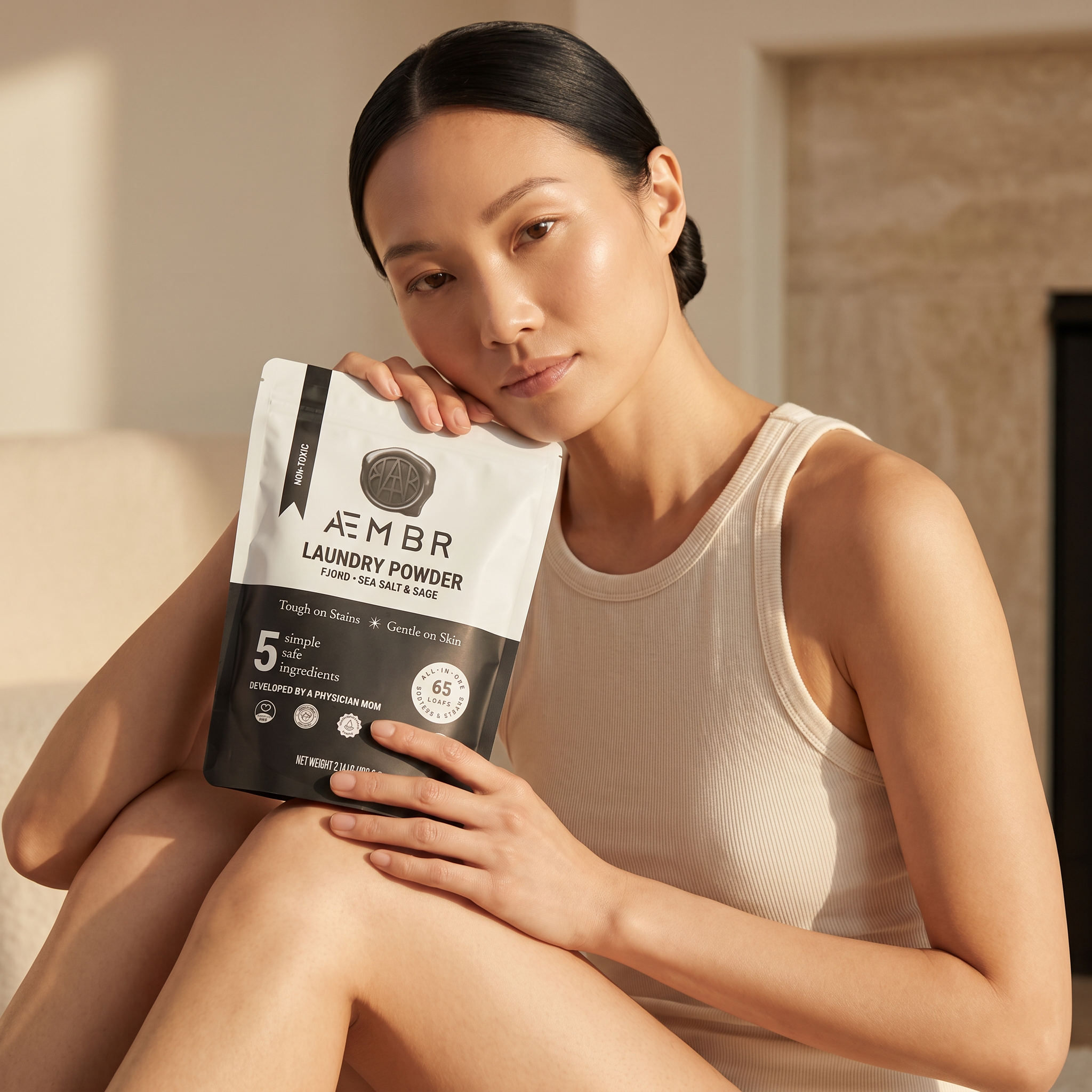
Fix: Use less detergent than you think you need. For HE machines, use roughly half the indicated dose for standard loads. The water is doing more work than the detergent in most modern cycles — excess surfactant creates more problems than it solves. AEMBR Laundry Powder is a concentrated powder format, which means a tablespoon does the work of a cup of liquid — and the precise scoop prevents overdosing.
Cause #3 — Low-Water Wash Cycles
Modern HE washing machines are engineered for water efficiency. Many use as little as 3–5 gallons per load compared to the 40+ gallons of older top-loaders. That efficiency is genuinely good for water conservation — but it creates a mechanical problem for laundry hygiene.
Less water means less dilution of soils, bacteria, and detergent residue. It also means less mechanical agitation to physically dislodge biofilm or heavily soiled areas. High-density loads in low-water cycles frequently end up with inadequate rinsing, particularly in the center of the drum where water circulation is weakest.
Fix: Match load size to cycle selection. Never pack a drum more than three-quarters full. Use the "extra rinse" cycle if your machine offers it — one additional rinse adds minimal water but significantly reduces residue. If you have chronic smell issues, run a "bulky" or "heavy duty" cycle for regular cotton loads: these use more water and longer agitation.
Cause #4 — Leaving Wet Laundry in the Drum
This one is simple biology. Wet fabric at room temperature is an ideal growth environment for mold and bacteria. The critical window: anything beyond about 30 minutes in a closed drum is enough for microbial populations to begin establishing. An hour or two is enough to produce noticeable odor. Six hours in a closed machine and you'll need to rewash — sometimes twice.
The smell comes from the same VOCs mentioned above: primarily short-chain fatty acids, sulfur compounds, and aldehydes produced by anaerobic bacteria metabolizing the organic material in the fabric. Laundering removes some of these compounds, but not all — which is why rewashing sometimes doesn't fully eliminate the smell on the first pass.
Fix: Transfer to the dryer or hang immediately after the cycle ends. Set a reminder if needed. If you find yourself regularly forgetting, a spin-only cycle will re-agitate and partially re-aerate the load — not a substitute for drying, but better than letting it sit.
Cause #5 — Fabric Type and Construction
Not all fabrics respond the same way. Synthetic fibers — polyester, nylon, spandex, microfiber — are significantly more prone to odor retention than natural fibers like cotton or linen. The reason is structural: synthetic fibers are hydrophobic. They repel water, which is why they wick sweat away from skin efficiently. But that same property means they don't absorb detergent solution well during washing, so oils, bacteria, and odor compounds that have bonded to the fiber surface are harder to remove.
Microfiber in particular has a very high surface-area-to-volume ratio. There is simply more physical surface for odor compounds to adhere to, and the tight weave makes complete rinsing difficult. Athletic wear made from synthetic blends is the most common category where people notice persistent smell after washing.
Fix: Wash synthetics on cold with a smaller dose and an extra rinse. Do not use fabric softener on athletic wear — the coating seals in odor compounds rather than releasing them. An oxygen boost added to the wash cycle can help oxidize odor-causing compounds that standard surfactants don't touch. AEMBR Oxygen Boost is designed to work alongside the Laundry Powder for exactly this use case.
Cause #6 — Water Temperature Mismatch
Cold water washing is beneficial for energy consumption and fabric longevity. But cold water has a real limitation: it does not effectively kill bacteria. Clinical literature generally puts the minimum temperature for meaningful bacterial reduction at 60°C (140°F), which the vast majority of residential "hot" cycles don't reach — most residential hot cycles top out around 40–49°C (104–120°F).
This matters most for items with high microbial load: towels, bedding, gym clothes, cloth diapers, and anything in contact with broken skin or bodily fluids. Washing these in cold water removes soil but doesn't reduce bacterial counts meaningfully. Persistent smell in towels despite regular washing is almost always a temperature problem.
Fix: Wash towels and bedding in the hottest cycle the fabric tolerates, typically the "sanitary" or "hot" cycle. For everyday clothes where bacterial reduction isn't the primary goal, cold washing with a good enzyme-based detergent is fine. The enzymes do the soil-degradation work that hot water would otherwise do thermally.
Cause #7 — Mildew vs. Bacteria — Why It Matters for the Fix
Musty smell and sour smell come from different sources, and treating them the same way is why many people keep cycling through the same failed fix.
- Musty/earthy smell: mold or mildew — most often in the machine, the gasket, or items stored damp. Fix: machine cleaning + oxygen bleach treatment on affected fabrics.
- Sour/acrid smell: anaerobic bacteria — typically from wet laundry sitting too long, or residue buildup in fabric. Fix: hot wash with enzyme detergent + vinegar rinse.
- Chemical/waxy smell after washing: detergent residue — usually from over-dosing or inadequate rinsing. Fix: rewash with no detergent + extra rinse cycle.
Matching the diagnosis to the correct fix saves time and avoids adding more chemistry to a fabric that already has too much.
The Diagnostic Checklist
| Symptom | Most Likely Cause | First Fix to Try |
|---|---|---|
| Musty smell on everything from a specific machine | Drum biofilm | Clean the machine (citric acid + hot cycle) |
| Smell returns within hours of wearing | Detergent residue in fabric | Rewash with half dose + extra rinse |
| Sour smell from laundry left wet overnight | Anaerobic bacteria | Rewash on hot + transfer immediately |
| Gym clothes smell despite regular washing | Synthetic fiber + residue | Cold wash + no softener + oxygen boost |
| Towels smell musty despite weekly washing | Insufficient temperature + residue | Hot wash + strip with oxygen bleach |
| Front-loader clothes smell worse than top-loader | Over-sudsing in low-water cycle | Reduce dose 50% + add extra rinse |
How Detergent Formulation Affects Smell
Most liquid laundry detergents contain preservatives to prevent microbial growth in the bottle — because liquid formats are susceptible to contamination. Those preservatives stay in the formula when it's dispensed and can deposit on fabric. Some people are sensitive to these residues; others simply notice the smell once the masking fragrance fades.
Powder detergents don't have this problem. A dry format doesn't support microbial growth, so no preservatives are needed. This is one of the reasons I formulated AEMBR Laundry Powder as a powder rather than a liquid. It's also why powder dissolves more completely in water — there are no thickeners or stabilizers that leave a film on fabric.
The full ingredient transparency breakdown: AEMBR Laundry Powder — plant-derived surfactants, enzyme blend (protease, amylase, lipase), phthalate-free fragrance, sodium carbonate, sodium bicarbonate. No optical brighteners, no preservatives, no synthetic dyes. What you smell after washing should be the fabric — or very lightly, the fragrance you chose. Not chemicals.
A Note on Fragrance as a Diagnostic Tool
If you're layering heavy fragrance on top of laundry that has an underlying smell problem, you're not solving anything — you're masking it. And you'll use more and more fragrance over time as the underlying cause compounds. Fabric softeners and scent boosters are particularly prone to this dynamic: the fragrance load increases as the residue problem worsens.
Clean laundry has almost no smell. Slightly fresh-smelling at most. If your baseline expectation is "heavily fragranced," that expectation is worth examining — because achieving it usually requires adding chemistry that makes the smell problem worse over time, not better.
Summary: What to Do This Week
- Clean your washing machine. If you haven't done it in more than a month, start here. (Full protocol in the previous post.)
- Reduce your detergent dose by 30–50%. Run an extra rinse. See if the problem improves.
- Never leave wet laundry in a closed drum for more than 30 minutes.
- Wash towels and bedding on hot, or the hottest cycle that preserves the fabric.
- Add an oxygen boost for synthetics, towels, or anything with persistent odor — it oxidizes smell compounds that surfactants alone can't remove.
- Match load size to water volume. A full drum in an HE machine is almost always a half-cleaned load.
The laundry smell problem is solvable. It just requires diagnosing the actual cause instead of throwing more product at it.


