







By Kristina Braly, MD — Founder, AEMBR
I want to tell you what changed my mind about dishwasher pods.

I was standing at my kitchen sink rinsing plates after a cycle — a habit I'd never bothered to question — and I noticed something: a faint film on the inside of the glass I was holding up to the light. Not a water spot. Something else. Something that hadn't fully rinsed away. I'd been loading this dishwasher the same way for years. But that afternoon, I finally pulled out the pod I'd grabbed from the cabinet under the sink and read what was on the back of the package.
It wasn't much. "Surfactants, enzymes, bleach-based cleaning agents, fragrance." No percentages. No specifics. The kind of label that technically tells you something and practically tells you nothing.
As a physician, I've spent a career reading clinical data on ingredient safety. I knew enough to be curious. What followed was several months of digging through ingredient disclosures, food contact safety literature, and polymer studies — and it changed what I was willing to put in my dishwasher. Here's what I found.
What's Actually Inside a Dishwasher Pod?
A conventional dishwasher pod is a compressed multi-chamber detergent tablet enclosed in a dissolvable film. The formula typically contains a combination of the following ingredient classes:
Expert guidance on clean ingredients, home fragrance, and living well — from our physician-authored blog.
- Surfactants — the primary cleaning agents, responsible for lifting grease and food residue
- Enzymes — protein-based catalysts that break down starches, proteins, and fats
- Bleaching agents — usually sodium percarbonate or chlorine-based compounds, for whitening and sanitizing
- Builders and chelating agents — including EDTA and phosphonates, which soften water and prevent mineral deposits
- Optical brighteners — synthetic fluorescent compounds that make dishes appear whiter under light
- Synthetic fragrance — included in scented pods; frequently undisclosed in terms of specific components
- The pod film itself — typically polyvinyl alcohol (PVA), a synthetic polymer that dissolves in water
Most of these ingredients are functional. Some raise legitimate questions. A few I'd argue don't belong on food contact surfaces at all.
Polyvinyl Alcohol (PVA) Film: The Wrapper That Disappears Into Your Water
The film encasing the pod — the thing that makes the whole unit dissolvable — is typically polyvinyl alcohol, commonly abbreviated PVA or PVOH. PVA is a synthetic polymer derived from petrochemicals. It's water-soluble, which is the whole point: it dissolves in the dishwasher's wash cycle and releases the detergent inside.
Here's what the industry will tell you: PVA is biodegradable. And technically, that's true — it does eventually break down into carbon dioxide and water. The operative word is "eventually." Several studies have found that municipal wastewater treatment facilities are not reliably effective at treating PVA before it enters waterways. A 2021 study published in the International Journal of Environmental Research and Public Health found that PVA passes largely intact through conventional wastewater treatment, contributing to microplastic-adjacent polymer accumulation in aquatic environments.
On the food safety side: the concern isn't acute toxicity. The concern is that PVA residue can remain on dishes and glassware post-cycle, and that we don't have strong long-term data on repeated low-level exposure via food contact. Regulatory bodies haven't flagged PVA as a priority ingredient for household product restriction, but as a physician, I weight the absence of harm differently than evidence of safety — and the data here is genuinely thin.
This is one of the reasons I've been formulating without PVA film for AEMBR's forthcoming dishwasher product.
Phosphates and EDTA: The Chelating Agents
For decades, phosphates were the workhorse chelating agents in dishwasher detergent — they bind to calcium and magnesium ions in hard water, preventing mineral deposits on dishes and keeping cleaning agents working effectively. They also caused algae blooms in waterways when they reached natural water systems. By 2010, most U.S. states had banned phosphates in dishwasher detergents, and formulators shifted to alternatives.
The most common replacement is EDTA — ethylenediaminetetraacetic acid. EDTA performs the same chelating function without the acute environmental impacts phosphates caused. It's in most conventional pods you'll find on grocery store shelves today.
The concern with EDTA is persistence. Unlike phosphates (which were highly effective but environmentally damaging in a different way), EDTA doesn't break down readily in the environment. It's classified as "poorly biodegradable" in most environmental assessments. More concerning: EDTA is a strong metal chelator, meaning it can mobilize heavy metals from soil and sediment — including cadmium and lead — and carry them into groundwater systems. Some European countries have restricted or banned EDTA in cleaning products for this reason; U.S. regulation has not followed.
In terms of direct human exposure: EDTA at the concentrations found in dishwasher detergent isn't considered acutely toxic. But it does appear on EWG's list of ingredients of concern due to organ toxicity studies at higher doses, and its classification as an agricultural and industrial chelating agent means it's a compound that wasn't specifically designed with repeated food contact surface exposure in mind.
Alternatives include methylglycinediacetic acid (MGDA) and glutamic acid diacetate (GLDA) — both amino acid-derived chelating agents with significantly better biodegradability profiles. Look for these in cleaner pod formulations.
Chlorine Bleach: Why It's in There and What to Know
Many conventional dishwasher pods contain chlorine-based bleaching agents — typically sodium hypochlorite or sodium dichloroisocyanurate (NaDCC). These compounds are effective sanitizers. They kill bacteria and viruses, remove stains, and whiten dishes.
The trade-off is chemical reactivity. Chlorine-based bleaching agents react with organic matter to form disinfection byproducts (DBPs) — compounds like trihalomethanes and haloacetic acids — some of which are classified as probable human carcinogens by the EPA and IARC. In a dishwasher, you're running hot water through a chlorinated environment in a small enclosed space. The majority of the chemistry happens in the cycle; what you're dealing with afterward is residue and potential off-gassing during the heated dry cycle.
The more robust alternative for dishwasher sanitizing is oxygen-based bleaching — sodium percarbonate or sodium perborate — which releases hydrogen peroxide rather than chlorine compounds. Hydrogen peroxide breaks down into water and oxygen. The cleaning efficacy at dishwasher temperatures is comparable; the byproduct profile is significantly cleaner.
If the pod you're using lists sodium hypochlorite or NaDCC, it's a chlorine-based formula. If you see sodium percarbonate, it's oxygen-based. The difference matters more if you have a household with sensitive airways, young children, or if you're running your dishwasher in an enclosed kitchen space without good ventilation.
Synthetic Fragrance in Dishwasher Pods: The Ingredient That Doesn't Belong
I wrote at length about the fragrance exemption in my laundry detergent ingredients post, but the summary is this: "fragrance" is a legal trade secret category in the United States. Manufacturers are not required to disclose the specific compounds in a fragrance formula. A single word on an ingredient label can represent dozens or hundreds of undisclosed chemicals — including phthalates, synthetic musks, and volatile organic compounds.
In laundry detergent, the argument for fragrance is at least aesthetic: scent on clothing is a design feature some consumers want. In a dishwasher, it's harder to justify. The fragrance compounds that survive a dishwasher cycle — particularly under a heated dry — are those that don't fully volatilize at washing temperatures. They are the compounds most likely to remain as trace residue on dishes. You're then eating from those dishes.
My position on fragrance in dishwasher detergent is straightforward: the risk/benefit ratio doesn't favor it. The benefit is a fleeting "clean" smell when you open the dishwasher door. The risk is an undisclosed set of compounds with potential endocrine-disrupting activity deposited on your food surfaces. For AEMBR's formulation, this was an easy decision: no fragrance.
If you want to continue using a scented pod, choose one that at minimum discloses fragrance ingredients beyond the single-word label. Brands that have signed the fragrance ingredient transparency pledge make their full fragrance formulas available on request. It's a starting point.
Optical Brighteners: Making Dishes Look Clean vs. Being Clean
Optical brighteners — also called fluorescent whitening agents (FWAs) — work by absorbing ultraviolet light and re-emitting it as visible blue light. The result is that surfaces appear whiter and brighter under natural light than they would otherwise. They don't remove stains. They don't kill bacteria. They're a visual effect.
The concern with optical brighteners in dishwasher detergent is residue. Unlike rinse aid, which is specifically formulated to sheet off surfaces, the primary detergent in a pod isn't designed to zero-residue rinse every time. Optical brighteners are designed to adhere to surfaces — that's the mechanism by which they work in laundry (they bind to fabric fibers). On hard surfaces like dishes and glassware, the adhesion is less intentional, but residue does occur, particularly at the bottom of glasses and on plates in the back of the rack where water pressure is lower.
You're not going to experience acute toxicity from optical brightener residue on your dishes. The concern, again, is cumulative low-level exposure through food contact — and the specific concern with FWAs is skin sensitization and potential environmental persistence. Some FWAs are classified as reproductive toxicants in animal studies at high doses; regulatory risk assessments generally conclude they're safe at typical consumer exposure levels, while acknowledging that those assessments are often based on adult male models rather than children or pregnant women.
I formulate without them. The "bright" in clean should come from actually clean dishes, not from a fluorescence effect.
Food Contact Safety: What the Residue Literature Actually Says
The concept of "food contact safety" — whether an ingredient is safe when it remains on surfaces that will contact food — is distinct from ingredient safety in a rinse-off context. Most safety assessments for cleaning product ingredients assume a dilution and rinse mechanism: the compound is concentrated, applied, and then washed away. The residue scenario is different.
Food contact safety standards in the U.S. are governed primarily by the FDA under 21 CFR (Code of Federal Regulations). These standards are specific to packaging and materials that directly contact food during production and storage; they don't comprehensively regulate cleaning compounds that remain on food-contact surfaces in a home setting.
The practical implication: there's no regulatory body specifically verifying that every compound in your dishwasher pod is safe when present as trace residue on your fork. The ingredient assessments that exist are largely industry-sponsored or focused on direct ingestion rather than incidental contact.
This isn't an argument that conventional dishwasher pods are acutely dangerous. It's an argument that "it passed regulatory approval for use in a cleaning product" is not the same as "it's been specifically validated as safe for the specific exposure scenario of dish residue."
As a physician, I make decisions based on available evidence, not the absence of demonstrated harm. Where evidence is thin, I formulate conservatively.
Conventional vs. Cleaner Dishwasher Pod Ingredients: A Comparison
| Ingredient | Found in conventional pods? | Primary concern | Cleaner alternative |
|---|---|---|---|
| PVA film | Yes — almost universally | Wastewater persistence; food surface residue data gap | No pod film; loose powder or tablet without polymer coating |
| EDTA | Yes — most brands post-phosphate ban | Poor biodegradability; heavy metal mobilization | MGDA (methylglycinediacetic acid) or GLDA |
| Chlorine bleach (NaDCC, NaOCl) | Frequently | Disinfection byproducts (DBPs); off-gassing during heated dry | Oxygen bleach (sodium percarbonate) |
| Synthetic fragrance | In scented formulas | Undisclosed phthalates and VOCs; food surface residue | Fragrance-free; or disclosed plant-derived fragrance |
| Optical brighteners | Common | Adhesion to food surfaces; environmental persistence | None — visual effect only, no functional cleaning benefit |
| Phosphates | Banned in most U.S. states since 2010 | Aquatic eutrophication | EDTA (imperfect), MGDA, GLDA, citrates |
How to Read a Dishwasher Pod Label (the Physician Way)
Dishwasher pod labels are not required to list every ingredient in the U.S. The EPA's Safer Choice program and the EU's detergent regulation require fuller disclosure, but conventional products sold in the U.S. can get by with ingredient categories rather than specific compounds.
Here's what to look for:
- Film type, if disclosed. "Polyvinyl alcohol" or "PVOH" in the description means PVA film. Some brands are beginning to disclose this; many still don't.
- "Fragrance" on the label. If it's there and undisclosed, the formula contains an unknown blend of compounds. Look for "fragrance-free" or brands that have published their fragrance ingredient lists.
- Bleach type. "Sodium percarbonate" is oxygen-based. "Sodium hypochlorite" or "sodium dichloroisocyanurate" are chlorine-based.
- Chelating agent. "EDTA" is the most common. "MGDA" or "GLDA" suggest a cleaner formulation approach.
- Brighteners. Rarely disclosed on label; look for brands that explicitly state "no optical brighteners."
- Third-party certification. EPA Safer Choice, EWG Verified, and MADE SAFE are the three certifications I consider meaningful in the cleaning product space. They each have different criteria; EWG Verified is the most stringent on ingredient transparency.
What the Rinsing Myth Gets Wrong
A common response to dishwasher detergent concerns is: "It all rinses off." And largely, yes — the mechanical action of a dishwasher cycle removes the bulk of detergent. But residue isn't zero, and the dose makes the poison is only a useful principle when you know the dose.
Rinse aid — a separate product from the pod — is specifically engineered to promote sheeting and reduce residue. If you're running your dishwasher with rinse aid and a rinse cycle, you're reducing residue more effectively than if you're using pods alone. But "less residue" and "no residue" aren't the same thing, and the compounds most likely to remain — the ones with higher molecular weights or surface adherence properties — tend to be the ones I'm most cautious about in the first place.
The film on that glass was what it was: a reminder that the rinse cycle isn't magic. What goes in doesn't always fully come out.
What I'm Building Instead
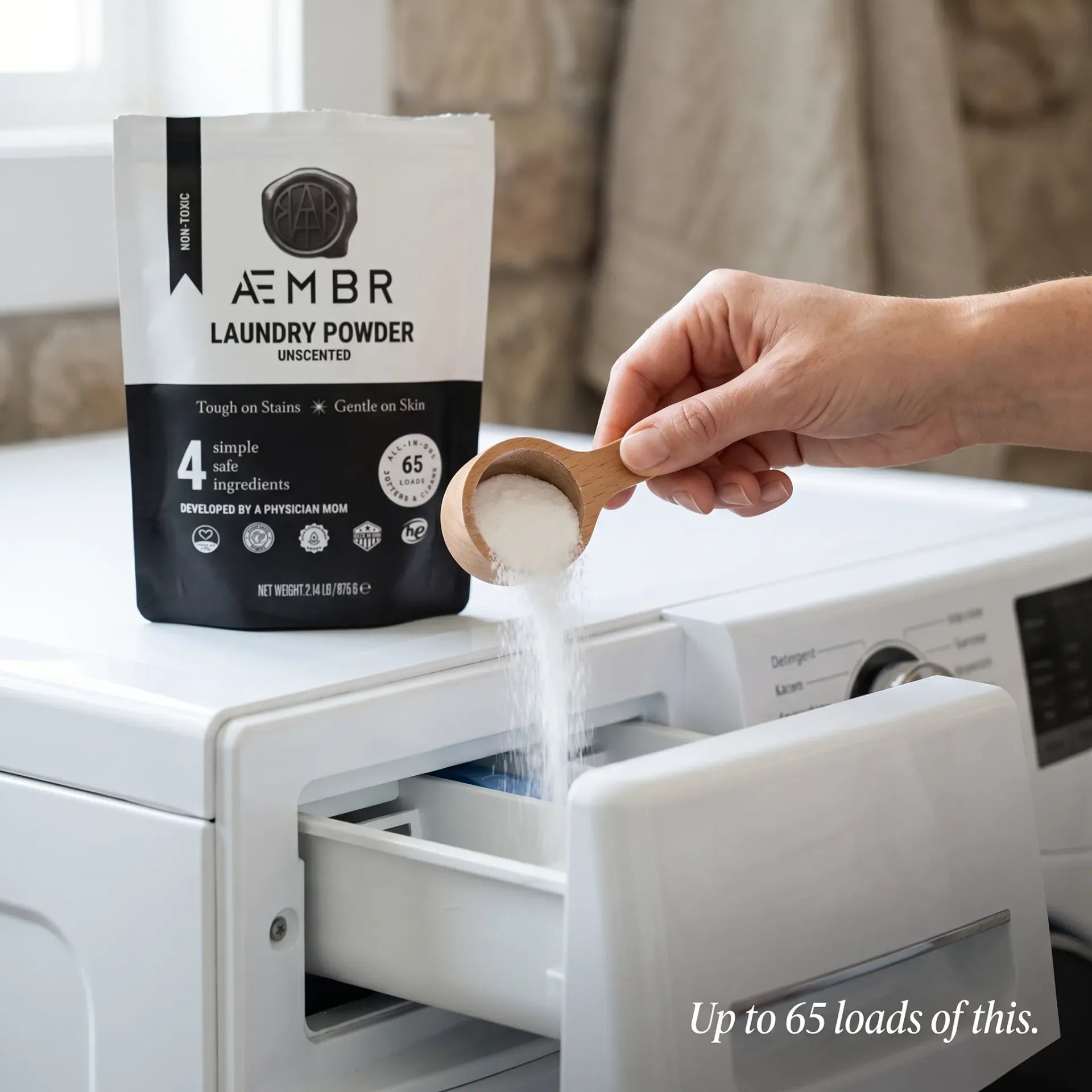
This work — reading labels, evaluating ingredients, sitting with the gap between "approved for use" and "specifically safe for my kids' dishes" — is exactly what led me to start formulating AEMBR's cleaning line. The candles and room sprays were the beginning. The laundry powder was the next step. Dishwasher cleaning is next.
I'm not ready to launch yet, but I can tell you what the formulation standards are: no PVA film, oxygen-based bleaching only, no synthetic fragrance, no optical brighteners, and a chelating system based on amino acid-derived compounds with established biodegradability. The same level of scrutiny I applied to laundry powder.
If you want to be notified when it launches: join the waitlist here.
Your Dishwasher Pod Evaluation Checklist
- ☐ Film: does the brand disclose what the pod film is made of?
- ☐ Fragrance: is the formula fragrance-free, or does the brand publish fragrance ingredients?
- ☐ Bleach type: oxygen-based (sodium percarbonate) or chlorine-based?
- ☐ Chelating agent: MGDA or GLDA, or EDTA?
- ☐ Optical brighteners: explicitly excluded by the brand?
- ☐ Certifications: EPA Safer Choice, EWG Verified, or MADE SAFE?
- ☐ Full ingredient list: is it published online beyond what appears on the package?
No conventional pod currently checks every box. Several cleaner brands check three or four. The goal isn't perfect — it's directionally better, with eyes open to what the tradeoffs are.
Further Reading
- What Are Laundry Detergent Ingredients? A Physician's Complete Breakdown
- EPA Safer Choice Program
- EWG Guide to Healthy Cleaning
- PVA Persistence in Wastewater Treatment — NIH/IJERPH
Kristina Braly, MD, is the physician founder of AEMBR, a physician-formulated home fragrance and household cleaning brand. She writes about ingredient safety, clean formulation, and the gap between regulatory approval and evidence-based safety. Nothing in this article should be construed as medical advice.


