



By Kristina Braly, MD — Founder, AEMBR
I want to be upfront about something before this review of the best non toxic laundry detergent options of 2026 begins: AEMBR makes a laundry detergent, and it's on this list. That's a real conflict of interest, and I'd rather name it clearly than pretend it doesn't exist. What I can tell you is that I've tried to apply the same formulation criteria to every brand here — including my own — and I've acknowledged where other products do something well. This isn't a ranking designed to make AEMBR look good by making everyone else look bad. It's an honest evaluation of the field as of 2026.

My methodology comes from a particular vantage point: I'm a physician who spent years looking at ingredient safety literature before I formulated a product myself. I evaluate detergents the way I'd evaluate a clinical intervention — by asking what the active compounds are, what the evidence says about their safety profile, and whether the benefit justifies the risk. Most conventional detergents don't hold up to that standard. A growing number of cleaner alternatives do — with meaningful differences between them.
Here's how I evaluated each brand, and what I found.
My Evaluation Criteria: How I Assessed Each Detergent
Before I get to the brands, let me be explicit about the framework. These are the criteria I used, in order of weight:
1. Ingredient transparency. Can I read the full ingredient list? Does "fragrance" appear without further disclosure? Are preservatives named? Opacity is a red flag — it means the brand either doesn't know what's in their product (unlikely) or doesn't want you to know (more likely). Full disclosure is the baseline for any product I'd recommend.
Expert guidance on clean ingredients, home fragrance, and living well — from our physician-authored blog.
2. Surfactant system. Is SLS or SLES the primary surfactant? Are plant-derived alternatives used? At what concentrations? The surfactant choice determines both skin compatibility and environmental footprint.
3. Fragrance approach. Fragrance-free is the gold standard for sensitive skin and family use. If a scented option is offered, are the fragrance compounds disclosed? Is it verified phthalate-free? "Natural fragrance" without further disclosure is not meaningfully better than "fragrance" for assessment purposes.
4. Optical brighteners. Present or absent. If present, the product cannot be considered fully clean regardless of other claims. OBAs are intentional leave-on compounds with skin sensitization potential and poor biodegradability — and they don't clean anything.
5. Preservative system. Does the product contain MIT or CMIT? Formaldehyde-releasing preservatives? These are the two preservative classes with the most documented sensitization and toxicity concerns. A powder format sidesteps this entirely.
6. Third-party certification. EWG Verified, MADE SAFE, Leaping Bunny, B Corp, or equivalent. Third-party review doesn't guarantee perfection but it creates accountability that self-labeling doesn't. For background on why these criteria matter, see our deep-dives on laundry detergent ingredients and phthalate free laundry detergent.
7. Cleaning performance. Does it actually clean? Ingredient purity means nothing if the product doesn't perform its core function. I've tested products personally and reviewed independent cleaning performance assessments where available.
8. Format and environmental footprint. Concentrated powders and tablets have a substantially lower packaging and transport footprint than diluted liquid formulas. This matters for environmental claims.
Best Non Toxic Laundry Detergent Comparison Table 2026
| Brand / Product | Format | Fragrance-Free Option | Optical Brighteners | Surfactant System | Key Certifications | Ingredient Transparency | Est. Price Per Load | EWG Rating |
|---|---|---|---|---|---|---|---|---|
| AEMBR Laundry Powder | Concentrated powder | ✅ Only option (no scented version) | ❌ None | Plant-derived; no SLS/SLES | Phthalate-free; physician-formulated | Full disclosure — every ingredient named | ~$0.50–$0.65 | Not yet rated (new brand) |
| Branch Basics Concentrate | Concentrated liquid (dilute to use) | ✅ Yes (fragrance-free) | ❌ None | Plant-derived; coco glucoside-based | EWG Verified; MADE SAFE | Good — full ingredient list published | ~$0.35–$0.55 | A |
| Molly's Suds Original Powder | Powder | ✅ Yes (fragrance-free available) | ❌ None | Sodium carbonate-based with plant surfactants | EWG Verified; Leaping Bunny; MADE SAFE | Good — full ingredient list published | ~$0.20–$0.35 | A |
| Seventh Generation Free & Clear | Liquid | ✅ Yes | ❌ None (fragrance-free version) | Plant-derived; SLES present in some SKUs — check label | EWG Verified; Leaping Bunny; B Corp | Moderate — EWG database entry available | ~$0.20–$0.30 | A (Free & Clear) |
| Attitude Baby Leaves | Liquid | ✅ Yes | ❌ None | Plant-derived glucosides | EWG Verified; Leaping Bunny; COSMOS Natural | Good | ~$0.25–$0.40 | A |
| Method Free + Clear | Liquid | ✅ Yes (Free + Clear) | ⚠️ Present in some scented versions; absent in Free + Clear | Plant-derived; glucoside system | Leaping Bunny; B Corp (parent company) | Moderate — not all compounds named | ~$0.15–$0.25 | B–C range depending on SKU |
| Seventh Generation Concentrated (scented) | Liquid | ❌ This SKU is scented | ⚠️ Present in some versions | Plant-derived primary surfactants | EWG Verified; Leaping Bunny | Moderate | ~$0.20–$0.30 | B |
Branch Basics: The Standard-Bearer for Clean Liquid Formulas
Branch Basics is probably the most rigorous liquid concentrate on the market from a formulation standpoint. It's EWG Verified and MADE SAFE certified — two of the more demanding third-party standards — and the full ingredient list is published and short. The concentrate system means less packaging per load than conventional liquids, and the dilution approach keeps surfactant concentrations low in the finished wash solution.
The one limitation I'd note: it's a multi-purpose concentrate, meaning the same product is diluted differently for laundry, all-purpose cleaning, and hand washing. For dedicated laundry use, you're applying a product optimized for versatility rather than specifically for fabric care. For most people, this doesn't matter. For people washing heavily soiled items or dealing with hard water, a formula specifically designed for laundry performance may outperform it.
Branch Basics is also on the higher end of cost per load at full price. The concentrate math makes it more affordable than it first appears, but it's still a premium commitment.
Best for: Households looking for one clean product to replace multiple conventional cleaners. People who want EWG and MADE SAFE dual certification.
Molly's Suds: The Best Value in the Clean Powder Space
Molly's Suds has been in the clean laundry market for over a decade, and their formulation reflects that experience. The Original Powder formula — short ingredient list, no optical brighteners, EWG Verified, Leaping Bunny, and MADE SAFE certified — is hard to argue with at this price point. At roughly $0.20–$0.35 per load, it's accessible to households where budget is a real constraint on switching to cleaner products.
The trade-off: the formula is built around sodium carbonate (washing soda), which is highly alkaline. It works well for general laundry but can be harsh on delicates, wool, and silk. It's also not ideal for cold-water washing in very hard water. For a household doing mostly cotton and synthetic fabric loads in warm water, it performs well. For specialty fabrics or cold-only machines, you may need to supplement.
The scented version of Molly's Suds contains essential oils — they're disclosed, which is better than most. But if you're avoiding all fragrance for sensitive skin or infant laundry, opt for the unscented powder.
Best for: Budget-conscious households making the switch to clean. High-volume laundry. Cotton and synthetic fabrics.
Seventh Generation Free & Clear: The Accessible Middle Ground
Seventh Generation was doing "plant-based" before it was a marketing trend, and their Free & Clear liquid remains one of the most accessible clean-ish options in mainstream retail. It's widely available, competitively priced, and the Free & Clear SKU has an EWG "A" rating — which is a meaningful independent validation.
I say "clean-ish" with some nuance: Seventh Generation's broader product line varies significantly in formulation quality. Some scented SKUs contain optical brighteners and have lower EWG ratings. The Free & Clear specifically earns its rating. The lesson here is that brand reputation doesn't transfer uniformly across SKUs — read the label on the specific product you're buying, not the brand's general positioning.
Seventh Generation is also a B Corp — a certification that assesses overall corporate social responsibility, not specifically ingredient safety. It's meaningful for evaluating the company but shouldn't be interpreted as an ingredient-level endorsement.
Best for: People transitioning to cleaner products who want mainstream availability. Households where budget is a limiting factor. The Free & Clear SKU specifically — not the scented versions.
Attitude Baby Leaves: The Best Option for Infant and Sensitive Skin Use
For infant and sensitive skin laundry specifically, Attitude Baby Leaves stands out. It's EWG Verified, Leaping Bunny certified, COSMOS Natural certified — a triple certification stack that's unusual and meaningful. The surfactant system uses plant-derived glucosides. No optical brighteners, no MIT, no SLS. The fragrance-free version checks every box on my baby detergent checklist from the previous post in this series.
Performance is good for normal soiling on infant fabrics — onesies, swaddles, sleep sacks, light cotton. For heavily soiled adult laundry (gym clothes, work uniforms), I'd evaluate whether a more powerful formulation is needed. But for its intended use case — infant and sensitive skin laundry — it's well-formulated.
Best for: Infant laundry. Households with eczema or fragrance sensitivity. Anyone who wants a certified clean product specifically validated for sensitive skin. See also: our full guide to baby safe laundry detergent.
Method Free + Clear: A Good Option With One Transparency Gap
Method has done a lot for making clean-positioned products mainstream, and their Free + Clear liquid is a genuine improvement over conventional detergents. No optical brighteners in this SKU, plant-derived surfactant system, Leaping Bunny certified.
Where I have a reservation: Method's ingredient disclosure is less complete than Branch Basics, Molly's Suds, or Attitude. The full compound-level breakdown isn't always publicly available, and some SKUs carry a lower EWG rating due to incomplete disclosure. "Not enough information to assess" is a data problem, not an automatic safety concern — but it means I can't fully validate the formulation against my criteria.
For a household on a tight budget looking for a mainstream-accessible option that's meaningfully cleaner than conventional detergent, Method Free + Clear is a reasonable choice. It's not the most transparent formulation on this list, but it's accessible, affordable, and has removed the most concerning ingredients from this SKU.
Best for: Budget-conscious households. Easy retail accessibility. A stepping stone product for people not yet ready to commit to a specialized clean brand.
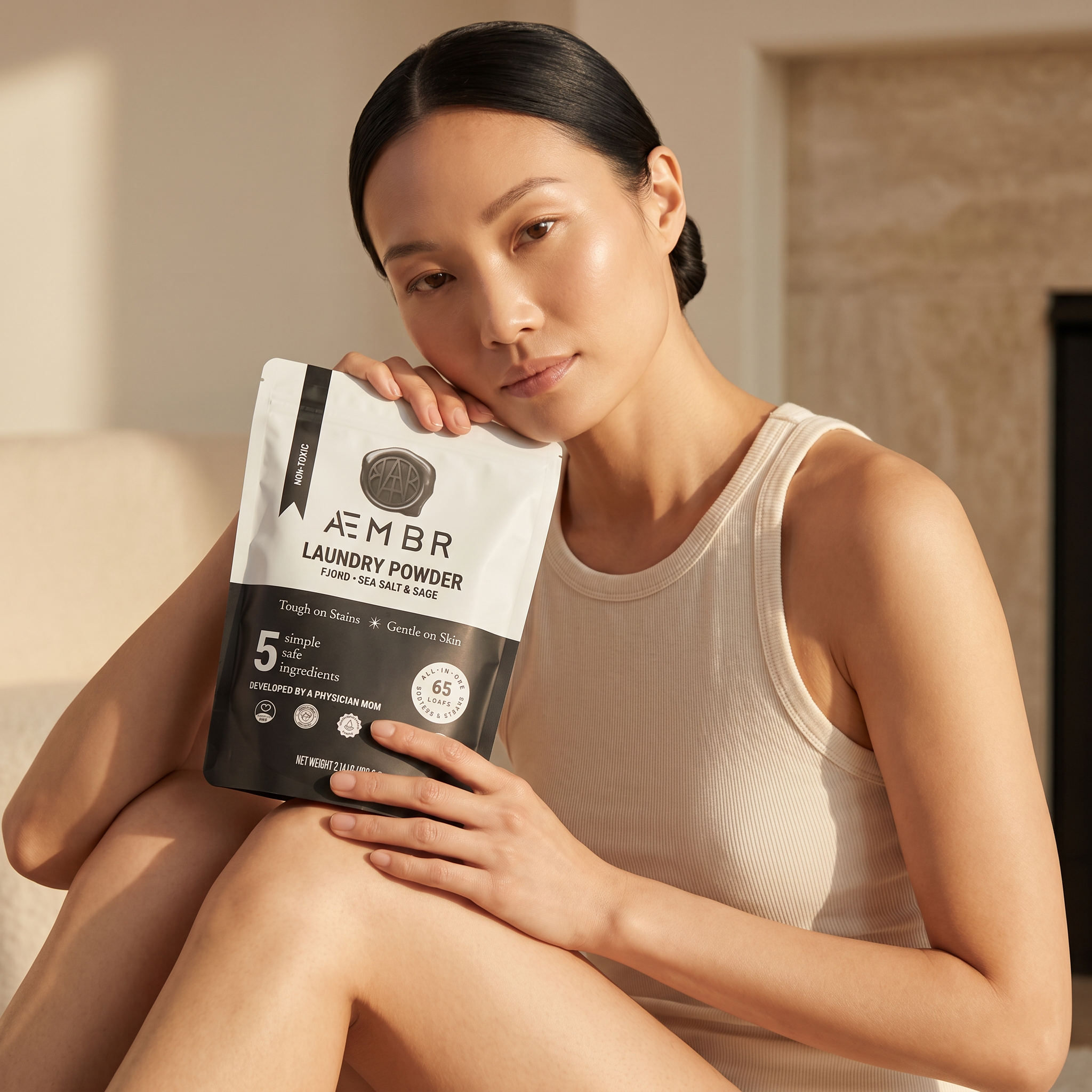
AEMBR Laundry Powder: What I Built and Why
I'll be straightforward: AEMBR Laundry Powder is my product, and I have an inherent perspective on it. What I can say honestly is that I formulated it to meet a standard I couldn't find elsewhere — specifically for a physician who would be using it on her children's laundry and wanted complete ingredient transparency with no compromises on the compounds I'd identified as concerns in the clinical literature.
The formula is a concentrated powder — which eliminates the water-based preservative system entirely, reduces packaging weight and transport footprint, and concentrates cleaning efficacy. No fragrance, no SLS or SLES, no optical brighteners, no MIT, no synthetic dyes. Every ingredient is named on the label and on our website — no trade secrets, no fragrance loopholes.
Where I'll be honest about limitations: AEMBR is a newer brand without the years of EWG rating history that Branch Basics or Molly's Suds carry. We haven't yet gone through the EWG Verified application process — that's on my product roadmap for 2026. Independent third-party certification matters to me and I intend to pursue it. In the meantime, full ingredient transparency is our accountability mechanism.
On performance: concentrated powder formulations require the right wash temperature and dispensing technique to dissolve fully. In cold water with a very short wash cycle, undissolved powder is a potential issue — I recommend dissolving the powder in a small amount of warm water first if you're washing cold. This is a format consideration, not a formulation weakness.
Best for: Households that want complete ingredient transparency and a physician-verified formulation. Infant and sensitive skin laundry. People who've read the other posts in this series and understand what they're looking for.
What I'd Tell a Friend Who Asked
If a friend — a patient, a new parent, someone with a child with eczema — asked me which of these detergents to buy, my answer would depend on their situation:
- Infant laundry or eczema-prone skin: Attitude Baby Leaves (fragrance-free) or AEMBR Laundry Powder
- Most thorough clean formulation in a liquid: Branch Basics
- Best value in a clean formula: Molly's Suds Original Powder (unscented)
- Most accessible in mainstream retail: Seventh Generation Free & Clear
- Budget option for transition: Method Free + Clear
The honest truth is that switching away from conventional detergent matters — even if the specific clean brand you choose is imperfect. The gap between a conventional detergent with SLS, synthetic fragrance, optical brighteners, and MIT, and any of the products on this list, is significant. Perfect shouldn't be the enemy of better.
A Clean Detergent Evaluation Checklist
- ☐ Full ingredient list is publicly available — not just front-panel claims
- ☐ No "fragrance" or "parfum" without full disclosure
- ☐ No optical brighteners / fluorescent whitening agents
- ☐ No SLS (Sodium Lauryl Sulfate)
- ☐ No methylisothiazolinone (MIT) or CMIT
- ☐ No synthetic dyes
- ☐ No formaldehyde-releasing preservatives
- ☐ Third-party certification is present (EWG Verified, MADE SAFE, Leaping Bunny)
- ☐ Format supports clean rinsing (concentrated powders rinse more completely than liquid)
- ☐ Brand has a stated policy on phthalates in fragrance (if any fragrance is used)
The Bottom Line
The non-toxic laundry market in 2026 is meaningfully better than it was five years ago. Third-party certification is more common, ingredient transparency has improved, and more brands are competing on formulation quality rather than just front-label positioning. That's real progress.
What hasn't changed: the regulatory gap that allows "fragrance" to hide phthalates and other undisclosed compounds in otherwise clean-positioned products. And the prevalence of optical brighteners in mainstream "baby" and "sensitive skin" detergents that most consumers don't know to look for. Reading labels critically — using the framework in this post and the checklist above — is still the most important tool you have.
Looking for complete ingredient transparency and physician-verified formulation? AEMBR Laundry Powder was built to meet a standard I couldn't find anywhere else — and every ingredient is named on the label.
By Kristina Braly, MD — Founder, AEMBR


