





By Kristina Braly, MD — Founder, AEMBR
Somewhere between "I should probably wash those" and "I just washed them last month" lives the question most people are quietly unsure about: how often should you wash your sheets? It sounds like a simple hygiene question. But the clinical answer draws on dermatology, allergy medicine, and microbiology — and it's more nuanced than any weekend-cleaning checklist suggests.

As a physician and the founder of AEMBR, I've spent years thinking about what actually lives in our homes and how ingredient choices in cleaning products affect the people sleeping in them. Here's what the science says about washing frequency — and why the laundry detergent you use matters just as much as how often you wash.
What's Actually in Your Bed After One Week
Within seven days of use, a standard set of bed sheets accumulates a measurable load of biological material. This isn't alarmist — it's just biology:
- Skin cells: The average human sheds roughly 30,000–40,000 dead skin cells per hour. A meaningful fraction of those transfer to sheets each night.
- Sweat: We each lose approximately 200 mL of sweat per night — more in summer, more for people who run warm. That moisture creates the warm, humid environment that microorganisms favor.
- Body oils: Sebum from skin and hair transfers continuously. Over time, it degrades fabric fibers and creates the yellowing most people associate with "old" sheets.
- Fungi and bacteria: A 2019 study published in Applied and Environmental Microbiology found that pillowcases used for one week harbored significantly higher bacterial and fungal loads than toilet seats. That comparison exists not to horrify but to calibrate: proximity and moisture matter more than the fixture.
None of this is inherently dangerous to most people. The human immune system is designed to coexist with the microbial world. But for people with allergies, eczema, asthma, or sensitive skin — and for children, whose immune systems are still developing — that load becomes clinically relevant.
The Dust Mite Question
Dust mites are the primary allergen concern in bedding. They are not insects — they're eight-legged arachnids, 0.3 mm long, invisible to the naked eye, and they consume dead skin cells. A single used mattress can harbor anywhere from 100,000 to 10 million dust mites depending on humidity levels and cleaning frequency.
Expert guidance on clean ingredients, home fragrance, and living well — from our physician-authored blog.
Dust mite allergens are not the mites themselves but their fecal proteins — specifically, the enzymes Der p 1 (from Dermatophagoides pteronyssinus) and Der f 1 (from Dermatophagoides farinae). These proteins bind to airway epithelial tissue and trigger IgE-mediated allergic responses in sensitized individuals.
According to the National Institute of Environmental Health Sciences, dust mite allergy affects an estimated 20 million Americans and is one of the leading triggers of perennial allergic rhinitis and asthma. Regular hot-water washing of bedding is among the most evidence-supported environmental interventions for dust mite reduction.
The Clinical Recommendation: Once Per Week
The consensus among dermatologists, allergists, and the Asthma and Allergy Foundation of America is weekly washing for sheets and pillowcases — specifically in hot water (130°F / 54°C or higher) to kill dust mites. Cold water, even with effective detergent, does not kill mites; it reduces allergen load but leaves viable mite populations intact.
That said, weekly is the standard for average adults. The recommendation shifts based on individual factors:
| Situation | Recommended Frequency | Notes |
|---|---|---|
| Average healthy adult | Once per week | Hot water if possible; warm acceptable |
| Allergies or asthma | Once per week, hot water | 130°F minimum to kill mites and denature allergens |
| Eczema / atopic dermatitis | Once per week or more often | Fragrance-free detergent critical — see below |
| Pets sleeping in bed | Twice per week | Pet dander multiplies allergen load significantly |
| Illness (cold, flu) | Immediately after recovery | Viral particles can survive on fabric 8–12 hours |
| Children's bedding | Weekly minimum | Children accumulate more dander and have lower immune tolerance |
| Guest bedroom (infrequently used) | Before each guest + upon return home | Dust accumulates even without active use |
What About Duvet Covers and Pillowcases Specifically?
Pillowcases deserve extra attention. They are in direct contact with your face — your eyes, nose, and mouth — for 6–8 hours per night. That sustained contact means:
- Higher bacteria transfer to pores (acne-prone skin is particularly affected)
- Fragrance residue from detergent contacts mucous membranes directly
- Drool and nasal secretions accelerate microbial load
Recommendation: Wash pillowcases at the same frequency as sheets, or more often if you are acne-prone or have nasal allergies.
Duvet covers follow the same once-per-week rule. The duvet insert itself (down or synthetic fill) needs less frequent washing — monthly or quarterly — but should be done in a large-capacity machine that allows the fill to agitate freely. Under-washing duvet inserts is common and directly linked to elevated dust mite counts inside the fill material.
Temperature: Why It Matters More Than Detergent Alone
The temperature of your wash cycle is not a minor variable. It's the primary mechanism for mite mortality.
Research from the Journal of Allergy and Clinical Immunology confirmed that washing at 55°C (131°F) for 10 minutes killed 100% of Dermatophagoides mites and removed more than 95% of measured allergen load. Cold water washing removed allergens but left viable mite populations intact — meaning the mites simply recolonized the bedding within days.
Practical guidance:
- Use the hottest water setting your fabric can tolerate — check care labels
- If fabric requires cold wash (delicate linens, some cotton blends), follow with a high-heat dryer cycle — sustained heat above 130°F for 15+ minutes achieves equivalent mite kill
- Line drying in direct sunlight has some UV-mediated antimicrobial effect, but is insufficient on its own for mite control
The Detergent You Use Changes What Stays in Your Sheets
Here's the part that rarely appears in standard bedding hygiene advice: the residue your detergent leaves behind matters — especially for bedding, because you spend a third of your life in direct contact with it.
Conventional laundry detergents contain several ingredients that don't fully rinse out and accumulate in fabric fibers over repeated washes:
- Synthetic fragrance compounds: Many fragrance molecules bind to hydrophobic fabric fibers and are designed to remain detectable after drying (that's the point of "long-lasting freshness" claims). For people with fragrance sensitivity, this sustained contact is a continuous low-level exposure.
- Optical brighteners: Stilbene-based fluorescent whitening agents are designed to deposit on fabric and reflect UV light. They don't wash out — they accumulate. For sensitive skin, they can act as photosensitizers.
- Fabric softener residue: Quaternary ammonium compounds in fabric softener create a coating on fibers that repels water and reduces absorbency over time — the reason why towels washed with softener lose their ability to absorb.
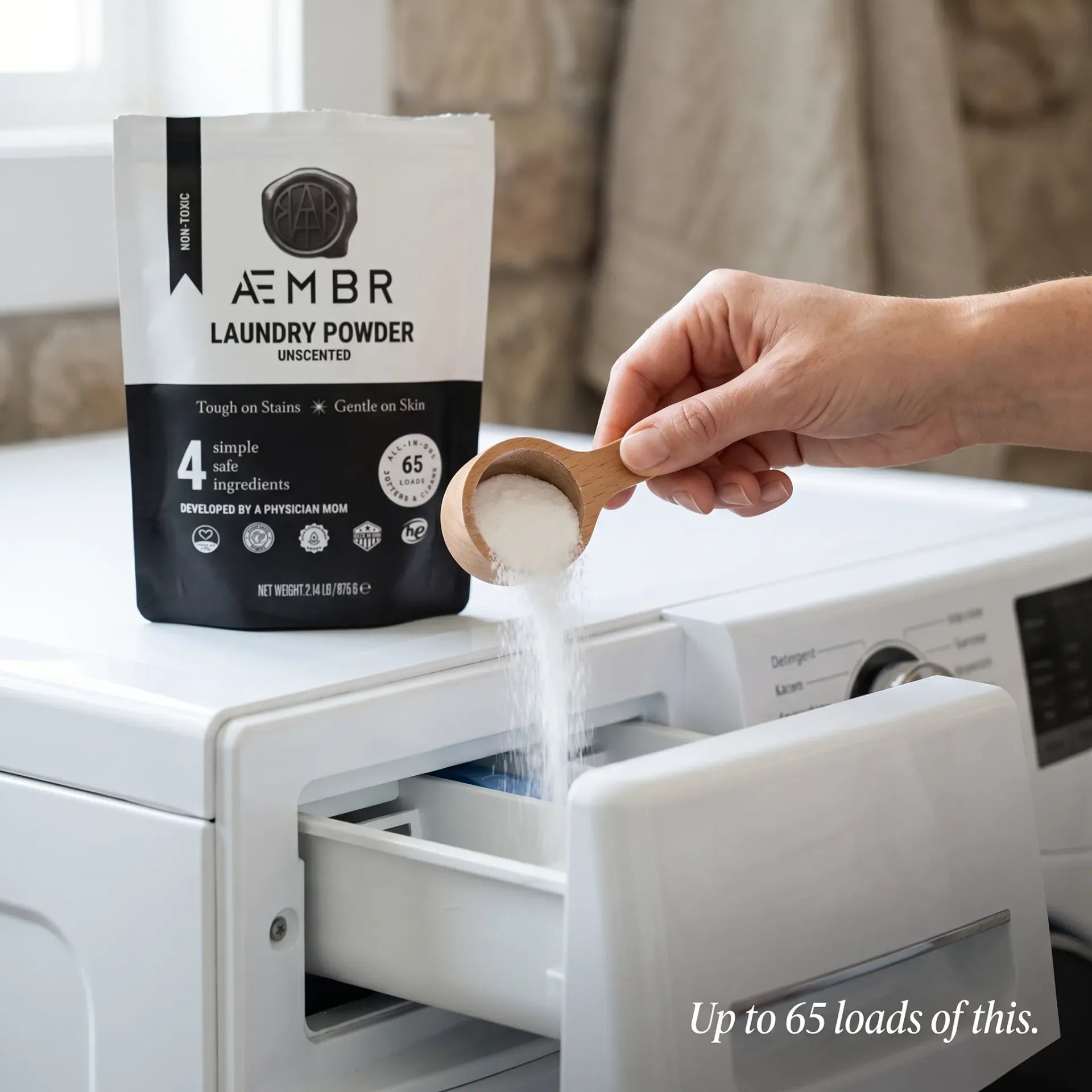
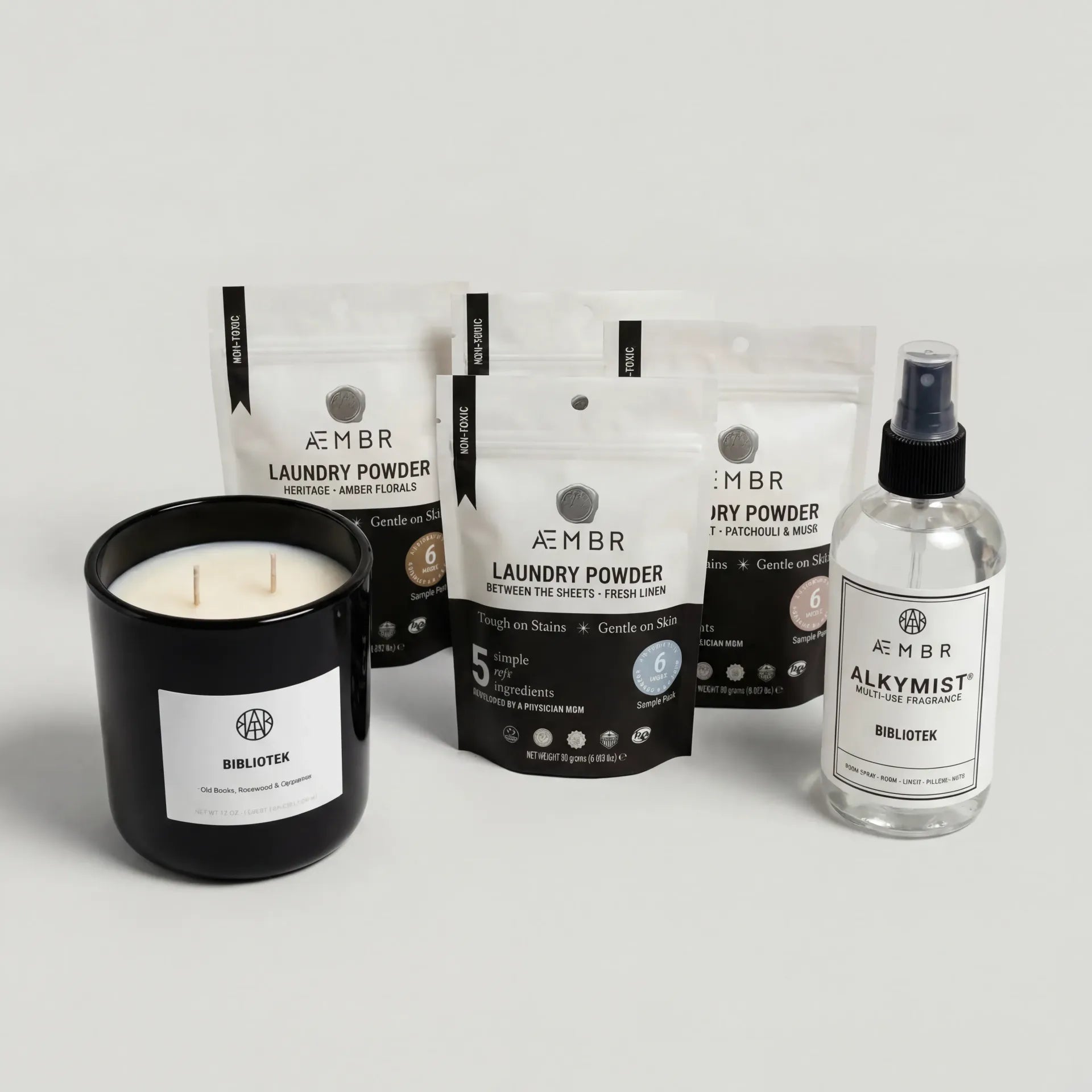
For bedding — which contacts your face, eyes, and open skin for hours at a stretch — a clean-formulated laundry detergent is the right baseline. AEMBR Laundry Powder is formulated without optical brighteners, without synthetic fragrance compounds that accumulate in fabric, and without sulfates — so what cleans your sheets is also what stays with you while you sleep.
Fragrance in Bedding: A Physician's Specific Concern
I want to dwell on this, because it's often framed as a preference issue when it's actually a clinical one.
Fragrance is one of the most common causes of contact dermatitis in the United States. The American Contact Dermatitis Society identifies fragrance mix as a top-five allergen in patch testing. When fragrance residue from laundry detergent is deposited in pillowcases and sheets, the exposure mode is:
- Direct skin contact for 6–8 hours
- Inhalation at close range throughout sleep
- Ocular mucosa contact from pillowcase fabric
For most people, this is subclinical. For people with eczema, allergic rhinitis, asthma, or contact fragrance sensitivity, it's a significant and often unidentified trigger. If you are working to identify allergic triggers, switching to a fragrance-free laundry detergent for bedding — even if you use a scented detergent for other laundry — is a reasonable clinical first step.
Related reading: The Safest Laundry Detergent for Babies and Can Laundry Detergent Trigger Eczema?
The Sheet-Washing Checklist
For a practical summary, here is what I follow in my own household:
- ✅ Wash sheets and pillowcases weekly — Sundays work well because it creates a clear cadence
- ✅ Wash in hot water (130°F+) whenever fabric allows; high-heat drying otherwise
- ✅ Duvet covers weekly; duvet insert monthly or quarterly
- ✅ Use a detergent without optical brighteners and without accumulating fragrance compounds — especially for bedding
- ✅ If pets sleep in the bed, add a mid-week pillowcase swap
- ✅ After illness, wash all bedding immediately before resuming regular use
- ✅ Replace pillows every 1–2 years; allergen load inside fill material eventually exceeds what surface washing can address
What About "Refreshing" Sheets Between Washes?
A linen spray or room spray used on bedding between wash cycles can reduce odor without removing allergens or bacterial load — useful as a between-wash freshener, not a substitute for washing. If you use this approach, the same fragrance caution applies: choose a formulation that's phthalate-free and made without accumulating synthetic fragrance compounds. ALKYMIST is formulated for exactly this kind of safe surface and fabric contact.
A brief shake and sun exposure (even through a window) also has modest photochemical antimicrobial effect between washes — not mite-effective, but useful for odor.
The Bottom Line
How often should you wash your sheets? Weekly, in hot water, with a clean-formulated detergent. That's the clinical answer — not because beds are uniquely dangerous, but because you spend 2,000+ hours per year in them, and the cumulative load of allergens, bacteria, and detergent residue has real biological effects on sleep quality, skin health, and respiratory function.
The laundry product you choose for your bedding deserves the same scrutiny you apply to what touches your face elsewhere. AEMBR Laundry Powder was formulated with bedding and sensitive-skin households in mind — no optical brighteners, no phthalate-based fragrance, plant-derived surfactants, and effective cleaning in both hot and cold water cycles.
Sleep well — and wash your sheets on Sunday.


