



By Kristina Braly, MD — Founder, AEMBR
If you have sensitive skin, eczema, or contact dermatitis, your laundry detergent is one of the highest-exposure chemical contacts your skin encounters every day. You sleep in it. You wear it against your body for eight, ten, twelve hours at a time. Residue left in fabric after rinsing sits directly against your skin barrier—and for people whose barrier is already compromised, that contact matters. Choosing the best laundry detergent for sensitive skin in 2026 isn't just a preference question. It's a clinical one.

I'm a physician who formulated my own laundry powder specifically because I couldn't find a product I'd confidently recommend to patients with reactive skin—or put on my own family's clothes. What follows is how I actually evaluate detergents for sensitive skin, which products meet that bar, and what the evidence says about the ingredients most likely to cause problems.
Why Laundry Detergent Matters More Than Most People Realize
Standard laundry detergents are designed to clean efficiently, smell good, and look bright white in the drum. Sensitive skin is not part of the design brief. The surfactants that lift soil also strip lipids. The fragrances that make clothes smell "fresh" are among the most common triggers for contact dermatitis. The optical brighteners that make whites look whiter deposit fluorescent compounds on fabric that stay there through wear.
The American Academy of Dermatology identifies fragrance as one of the leading causes of allergic contact dermatitis in the United States. The National Eczema Association has a seal program specifically to vet products safe for eczema-prone skin—because the problem is common enough and serious enough to warrant institutional guidance. If you or your child have reactive skin, this is not an area to guess on.
I wrote about the specific connection between laundry detergent and eczema triggers in a dedicated post. The short version: fragrances, dyes, SLS, and optical brighteners are the four most problematic ingredient classes, and the majority of mainstream detergents contain at least two of them.
Expert guidance on clean ingredients, home fragrance, and living well — from our physician-authored blog.
My Physician Selection Criteria for Sensitive Skin Detergents
Before I compare specific products, here's the framework I use to evaluate any detergent for sensitive skin use. A product needs to meet all of these to get a serious recommendation from me:
- Fragrance-free or phthalate-free, transparently sourced fragrance only. "Fragrance" on a label can conceal hundreds of undisclosed chemicals. For truly reactive skin, fragrance-free is safer. For skin that tolerates mild scent, I need to know the fragrance is phthalate-free and hasn't been flagged by IFRA or EWG for sensitization potential.
- Dye-free. Synthetic dyes serve no functional purpose and are a known sensitizer. There is no version of "the dye is fine for sensitive skin." It's a decoration that costs the reactive-skin population.
- No optical brighteners. Optical brighteners deposit UV-reactive compounds on fabric. They don't rinse out. They sit against skin all day. Multiple studies have flagged them as sensitizers, and the EWG rates them F for skin concerns. No sensitive-skin formulation should include them.
- Mild surfactant profile. Harsh surfactants (notably SLS/SLES and high concentrations of certain anionic surfactants) can themselves trigger contact irritation at residue concentrations. A sensitive-skin formulation should use milder, high-rinse surfactants or enzyme-forward cleaning that requires less surfactant load.
- Ingredient transparency. I will not recommend a product that doesn't publish its full ingredient list. If a brand can't disclose what's in the bottle, I can't evaluate what it's putting on your skin.
- Effective cleaning at lower dose. A product that requires high loading to clean becomes a residue problem in rinse cycles. Concentrated, effective formulas clean at lower doses—less residue contact per wear.
The Ingredient Red Flags to Avoid
For a deeper look at why these matter, my post on laundry detergent safety for babies and sensitive skin covers the clinical data on skin barrier disruption and sensitization. The summary for adults with reactive skin:
- Fragrance / parfum — The single highest-risk ingredient class for contact dermatitis. The word "fragrance" legally masks every component; a single fragrance entry on a label can contain dozens of individual chemicals, some of which are known IFRA allergens.
- Synthetic dyes (FD&C Blue No. 1, etc.) — Common sensitizers with no cleaning benefit. Their only job is to make the liquid look blue or the powder look white. Leave them out.
- Optical brighteners (stilbene derivatives, fluorescent whitening agents) — UV-fluorescent compounds that deposit on fabric and don't fully rinse. EWG score: F. No place in a sensitive-skin formula.
- Sodium lauryl sulfate (SLS) — Anionic surfactant well-documented as a skin irritant at concentrations found in some cleaning products. SLES is milder but still problematic for some individuals. Both are common in mainstream detergents.
- Chlorine-based bleaching agents — Sodium hypochlorite and related compounds are among the most irritating residues that can transfer from laundry. Not present in most liquid detergents but common in "whitening" booster products.
- Preservatives (methylisothiazolinone / MIT, methylchloroisothiazolinone / CMIT) — Found in many liquid detergents to prevent bacterial growth. Both are powerful sensitizers—MIT in particular has been the subject of EU regulatory action because of its high contact allergy rate.
2026 Comparison: Best Laundry Detergents for Sensitive Skin
| Product | Format | Fragrance-Free Option | Dye-Free | No Optical Brighteners | Full Ingredient Disclosure | NEA Recognized | Notes |
|---|---|---|---|---|---|---|---|
| AEMBR Laundry Powder | Powder | Fragrance-free option + scented (phthalate-free, transparently listed) | ✅ Yes | ✅ Yes | ✅ Full list published | No seal (independent) | Physician-formulated; no MIT/CMIT; enzyme-forward; concentrated |
| All Free Clear | Liquid | ✅ Yes (only option) | ✅ Yes | ✅ Yes | Partial (website, not always updated) | ✅ NEA Recognized | Well-established; widely available; contains SLES |
| Arm & Hammer Free & Clear | Liquid | ✅ Yes | ✅ Yes | ✅ Yes | Partial | No | Budget-accessible; sodium borate listed in some formulations; check label |
| Seventh Generation Free & Clear | Liquid / Pods | ✅ Yes | ✅ Yes | ✅ Yes | Good (website disclosure) | No | Plant-derived surfactants; USDA Biobased; contains MIT in some formulations—verify current label |
| Tide Free & Gentle | Liquid / Pods | ✅ Yes | ✅ Yes | ✅ Yes | Partial (SmartLabel QR) | ✅ NEA Recognized | High cleaning performance; contains polyethylene glycol compounds; limited independent ingredient transparency |
| Branch Basics Laundry | Concentrate | ✅ Yes (only option) | ✅ Yes | ✅ Yes | ✅ Good | No | Very clean formula; pH-balanced; requires separate oxygen boost for stains; higher price per load |
| Dreft Stage 1 | Liquid | ❌ No (scented) | ✅ Yes | Unconfirmed | Limited | ✅ NEA Recognized | Widely recommended for babies; fragrance-containing limits use for truly reactive skin |
| Molly's Suds | Powder | Unscented option available | ✅ Yes | ✅ Yes | Good | No | Very short ingredient list; high pH; not ideal for all fabrics or HE machines without testing |
Why Powder Formats Often Perform Better for Reactive Skin
Liquid detergents require preservatives to prevent bacterial and fungal growth in the water phase of the formula. The preservatives used most widely—MIT and CMIT—are among the most common contact sensitizers in leave-on and rinse-off products. The EU's Scientific Committee on Consumer Safety has issued restrictions on MIT in leave-on products specifically because of contact allergy rates. While rinse-off exposure is lower than leave-on, fabric residue means this isn't zero exposure.
Powder detergents don't have a water phase. That means they don't need MIT, CMIT, or any other preservative system. For reactive skin, this is a meaningful formulation advantage—one reason I chose powder format for AEMBR Laundry Powder. The other reason is that concentrated powder doses leave less surfactant residue per load than equivalent liquid volume, which matters when fabric residue is your concern.
The "Free & Clear" Marketing Problem
Every major detergent brand now sells a "Free & Clear" or "Sensitive" variant. The labeling means something—those products genuinely exclude dyes and fragrances in most cases—but "free and clear" is not a regulated term. It doesn't guarantee absence of optical brighteners, MIT, polyethylene glycol processing residues, or harsh surfactants. It means: no dye, no fragrance. For mild sensitivity, that's often enough. For moderate-to-severe eczema or contact dermatitis, you need to go further.
The National Eczema Association seal is more meaningful than a brand's own "sensitive" claim—it requires ingredient review against a specific criteria list. But even the NEA seal doesn't mean zero risk for every individual; it means the formulation meets criteria likely to be tolerated by most eczema patients. Personal patch testing is still the gold standard for identifying individual triggers.
How to Evaluate Whether Your Detergent Is Causing Skin Reactions
Skin reactions from laundry detergent tend to follow a predictable pattern: they appear in areas of friction or prolonged fabric contact (waistbands, collar lines, inner elbows, backs of knees), and they improve when you switch products and rewash bedding and clothing. If your eczema or dermatitis isn't responding to topical treatments, your laundry is worth investigating before escalating medication.
A clinical elimination approach:
- Switch to a fragrance-free, dye-free, preservative-minimal detergent.
- Rewash all clothing and bedding that was washed with the prior detergent—residue persists across multiple wash cycles.
- Run an extra rinse cycle for two to three weeks.
- Assess skin at four weeks (skin barrier repair takes time; don't judge at day three).
- If improvement is substantial, you've identified laundry detergent as a contributing factor. If not, look at fabric softener, dryer sheets, and detergent pods as separate variables.
The Detergent Pod Question
Pods are convenient, and many "sensitive" pod options exist. I'm cautious recommending them for reactive skin for two reasons. First, concentrated liquid pods still require preservatives; the sensitizer problem doesn't go away just because the dose is pre-measured. Second, pod dissolvability varies with water temperature, and undissolved pod residue in contact with skin is a higher-concentration exposure than detergent distributed through a full wash cycle. If you're managing reactive skin, powder or liquid measured from a concentrate is more predictable.
HE Machine Compatibility and Sensitive Skin
High-efficiency machines use less water, which means less rinse water to remove detergent residue. For sensitive skin, this amplifies any residue issue from a non-HE-optimized formula. Use an HE-compatible detergent (low-sudsing), dose at the lower end of the recommended range, and enable the extra rinse cycle if your machine offers one. This single change—extra rinse—is one of the most impactful things you can do if your current detergent is otherwise acceptable but you're still seeing reactions.
AEMBR Laundry Powder is HE-compatible, low-sudsing, and concentrated to work at doses that leave minimal residue even in low-water cycles.
What I Actually Use and Recommend
For most of my patients with reactive skin or eczema: start with All Free Clear or Tide Free & Gentle if budget and accessibility are priorities. Both are clinically vetted, widely available, and meaningfully better than fragranced mainstream options. If you've tried both and still react, switch to a preservative-free powder format.
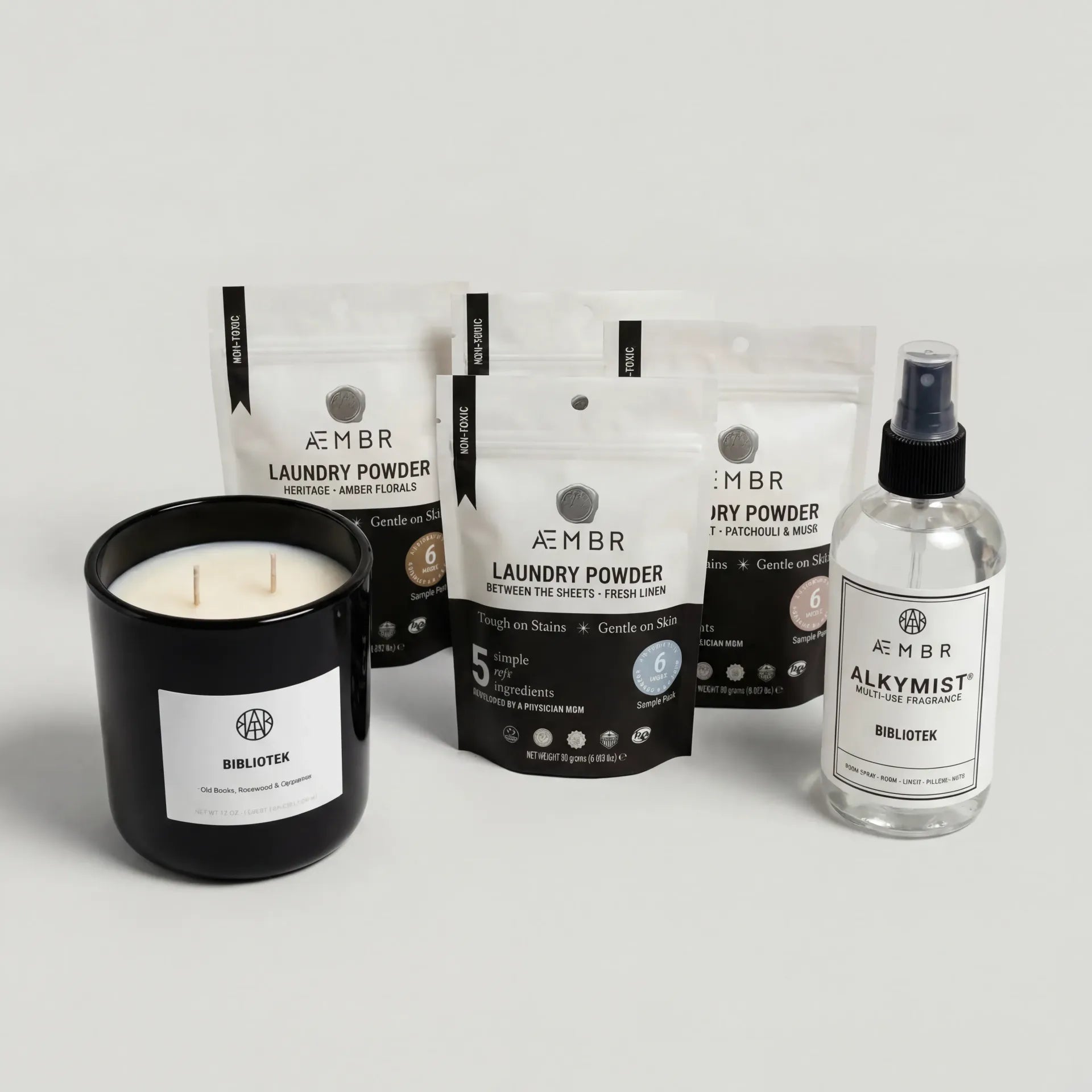
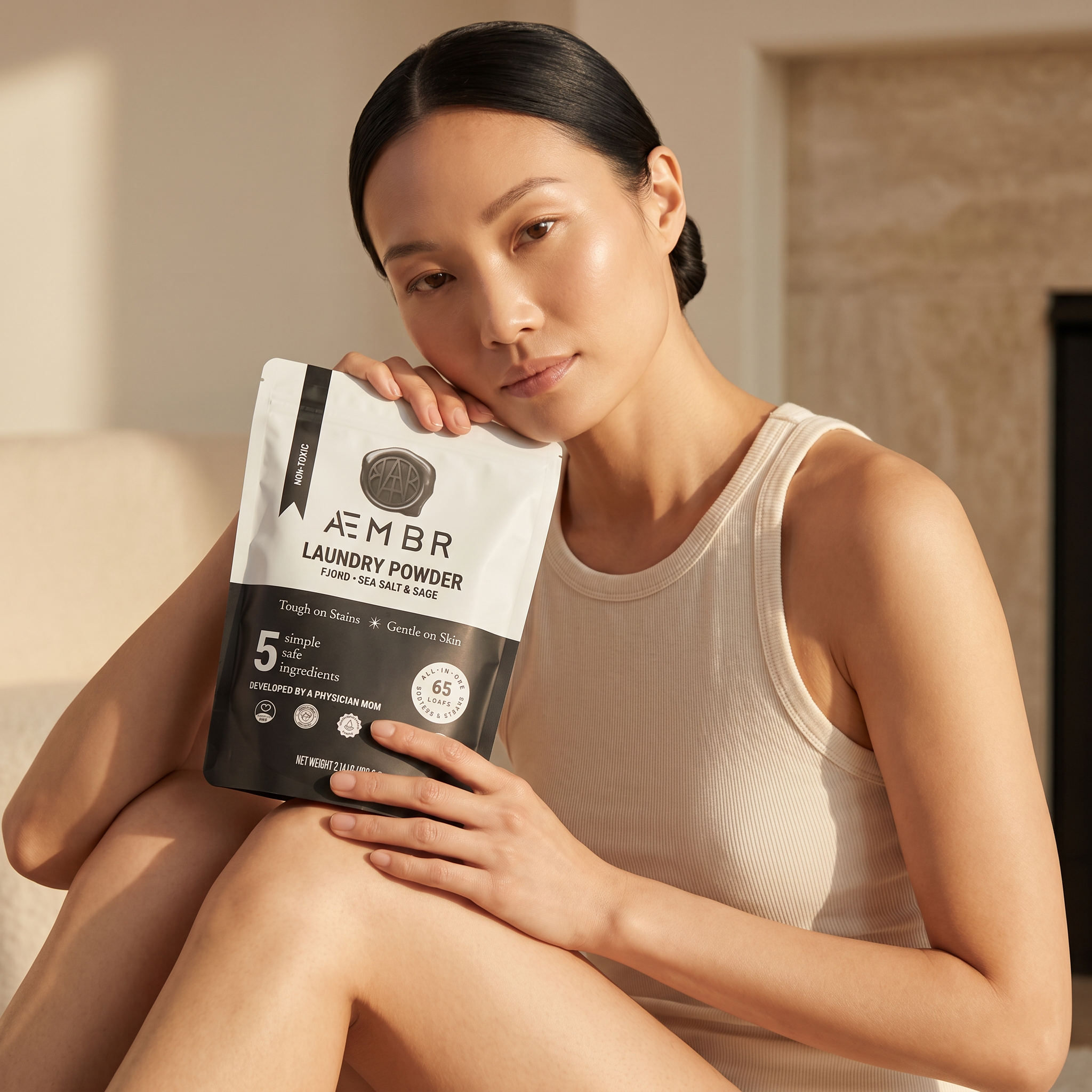
For my own household: AEMBR Laundry Powder, which I formulated to meet criteria that no single existing product satisfied—no optical brighteners, no MIT/CMIT, no synthetic dyes, enzyme-forward cleaning, phthalate-free fragrance options, and full ingredient transparency. If you want a starter kit that includes a stain booster, the Laundry Powder + Scoop Combo is what I'd suggest for a full sensitive-skin laundry overhaul, paired with Oxygen Boost for stain treatment (fragrance-free, no chlorine bleach).
Summary Checklist: Choosing a Detergent for Sensitive Skin
- ☑ Fragrance-free (or confirmed phthalate-free with full fragrance ingredient disclosure)
- ☑ Dye-free
- ☑ No optical brighteners
- ☑ No MIT or CMIT preservatives (more relevant for liquid formats)
- ☑ No SLS (sodium lauryl sulfate), especially for severe eczema
- ☑ Full ingredient list available (not just "fragrance-free" marketing claim)
- ☑ HE-compatible if using a front-loading or HE top-loader
- ☑ Low dose / concentrated (less residue per load)
- ☑ Extra rinse cycle enabled on your machine
- ☑ Rewash existing clothing and bedding after switching
If you've been managing sensitive skin or eczema for years and have never systematically eliminated laundry detergent as a variable, it's worth doing. The exposure is high, the residue is persistent, and the alternative formulations are good enough now that you don't have to sacrifice cleaning performance to protect your skin barrier.
—
Kristina Braly, MD, is a physician and the founder of AEMBR, a clean home care brand she started after finding no products she'd confidently put on her own family's skin. All posts reflect her clinical perspective and formulator experience.


