





By Kristina Braly, MD — Founder, AEMBR
If you've ever grabbed the wrong white powder from your pantry, you're not alone. Washing soda and baking soda look nearly identical, carry similar names, and share a spot in every DIY cleaning guide on the internet. But their chemistry is meaningfully different — and using one where you need the other can leave you with dingy laundry, scratched surfaces, or a recipe for bread that tastes like soap. This washing soda vs baking soda cleaning breakdown will tell you exactly what each compound does, where it works, and when to reach for each.

The Chemistry Behind the Name
Both compounds are sodium-based salts, but they're not the same molecule. Baking soda is sodium bicarbonate (NaHCO₃) — a mild alkaline compound with a pH around 8.3. Washing soda is sodium carbonate (Na₂CO₃) — a stronger alkali with a pH between 11 and 12. That single extra sodium and oxygen atom changes the cleaning behavior entirely.
Sodium carbonate (washing soda) is sometimes called soda ash. It's produced commercially through the Solvay process or mined as trona ore. You can also make it at home by heating baking soda in an oven at 400°F for about an hour — the bicarbonate releases carbon dioxide and water and converts to carbonate. The reverse doesn't happen at room temperature, which is why you can't substitute baking soda in recipes that call for washing soda.
pH Is the Key Difference
The practical gap between a pH of 8 and a pH of 11–12 is enormous. pH is a logarithmic scale, meaning washing soda is roughly 1,000 times more alkaline than baking soda. That higher alkalinity drives washing soda's cleaning power in ways that baking soda simply cannot match.
High pH breaks down grease and oil more aggressively. It softens hard water by precipitating calcium and magnesium ions. It loosens protein-based stains — blood, sweat, food — from fabric. Baking soda is a gentler buffer, effective for deodorizing and light surface cleaning but not for heavy-duty laundry or grease-cutting.
Expert guidance on clean ingredients, home fragrance, and living well — from our physician-authored blog.
Where Washing Soda Excels
Washing soda earns its name in the laundry. Added to a wash cycle, it acts as a water softener and alkalinity booster — both of which help detergent surfactants work more effectively. Hard water (high in calcium and magnesium) neutralizes anionic surfactants, reducing lather and cleaning ability. Washing soda sequesters those minerals before they can interfere, which is why it's a standard ingredient in many powder laundry formulas.
Other effective uses for washing soda:
- Removing heavy grease from stovetops and range hoods
- Cleaning tile grout (pH dissolves organic buildup)
- Stripping fabric softener residue from laundry that's gone waxy
- Dishwasher booster when water is especially hard
- DIY laundry detergent base (paired with soap flakes or a surfactant)
Important caveat: washing soda is caustic at that pH. Wear gloves when using it undiluted. Avoid contact with aluminum, which it can corrode. And don't use it on wool, silk, or other protein-based fibers — high pH degrades the disulfide bonds in keratin and can permanently damage delicate fabrics.
Where Baking Soda Excels
Baking soda's gentler pH makes it the right choice for odor neutralization and mild abrasive cleaning. It's amphoteric — meaning it reacts with both acids and bases — which makes it effective at neutralizing acidic odors (like vinegar, sweat, or fermentation). This is why it works in refrigerators, on carpets, and as a deodorizer in shoes or gym bags.
Effective uses for baking soda:
- Deodorizing fabric, upholstery, and carpets
- Gentle scrubbing of sinks and tubs (mild abrasive, low risk of scratching)
- Neutralizing acidic spills on countertops
- Refreshing laundry in the rinse cycle (not a replacement for detergent)
- Unclogging drains when combined with vinegar (the fizzing loosens organic blockages)
Baking soda is also safer for most surfaces — including stainless steel, porcelain, and sealed stone — because its pH won't etch or discolor finishes that alkaline compounds at pH 11+ would damage.
Side-by-Side Comparison
| Property | Baking Soda (NaHCO₃) | Washing Soda (Na₂CO₃) |
|---|---|---|
| pH | ~8.3 | 11–12 |
| Grease cutting | Weak | Strong |
| Water softening | Minimal | Effective |
| Odor neutralizing | Excellent | Moderate |
| Safe on delicate fabrics | Yes | No (avoid wool/silk) |
| Safe on aluminum | Yes | No (can corrode) |
| Skin safety (undiluted) | Generally safe | Wear gloves |
| Laundry booster | Mild | Yes — primary use |
| DIY cleaner base | Secondary | Primary |
Can You Use Them Together?
Yes — and the combination is more useful than either alone for certain applications. In laundry, some formulas combine both: washing soda to soften water and boost alkalinity, baking soda to buffer the pH slightly and help with odor control. In drain-cleaning, the sequence matters: washing soda first (to break down grease at the clog), followed by baking soda and vinegar (to create a fizz that dislodges loosened material).
Don't mix them and expect the result to be stronger washing soda — the baking soda will partially neutralize the high pH. Use them sequentially or in balanced formulas where each has a defined role.
What About "Washing Soda" Laundry Products?
Many commercial laundry detergents list sodium carbonate (washing soda) as a component — often alongside enzymes, surfactants, and fragrances. It functions as a builder: it improves the performance of surfactants by controlling water hardness and keeping the wash pH in the alkaline range where enzymes and surfactants are most effective.
When you see "sodium carbonate" in an ingredient list, that's washing soda doing exactly this job. It's a well-understood, low-toxicity compound — the Environmental Working Group (EWG) rates it with minimal health concerns at use concentrations. The EPA lists it as a safer chemical alternative in cleaning product formulations.
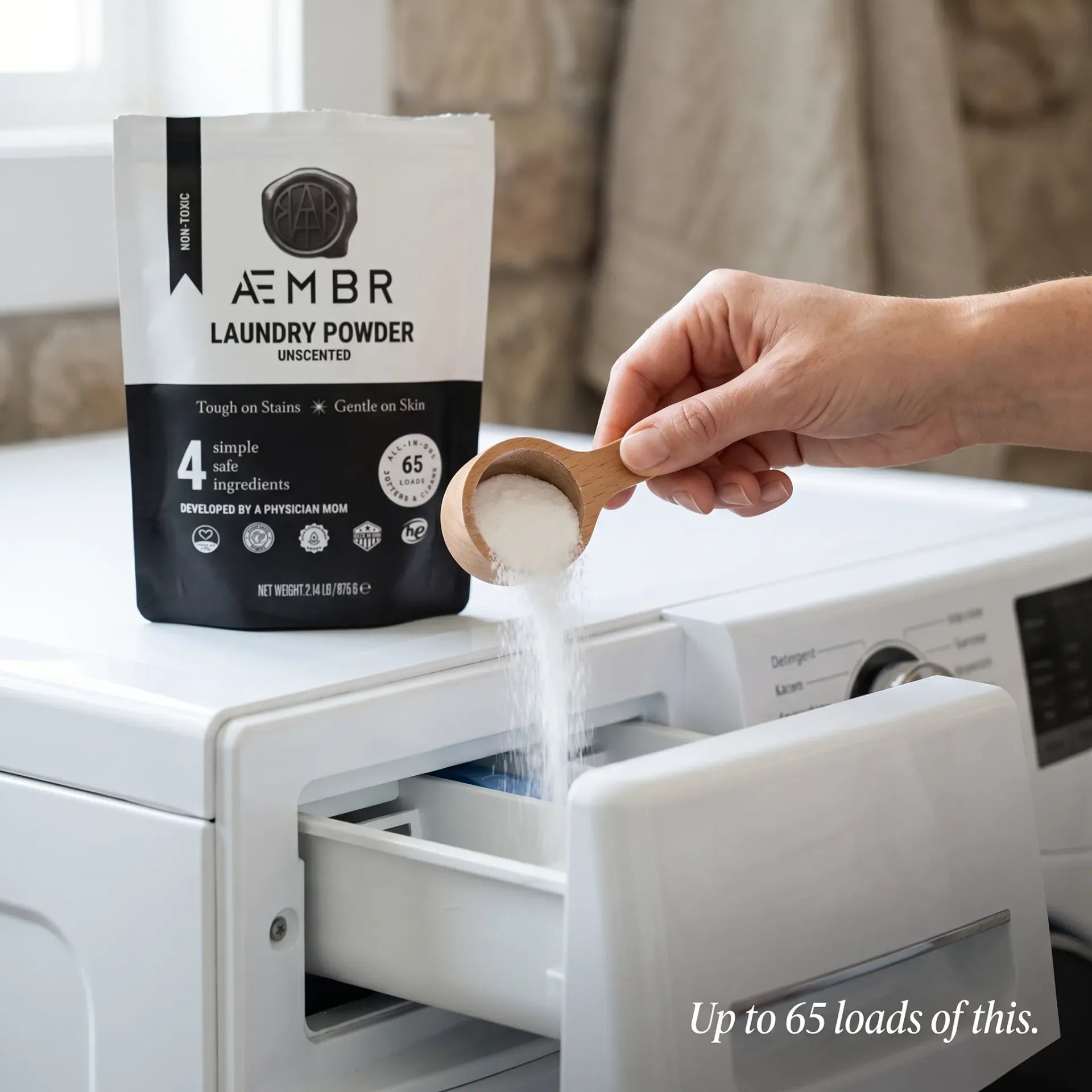
At AEMBR, formulating AEMBR Laundry Powder meant thinking carefully about the builder system. Sodium carbonate is one of the ingredients that allows our formula to perform in hard water without relying on synthetic chelators like EDTA or phosphates — both of which carry higher environmental load. The goal was effective and clean, not one at the expense of the other.
DIY Cleaning: When to Reach for Each
A practical guide for the most common household cleaning situations:
- Greasy oven or stove: Washing soda paste (mix with just enough water to form a thick consistency, apply, wait 30 minutes, wipe)
- Smelly gym clothes: ½ cup baking soda in the rinse cycle, or soak in baking soda solution before washing
- Hard water laundry stains: ¼ cup washing soda added to the wash drum before starting the cycle
- Fridge odors: Open box of baking soda — baking soda, not washing soda (washing soda at that concentration in an enclosed space isn't appropriate)
- Grout cleaning: Washing soda paste, scrub with a stiff brush
- Carpet odor before vacuuming: Baking soda sprinkled liberally, left for 15–30 minutes
Safety and Skin Considerations
Baking soda is generally regarded as safe for skin contact at cleaning concentrations. Some people use it as a DIY exfoliant, though dermatologists typically advise against that — pH 8 on the skin disrupts the acid mantle (pH 4.5–5.5) and can cause irritation with repeated use.
Washing soda at pH 11–12 is caustic in undiluted form. Direct skin contact can cause irritation and, with prolonged exposure, chemical burns. In solution (dissolved in wash water), the pH drops considerably and is not a concern for laundry. But when handling the powder directly — mixing DIY formulas, scooping into a wash — gloves are appropriate.
Neither compound produces toxic fumes, and both are safe to use in enclosed spaces like laundry rooms and kitchens when used as directed.
What Physicians Actually Worry About in Cleaning Products
As a physician and formulator, the ingredients that concern me in cleaning products aren't sodium carbonate or sodium bicarbonate — both are well-characterized, low-toxicity compounds with long safety records. The concerns are elsewhere: synthetic fragrance blends with undisclosed allergens, optical brighteners that accumulate in fabric and on skin, quaternary ammonium compounds in fabric softeners that appear in emerging reproductive toxicity literature.
Washing soda and baking soda represent the kind of ingredients I'm comfortable with — transparent chemistry, understood mechanisms of action, clear exposure limits. That's the standard I applied when formulating AEMBR Laundry Powder: every ingredient earns its place, and none of them are hiding behind "fragrance" or obscure trade names.
If you want to understand what's in your laundry detergent at this level of detail, my earlier post on how to read a laundry detergent ingredient label is a good starting point. The short version: look for surfactant type, builder system, enzyme disclosure, and fragrance transparency. The long version involves a chemistry refresher that starts with compounds exactly like these.
Quick Reference Checklist
- ☑ Washing soda = sodium carbonate (Na₂CO₃), pH 11–12 — strong alkali, water softener, grease cutter
- ☑ Baking soda = sodium bicarbonate (NaHCO₃), pH ~8.3 — mild alkali, deodorizer, gentle abrasive
- ☑ They are not interchangeable — using baking soda where washing soda is needed will underperform; using washing soda on delicate fabrics or aluminum will cause damage
- ☑ Washing soda in laundry: add to drum to soften hard water and boost detergent performance
- ☑ Baking soda in laundry: add to rinse cycle for odor control
- ☑ Wear gloves when handling washing soda powder directly
- ☑ Neither produces toxic fumes; both are low-toxicity household compounds
- ☑ Both appear as builder ingredients in clean laundry detergent formulas — their presence is a sign of transparent, well-designed chemistry


