


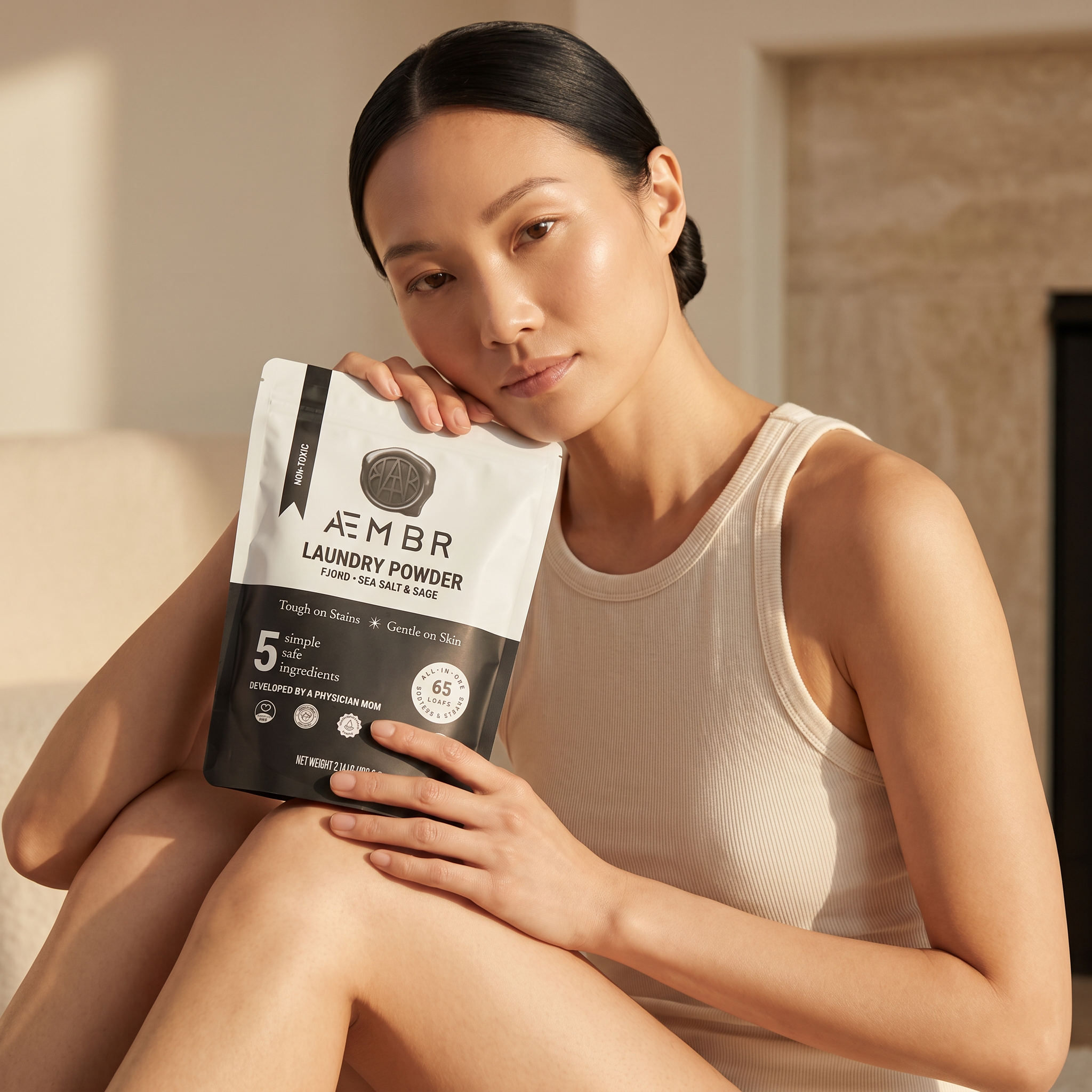

If you have an HE washing machine and you're trying to switch to a non-toxic laundry detergent, the overlap between those two requirements is smaller than it should be. Most clean laundry detergents are formulated without much thought for HE compatibility — they suds too aggressively, leave residue in front-loader drums, or require dosing instructions that don't translate to low-water cycles. This guide breaks down exactly what makes a laundry detergent genuinely HE-compatible, which ingredients to avoid, and which options actually perform.

I developed AEMBR Laundry Powder with HE machines specifically in mind — because I have one, and because most of the clean formulas I tested before launching were disappointments in a front-loader. Here's what I learned.
What Does HE (High-Efficiency) Actually Mean?
HE washing machines — both front-loaders and top-loaders with the HE designation — use significantly less water than conventional agitator machines. A standard top-loader might use 40–45 gallons per cycle. A modern HE front-loader uses 10–15 gallons. That water reduction is great for your utility bill and environmental footprint. But it creates a specific problem: detergents formulated for high-water environments don't rinse properly in low-water environments.
The result is detergent residue buildup in the drum, on clothes, and in the rubber gasket seals — which eventually causes the musty, sour smell that front-loader owners know well. The fix isn't scrubbing your machine more often; it's using a detergent actually designed for how your machine works.
The HE Compatibility Problem With Most Clean Detergents
Many "natural" or "non-toxic" laundry detergents are built around castile soap or high-surfactant formulas that were originally developed for conventional machines. When you put them in an HE washer, a few things happen:
Expert guidance on clean ingredients, home fragrance, and living well — from our physician-authored blog.
- Excess sudsing. HE machines have sensors that detect suds and extend the rinse cycle — sometimes multiple times — to compensate. This wastes water and extends cycle time, defeating the point of an HE machine.
- Residue accumulation. Soap and surfactant residue that doesn't fully rinse in 10 gallons of water stays on your clothes (contributing to skin irritation) and in your machine (contributing to mold and biofilm).
- Concentration mismatch. Many clean liquid detergents are under-concentrated and require large doses — which compounds the sudsing problem.
The HE symbol on detergent packaging tells you the formula was tested to suds at low-water volumes. But "HE-safe" is not a regulated certification. It's a claim manufacturers make based on internal testing. That matters when you're evaluating non-toxic options.
Ingredients to Avoid in Any Laundry Detergent (HE or Not)
Before getting to HE-specific concerns, here are the ingredients I look for and avoid as a physician and formulator. These apply regardless of machine type:
- Synthetic fragrance (unlisted). The word "fragrance" on a label can legally conceal hundreds of untested compounds, including phthalates. EWG's database flags this routinely across mass-market detergents. If a brand won't disclose what's in their fragrance, that's a problem.
- 1,4-Dioxane (process contaminant). Not listed as an ingredient — it's a byproduct of ethoxylation, the process used to make surfactants like SLES milder. The EPA classifies it as a likely human carcinogen. Ask whether a brand's surfactants are ethoxylated and whether they test for 1,4-dioxane.
- Optical brighteners. Fluorescent whitening agents that make clothes appear brighter by reflecting UV light. They stay on fabric and can accumulate on skin. They don't clean anything — they just create a visual illusion of cleanliness.
- Phosphates. Largely phased out in the US due to aquatic toxicity concerns but still found in some international brands sold through domestic retailers.
- Synthetic dyes. No functional cleaning purpose. Present in most mass-market detergents for visual branding. Unnecessary skin and aquatic exposure.
What Makes a Detergent Genuinely HE-Compatible?
HE compatibility comes down to three formulation characteristics:
- Low-sudsing surfactant chemistry. The detergent needs surfactants that clean effectively without generating a high foam volume. Alkyl polyglucosides (APGs) — which are what AEMBR Laundry Powder uses — are plant-derived, low-sudsing, and effective in cold water. They're also one of the most skin-compatible surfactant classes available.
- Concentration efficiency. Powder and concentrate formats are inherently better for HE machines than large-volume liquids. A 2–3 tablespoon scoop of powder dissolves completely in low-water conditions without leaving the liquid-formula residue problem.
- Enzyme stability. HE cycles are often shorter. Enzymes that activate quickly and work in cold water are essential for cleaning performance when you don't have a 45-minute hot-water soak cycle. Protease (for protein stains), amylase (for starch), and lipase (for oils) all need to function at 60–85°F — not just at 140°F.
Comparison: Non-Toxic HE Laundry Detergents
| Brand | Format | HE-Rated | Fragrance Disclosure | Optical Brighteners | 1,4-Dioxane Risk | EWG Rating |
|---|---|---|---|---|---|---|
| AEMBR Laundry Powder | Powder | Yes | Full ingredient disclosure, phthalate-free fragrance | None | Low (non-ethoxylated surfactants) | — |
| Seventh Generation Free & Clear | Liquid | Yes | Fragrance-free | None | Low | B |
| Branch Basics Concentrate | Liquid concentrate | Yes (with dilution) | Fragrance-free | None | Low | A |
| Molly's Suds | Powder | Yes | Essential oil-based | None | Low | A |
| Arm & Hammer Free & Clear | Liquid | Yes | Fragrance-free | None | Moderate (SLES-derived) | C |
| Tide Free & Gentle | Liquid | Yes | Fragrance-free | Present | Moderate | D |
| All Free Clear | Liquid | Yes | Fragrance-free | Present | Moderate | C |
Note: EWG ratings reflect formulations at the time of publication and may have been updated. Always check the current EWG Healthy Cleaning Guide for the most accurate data.
Why Powder Format Has an Advantage in HE Machines
This is something the detergent industry doesn't emphasize loudly because liquid is the dominant commercial format — but powder is structurally better suited to HE machines for several reasons:
- Powder dissolves completely in the initial water intake without requiring a full drum of water to dilute. Liquid sits in the detergent drawer and gets pulled into a drum that may only partially fill in an HE cycle.
- Powder formulas don't require preservatives (a common source of sensitizing ingredients in liquid formulas). The dry format is inherently shelf-stable.
- Powder generates less packaging waste — a 45-load bag of powder represents a fraction of the plastic of the equivalent liquid jugs.
- Powder dosing is more precise. A scoop is a scoop. Liquid pour lines are notoriously inaccurate, leading to overdosing — which directly worsens sudsing in HE machines.
HE Front-Loader Specific Tips From a Formulator
If you have a front-loader specifically (as opposed to an HE top-loader), a few additional considerations apply:
- Use the drum, not the drawer, for powder. Many HE front-loader manufacturers recommend adding powder directly to the drum rather than the detergent drawer for complete dissolution — especially for low-temperature cycles.
- Don't overdose. The standard "fill line" on a cap or the standard scoop size for a powder is almost always more than you need for a modern HE machine. Start at half the recommended dose and adjust. Residue accumulation in front-loaders almost always traces to overdosing, not underdosing.
- Run a monthly drum clean cycle. Even with the right detergent, the rubber gasket on a front-loader accumulates water residue. Wipe it dry after every wash, and run an empty hot-water cycle monthly with a drum cleaner or cup of white vinegar.
- Leave the door ajar. Front-loaders seal tightly. Leaving the door slightly open between washes prevents the moisture buildup that feeds mildew and biofilm.
The Sensitive Skin Intersection
HE machine owners who have sensitive skin, eczema, or fragrance allergies face a double constraint: a formula that works in low water and doesn't trigger a reaction. Most "hypoallergenic" options lean into fragrance-free, which is the right instinct — but not sufficient on its own.
Residue is the underappreciated mechanism. When a detergent doesn't fully rinse — because the formula isn't calibrated for low-water cycles — the residue stays in contact with skin all day. A fragrance-free formula that suds too aggressively is still leaving sensitizing surfactants against your skin after every wash. This is why HE compatibility and skin compatibility are linked, not separate.
For a deeper look at laundry detergent options for sensitive skin specifically, see my earlier post on the best laundry detergents for sensitive skin.
A Note on "Concentrated" Claims
Many detergent brands market their products as "ultra-concentrated" or "2x concentrated" — but this is largely a marketing construct without a regulatory definition. Concentrate claims can mean the product is more dense than the previous formula (a low bar), or that it's genuinely more efficient per wash load.
The real number to look for is the per-load cost and the recommended dose volume. A liquid detergent that recommends 4 oz. per load is not concentrated in any meaningful sense. A powder that requires 2 tablespoons (roughly 30g) for a full load of laundry is.
HE Compatibility Checklist
- ✅ Labeled HE-compatible (or explicitly formulated for low-water cycles)
- ✅ Low-sudsing surfactant base (APG, glucoside, or HE-certified surfactant blend)
- ✅ No optical brighteners
- ✅ No synthetic fragrance unless fully disclosed and phthalate-free
- ✅ No 1,4-dioxane risk (avoid ethoxylated surfactants like SLES, or confirm brand tests for contaminants)
- ✅ Powder or concentrate format preferred for front-loaders
- ✅ Dosing instructions sized for HE (not conventional machine volumes)
What I Use
I formulated AEMBR Laundry Powder to check every box on that list. Plant-derived alkyl polyglucoside surfactants for low-sudsing performance in HE machines. Cold-water-active enzymes. No optical brighteners. No phthalates. Full fragrance ingredient transparency. A powder format that doses precisely and dissolves completely even in a partial-fill front-loader drum.
If you're building out a complete non-toxic laundry routine — particularly for HE machines — I'd also recommend the Non-Toxic Laundry Routine Kit, which pairs the powder with our Oxygen Boost (for stain treatment and whites) and Dryer Balls (the non-toxic alternative to dryer sheets). The combination handles what a single detergent can't — stain treatment, static, and softening without any of the ingredient concerns that come with fabric softeners and conventional dryer sheets.
The short version: for HE machines, format matters as much as formula. Choose low-sudsing, dose correctly, and leave the door open.


