


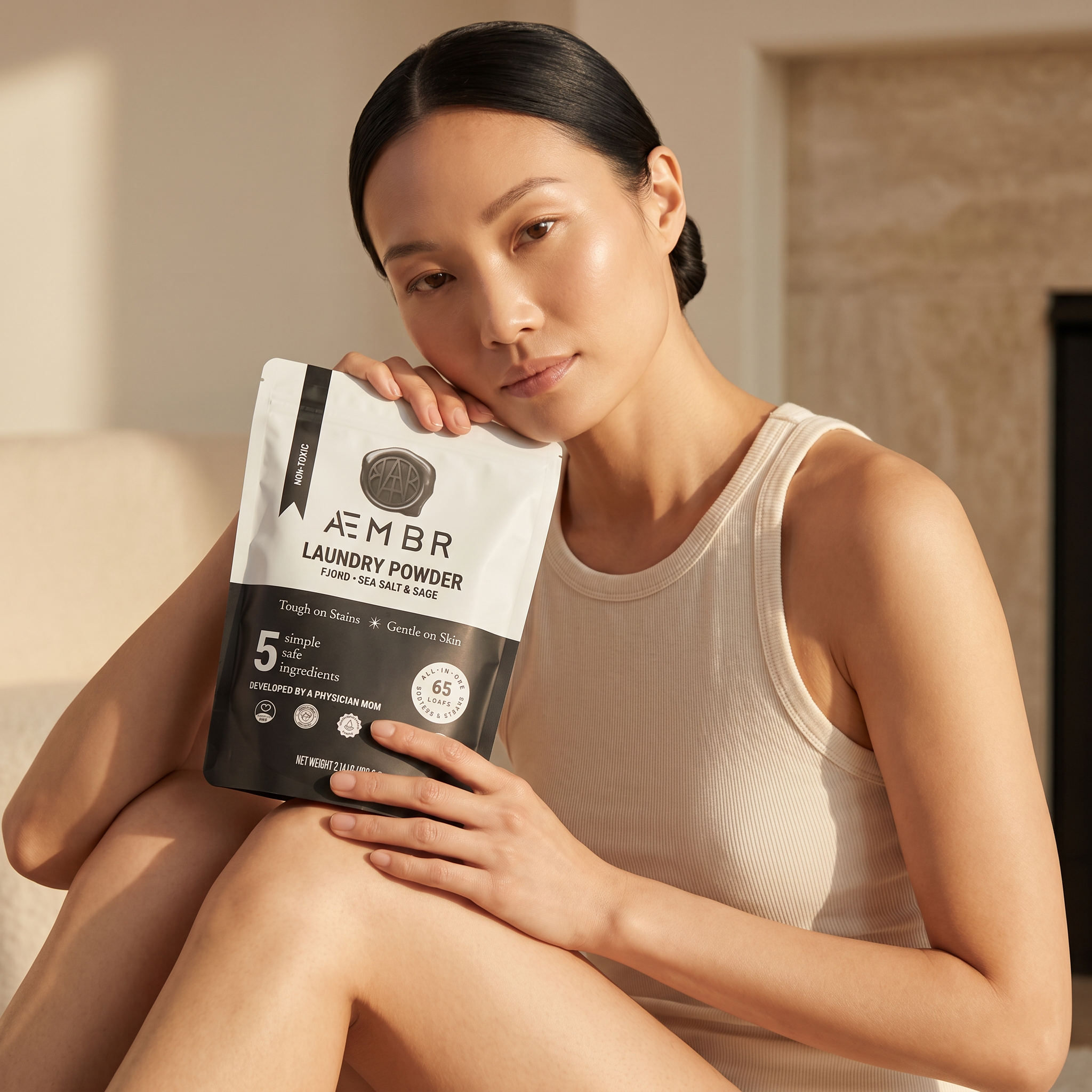

By Kristina Braly, MD — Founder, AEMBR
Cleaning wipes feel like a modern convenience win: grab one, swipe a surface, done. Clorox and Lysol dominate the category, and their "kills 99.9% of bacteria" messaging is everywhere. But when patients and customers ask me whether these wipes are actually safe — especially on food-contact surfaces, around children, or for daily use — the honest answer is more complicated than the label suggests. The active ingredient class at the center of this conversation is quaternary ammonium compounds, or quats, and they're worth understanding before you reach for another canister.

What Are Quaternary Ammonium Compounds (Quats)?
Quaternary ammonium compounds are a family of synthetic antimicrobials that have been used in cleaning and disinfectant products for decades. In Clorox Disinfecting Wipes and Lysol Disinfecting Wipes, the primary active ingredients are alkyl dimethyl benzyl ammonium chloride (ADBAC) and alkyl dimethyl ethylbenzyl ammonium chloride — sometimes listed together as "quaternary ammonium compounds" or "Benzalkonium chloride" variants on the EPA-registered label.
These compounds work by disrupting the cell membrane of bacteria and viruses, effectively killing the microorganism. From an antimicrobial mechanism standpoint, they're effective — that part of the marketing is accurate. The questions worth asking are about residue, cumulative exposure, and the gap between "EPA-registered disinfectant" and "safe for all uses."
EPA Registration: What It Does and Doesn't Mean
Clorox and Lysol wipes are registered with the EPA under the Federal Insecticide, Fungicide, and Rodenticide Act (FIFRA). EPA registration means the product has been evaluated for efficacy against the pathogens listed on the label and that the label directions, when followed exactly, represent an acceptable risk profile. It does not mean the product is safe in all use scenarios, at all frequencies, or for all populations.
This is a distinction that gets lost in marketing. "EPA-registered" is often interpreted by consumers as a general safety endorsement. It isn't. It's a performance and directed-use certification.
Expert guidance on clean ingredients, home fragrance, and living well — from our physician-authored blog.
The Residue Problem: Quats Stay on Surfaces
One of the most clinically relevant concerns with quat-based wipes is residue persistence. Unlike hydrogen peroxide-based disinfectants, which decompose into water and oxygen after drying, quats leave an active chemical residue on surfaces. On a kitchen counter, cutting board, or highchair tray, that residue doesn't evaporate — it stays there until the surface is rinsed or wiped again with a clean, damp cloth.
Multiple studies have documented measurable quat transfer to food from treated food-contact surfaces. A 2014 study published in Environmental Science & Technology found that quats from kitchen wipes transferred to food placed on treated surfaces, with transfer rates dependent on contact time and surface porosity. The EPA label directions for Clorox and Lysol wipes do specify that food-contact surfaces should be rinsed with potable water after disinfecting — but this instruction is routinely skipped by real-world users, and the product packaging does not prominently feature it.
Reproductive Toxicity Concerns: What the Research Says
The most significant emerging concern in the quat literature is reproductive and developmental toxicity. A series of peer-reviewed studies from the Hrubec lab at Virginia Tech (published between 2014 and 2021) found that chronic quat exposure in mice was associated with reduced fertility in both males and females, decreased sperm motility, neural tube defects in offspring, and reproductive impairment across multiple generations. The exposure routes included both ingestion and skin absorption.
These are animal studies, and the exposure levels used were generally higher than what a person would encounter from typical household use of a single wipe product. However, the concern is cumulative exposure. Quats aren't just in disinfecting wipes — they appear in hand sanitizers, floor cleaners, fabric softeners, and some personal care products. The question isn't whether one Clorox wipe causes harm. The question is what regular, multi-source quat exposure looks like over years, especially during pregnancy.
In 2020, the American Journal of Obstetrics & Gynecology published a commentary calling for more research on quat exposure in occupational and household settings, noting that nurses and cleaning workers — who have the highest exposure — showed associations with adverse reproductive outcomes in some occupational studies.
Asthma and Respiratory Exposure
Beyond reproductive concerns, quats have a documented association with occupational asthma. The National Institute for Occupational Safety and Health (NIOSH) has flagged quaternary ammonium disinfectants as potential asthmagens — chemicals capable of inducing new-onset asthma — in healthcare workers and custodial staff who use them daily in enclosed spaces.
For household consumers wiping down a counter twice a day, the respiratory exposure is lower than in a hospital setting. But for people with existing asthma, in small spaces, or using wipes on warm surfaces (where volatilization increases), it's worth noting that the air quality effect is not zero.
Food-Contact Surfaces: The Label Instructions Nobody Reads
Let me be specific about what the manufacturers' own label instructions say, because this matters:
- Clorox Disinfecting Wipes (Lemon Fresh): "For food contact surfaces: allow to remain wet for 30 seconds. Rinse with potable water."
- Lysol Disinfecting Wipes (Crisp Linen): "For food contact surfaces: allow to remain wet for 10 seconds, then rinse with potable water."
The rinse instruction is there. But observe how the product is actually used: someone pulls a wipe, swipes the counter, tosses the wipe, and sets a child's plate directly on the counter. No 10-second dwell time. No rinse. The product isn't being used incorrectly in any dramatic sense — this is how wipes are designed to feel usable — but the gap between label directions and real-world use is wide.
Antimicrobial Resistance: A Secondary Concern Worth Naming
There is a growing body of literature linking widespread quat use to the selection of quat-resistant bacteria, some of which also exhibit cross-resistance to clinically important antibiotics. A 2016 review in Antimicrobial Agents and Chemotherapy documented quat resistance genes in environmental bacteria and noted potential for co-selection of antibiotic resistance. This is primarily a public health and hospital concern rather than a direct household consumer risk, but it's part of why the infectious disease community has nuanced views on routine household disinfection with antimicrobials.
When Disinfecting Wipes Are Actually Warranted
I want to be precise here: there are absolutely situations where EPA-registered disinfecting wipes are the right tool. I covered this in more depth in the post on the difference between cleaning, disinfecting, and sanitizing, but the short version is this:
- Someone in the household has an active gastrointestinal illness (norovirus, C. diff exposure)
- You're dealing with a surface that has had contact with raw poultry or other high-pathogen food
- Healthcare-adjacent home care situations (immunocompromised household member, wound care)
- Cold and flu season protocols when there's active illness in the home
In these scenarios, the quat exposure tradeoff is justified by the pathogen reduction benefit. The problem isn't that quat wipes exist — it's that they've been marketed for daily, routine use on every surface, which is a different risk calculation entirely.
Comparison: Cleaning Wipes by Ingredient Profile
| Product | Active Ingredient | Residue After Dry | Food-Contact Rinse Required | EWG Rating |
|---|---|---|---|---|
| Clorox Disinfecting Wipes | Quats (ADBAC) | Yes | Yes | D |
| Lysol Disinfecting Wipes | Quats (ADBAC + ADEBAC) | Yes | Yes | D |
| Seventh Generation Disinfecting Wipes | Thymol (thyme-derived) | Minimal | Yes (label) | B |
| Method Antibacterial Wipes | Benzalkonium chloride | Yes | Yes | C |
| Hydrogen peroxide-based wipes | H₂O₂ (0.5–1.5%) | No (decomposes) | No (after dry) | A–B |
EWG ratings based on EWG's Guide to Healthy Cleaning as of 2025.
What I Use at Home — and What I Recommend Instead
For everyday surface cleaning in my kitchen and home, I use a spray cleaner that doesn't rely on quats — specifically formulated to clean without leaving an antimicrobial residue on surfaces my kids touch constantly. Our AEMBR Multi Surface Spray is free from quaternary ammonium compounds, phthalates, and synthetic fragrances designed to mask chemical odors. It cleans effectively for everyday soil — food residue, fingerprints, general grime — which is what 95% of household surface cleaning is actually about.
If you want to dig into what "disinfecting" really requires versus what routine cleaning achieves, this post on multi-surface spray safety around kids and pets covers the practical framework I use in my own home.
Reserving actual disinfectants for situations that warrant them — illness, high-pathogen food prep, healthcare scenarios — means when you do reach for a quat-based product, it's a deliberate choice with a clear benefit-risk calculus, not a daily habit built by marketing.
Checklist: Safer Cleaning Wipe Practices
- ✅ Read the label directions — especially for food-contact surfaces (rinse requirement)
- ✅ Reserve disinfecting wipes for high-risk scenarios — illness, raw meat, healthcare
- ✅ Use a quat-free cleaner for daily surfaces — countertops, highchairs, cutting boards (when not actively contaminated)
- ✅ Ventilate when using any disinfecting wipe — especially relevant if you or a family member has asthma
- ✅ Don't conflate "EPA-registered" with "safe for all uses" — they're different certifications
- ✅ Rinse food-contact surfaces after disinfecting — this is on the label for a reason
- ✅ Consider hydrogen peroxide-based wipes when a one-use disinfecting wipe is genuinely needed — they leave no active residue after drying
The Bottom Line
Clorox and Lysol wipes are effective disinfectants within the scope of their EPA registrations. The quats they contain are not acutely toxic at the concentrations used in a consumer wipe. But the combination of surface residue, label directions that require a rinse step most users skip, emerging reproductive toxicity data in animal models, and the fact that most daily household cleaning doesn't require a registered disinfectant at all — that combination makes routine, daily use a harder recommendation to justify.
Use them when you need them. Know what's in them when you do. And for everything else, a well-formulated spray cleaner without the residue tradeoff does the job.


