



By Kristina Braly, MD — Founder, AEMBR
How you scent your home safely is one of the most common questions I get as a physician who also formulates home fragrance. The answer isn't "avoid fragrance entirely." It's knowing which fragrance delivery methods introduce meaningful risk — and which don't — so you can make informed choices rather than fearful ones. If you've searched "how to scent your home safely non toxic" and come up mostly empty, this is the post I wanted to exist before I started AEMBR.

Why Home Scenting Raises Legitimate Health Questions
Indoor air quality is worse than outdoor air quality in most U.S. homes — a finding that has appeared consistently in EPA research since the 1980s. Fragrance-related products contribute to that picture through volatile organic compound (VOC) emissions: chemical compounds that evaporate at room temperature and can react with airborne ozone to form secondary pollutants including formaldehyde and ultrafine particles.
Not all VOCs are hazardous. Ethanol, for example, is a VOC and is classified as low risk at indoor fragrance concentrations. The concern is with specific compounds: formaldehyde precursors, phthalates used as fixatives, and benzene derivatives that can appear in poorly formulated synthetic fragrance. Understanding which delivery methods introduce which compounds is the starting point for safer home scenting.
The Problem With "Fragrance" on a Label
Under FDA and EPA rules, "fragrance" is a trade-secret ingredient category that can encompass hundreds of individual chemical compounds in a single product. The International Fragrance Association (IFRA) maintains a list of restricted and prohibited ingredients, but compliance is voluntary and self-reported. That gap — between what brands are legally permitted to omit and what they actually disclose — is where consumer risk lives.
The specific compounds I look for when auditing any fragrance product:
Expert guidance on clean ingredients, home fragrance, and living well — from our physician-authored blog.
- Phthalates (diethyl phthalate, dibutyl phthalate) — used as fixatives and solvents, linked to endocrine disruption in animal models at sustained exposure levels; classified by EWG as high concern
- Synthetic musks (galaxolide, tonalide) — bioaccumulative, detected in human breast milk in environmental monitoring studies
- Benzaldehyde and related aromatic compounds — irritant at elevated concentrations; concentration in a single candle is typically below concern thresholds, but ongoing exposure from multiple sources adds up
- Formaldehyde-releasing preservatives — less common in fragrance than in personal care products, but present in some liquid room sprays
Candles: What the Wax and Wick Actually Do
The wax type matters less than the fragrance load and wick composition. Paraffin wax — frequently cited as the "toxic candle wax" — produces soot at combustion, the same carbon particulate you'd get from burning any organic material. At normal residential ventilation, soot from a well-trimmed candle is not a clinically significant exposure. The data behind "paraffin is carcinogenic" is almost always extrapolated from industrial exposure studies, not from single candles in living rooms.
Wick composition is more consequential. Cotton and wooden wicks are the cleaner options. Lead-core wicks were banned in the U.S. in 2003, but zinc-core wicks — still used by some manufacturers — can emit trace heavy metals during combustion. Check wick composition before assuming "natural fragrance" on a label means a clean burn overall.
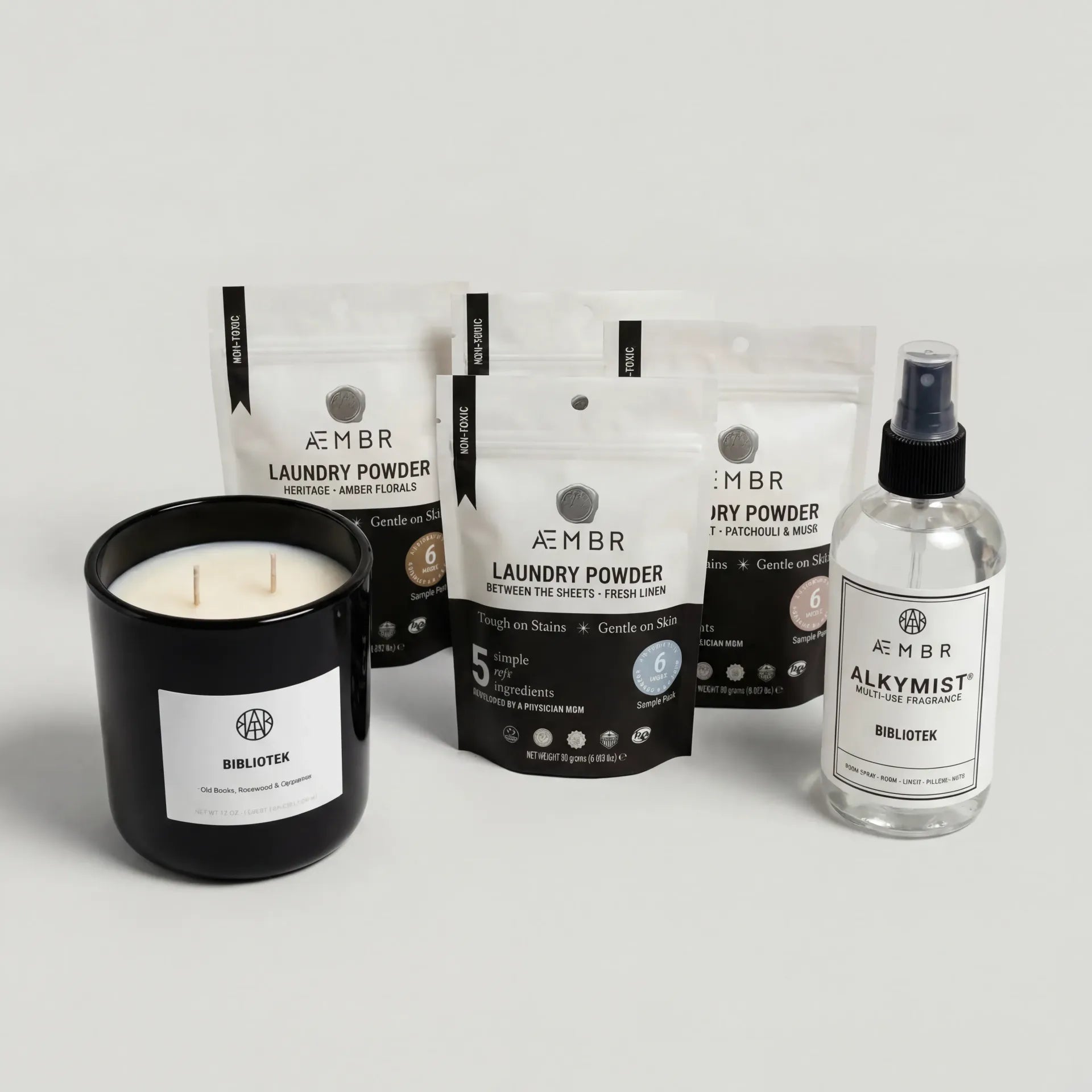
The AEMBR Bibliotek Candle uses a cotton wick and phthalate-free fragrance — the two non-negotiables I apply when evaluating any candle for our collection. The full AEMBR candle collection is formulated to the same standard. When I'm burning a candle in a smaller room, I crack a window — not because the product is dangerous, but because basic ventilation is good practice with any combustion source.
Room Sprays: Fastest Delivery, Shortest Duration
Room sprays are inhalation products by design — you're aerosolizing fragrance molecules directly into the breathing zone. This makes ingredient transparency especially important. The primary concerns:
- Alcohol carrier quality — ethanol is preferred over propylene glycol as the primary solvent for respiratory exposure profiles
- Fragrance compound selection — phthalate-free verification matters more here than in candles because the spray enters the air immediately, without combustion to thermally transform any compounds
- Propellants in aerosol formats — pressurized propellants (isobutane, propane in most canned air fresheners) introduce an additional inhalation concern absent in pump sprays
I formulated ALKYMIST as a pump spray specifically to avoid aerosol propellants. The entire ALKYMIST fragrance collection uses phthalate-free fragrance compounds in an ethanol-and-water base. I made that formulation decision when I was still seeing pediatric patients — the population most vulnerable to repeated fragrance exposure is children, and room sprays are commonly used in nurseries and kids' rooms without much scrutiny.
Essential Oil Diffusers: Not Automatically Safer
The perception that essential oil diffusers are categorically safer than synthetic fragrance products isn't well-supported by indoor air quality data. Key considerations:
- Ultrasonic diffusers aerosolize essential oil particles into the air. At high concentrations or in small rooms with limited ventilation, this can produce VOC levels that equal or exceed the synthetic fragrance products they're meant to replace.
- Terpene oxidation — limonene (citrus oils), linalool (lavender), and alpha-pinene (pine, eucalyptus) react with indoor ozone to form secondary organic aerosols and trace formaldehyde, as documented in peer-reviewed indoor chemistry research.
- Pet toxicity is documented and meaningful. Tea tree, eucalyptus, clove, and cinnamon essential oils are toxic to cats and dogs at relatively low airborne concentrations. This is not a fringe concern — it appears consistently in veterinary toxicology literature.
Essential oil diffusers are not hazardous in normal residential use with reasonable ventilation and session lengths under 30–60 minutes. But the "natural = safe" assumption that underpins most essential oil marketing is not a toxicological position.
Wax Melts: The No-Flame Alternative
Wax melts release fragrance through thermal evaporation rather than combustion. Because there's no open flame, the carbon soot concern that applies to candles is absent. What remains relevant: fragrance compound selection. A wax melt using phthalate-containing fragrance oil will evaporate those compounds into room air at sustained concentrations across the entire melt session — without the combustion that transforms some compounds in a candle flame.
The practical standard: if a wax melt brand discloses phthalate-free fragrance and uses a clean wax base (soy, coconut, or a blend without synthetic hardeners like polyethylene), it's a lower-risk home scenting option than most aerosol air fresheners and a viable candle alternative for households with young children or pets where open flames aren't practical.
Reed Diffusers: The Passive Option
Reed diffusers release fragrance through passive evaporation — the slowest and lowest-concentration delivery method available for home scenting. The primary variable is the carrier fluid: synthetic dipropylene glycol (DPG) is standard and is classified as low acute toxicity. The fragrance compound quality matters as it does in any format.
Reed diffusers are well-suited for bedrooms and nurseries where you want continuous ambient scenting without managing candle burn sessions or remembering to run a diffuser. The trade-off is lower scent intensity — useful for subtle background scenting, not for rapid scent reset after cooking.
Comparison: Home Scenting Methods by Risk Profile
| Method | VOC Release Pattern | Combustion? | Phthalate Risk (if unlabeled) | Best Use Case |
|---|---|---|---|---|
| Candle (cotton wick, phthalate-free) | Moderate, while burning | Yes | High if not disclosed | Living room, entertaining |
| Room spray — pump (phthalate-free) | Short-duration burst, dissipates quickly | No | High if not disclosed | Quick scent reset, pre-guests |
| Aerosol air freshener | High burst + propellant off-gas | No | High; rarely disclosed | Not recommended |
| Essential oil diffuser (ultrasonic) | Moderate (terpene-driven); terpene-ozone rxn concern | No | Low if using pure EO | Short sessions, ventilated rooms only |
| Wax melt (phthalate-free) | Moderate, sustained during session | No | Moderate if not disclosed | No-flame rooms, households with kids |
| Reed diffuser (phthalate-free) | Low, continuous passive | No | Low–Moderate | Nursery, bedroom, office |
| Plug-in air freshener | Continuous, heat-assisted | No | High; highest continuous exposure | Not recommended for bedrooms |
What I Actually Use at Home
I burn the Fjord Candle in the kitchen and main living area. I use ALKYMIST room spray in the kids' bathroom after bath time — it's the one scented product I'm confident using in their space because I know exactly what's in the fragrance. For the bedroom, I prefer a reed diffuser with a lighter fragrance concentration.
I don't use plug-in air fresheners anywhere in the house. The combination of synthetic fragrance compounds with continuous heat and a carrier that runs uninterrupted for weeks is the highest-exposure scenario in residential home scenting — and the exposure profile for that use pattern is not well-characterized in the literature relative to the market size of those products. That asymmetry is a red flag from an evidence-based medicine standpoint.
How to Evaluate Any Fragrance Product
The framework I apply when reviewing a home scenting product for the first time:
- Does the brand disclose phthalate-free fragrance specifically — not just "clean fragrance," which is an undefined marketing term with no regulatory meaning?
- What is the wax or carrier base, and is it disclosed on the product page or label?
- Is the wick or diffuser mechanism identified and specified (cotton, wood, zinc-core)?
- Does the brand reference IFRA standards, EWG Verified status, or a third-party fragrance safety certification?
- What is the EWG score for the product line, if available?
No fragrance product passes every standard — the chemistry of scent requires volatile compounds by definition. The goal is informed selection at a level of scrutiny proportional to the duration and type of exposure, not zero exposure.
Non-Toxic Home Scenting: Physician's Checklist
- ✅ Choose candles with cotton or wood wicks — avoid zinc-core
- ✅ Verify "phthalate-free fragrance" explicitly — "natural fragrance" and "clean scent" are marketing language, not ingredient specifications
- ✅ Use pump room sprays instead of aerosol canned air fresheners
- ✅ Keep essential oil diffuser sessions under 30–60 minutes; ventilate the room before and after
- ✅ Avoid plug-in air fresheners in bedrooms and nurseries — continuous heat-assisted exposure is the highest-risk residential scenario
- ✅ Trim candle wicks to ¼ inch before each burn to minimize soot and mushrooming
- ✅ Open a window when burning candles in small or poorly ventilated rooms
- ✅ Keep all fragrance products — including "natural" essential oils — away from pets; cats are especially sensitive to terpene-containing compounds
- ✅ For wax melts, verify phthalate-free fragrance oil — the sustained heat exposure model produces different VOC dynamics than combustion candles
- ✅ Use a reed diffuser in spaces where you want constant light scenting (nursery, bedroom, office) rather than intermittent high-intensity spray
The Bottom Line
A beautifully scented home and a safe one are not in conflict. The variables that actually matter are fragrance compound selection (phthalate-free, no synthetic musks), delivery format (pump over aerosol, passive over continuous-heat), combustion management (wick quality, ventilation), and duration of exposure. None of those require sacrificing scent — they require a standard, applied consistently.
The AEMBR Discovery Set is a good starting point if you want to explore the fragrance line before committing to full sizes. Every product is formulated to the same specification: phthalate-free, ingredient-transparent, designed by someone who reads the toxicology literature and then goes home and actually uses the products.


