



By Kristina Braly, MD — Founder, AEMBR
You've unboxed a new shirt, a pair of pants, or a set of sheets, and the smell that hits you is unmistakably chemical — sharp, synthetic, almost medicinal. You're not imagining it. That odor is real, it has a name, and there are specific reasons it's there. As a physician who has spent years thinking about what we put on and near our bodies, I find this topic worth taking seriously — not to frighten anyone, but to be honest about what we're actually wearing when we put on clothes without washing them first.

Here's what's causing that smell, what the research says about the chemicals involved, and — most practically — what actually gets rid of it.
Why Do New Clothes Smell Chemical?
The short answer: manufacturing. Fabric production involves a long sequence of chemical treatments — dye baths, fixatives, anti-wrinkle finishes, anti-static agents, mold inhibitors for shipping, and flame retardants in some categories. Most of these are either washed out during production or are in concentrations well below regulatory concern. But some are not.
The one most commonly associated with the characteristic "new clothes" odor is formaldehyde — specifically, its role in permanent press and wrinkle-resistant finishes. Formaldehyde-releasing resins (dimethylol dihydroxyethylene urea, or DMDHEU, is the most common) are applied to cotton and cotton-blend fabrics to create the smooth, unwrinkled appearance consumers expect on retail racks. The resin bonds to the fabric, but residual free formaldehyde remains — and it off-gasses, producing that distinctive smell.
Other contributors include:
Expert guidance on clean ingredients, home fragrance, and living well — from our physician-authored blog.
- Azo dyes — widely used synthetic dyes that can release aromatic amines during washing or wear
- Optical brighteners — chemical compounds that make white fabrics appear whiter under UV light; residue can cause skin irritation in sensitive individuals
- Phthalates in plastisol screen-print inks (common on graphic tees)
- Mold inhibitors — fungicides applied to prevent mold during long ocean freight from overseas manufacturers
- Sodium bisulfate and other bleaching agents used in textile processing
Is the Formaldehyde in New Clothes Actually Dangerous?
This is where I'll give you the honest physician's answer rather than the alarming clickbait version.
Formaldehyde is a known human carcinogen, classified as such by the National Cancer Institute and the International Agency for Research on Cancer (IARC). That classification is based primarily on occupational exposures — textile workers, embalmers, and lab workers with chronic high-level inhalation exposure.
The levels of free formaldehyde in consumer clothing are a different picture. A 2014 analysis in the Journal of Exposure Science and Environmental Epidemiology found that while some wrinkle-resistant garments contained detectable free formaldehyde, the vast majority were well below levels associated with systemic risk. The more common clinical concern is allergic contact dermatitis — a local skin reaction in people with formaldehyde sensitivity. According to the Environmental Working Group, formaldehyde is a known skin sensitizer, and the allergy is not rare.
The practical upshot: washing before wear significantly reduces residual formaldehyde levels. One wash can remove 60–80% of free formaldehyde. Two washes get you close to non-detectable in most fabric categories.
Fabrics Most Likely to Have Chemical Odors
Not all fabrics carry the same chemical load. Here's how they generally rank:
| Fabric Type | Common Chemical Treatments | Odor Risk |
|---|---|---|
| Wrinkle-resistant cotton / cotton blends | Formaldehyde-releasing resins (DMDHEU) | High |
| Synthetic athletic / performance wear | Antimicrobials, dye fixatives | Moderate-High |
| Printed graphic tees | Plastisol inks (phthalates) | Moderate |
| Bedding / sheet sets | Optical brighteners, wrinkle-resistant finishes | Moderate |
| Raw or undyed linen / wool | Minimal | Low |
| Silk | Varies; heavy processing possible | Low-Moderate |
| Organic cotton (GOTS-certified) | Restricted chemical use | Low |
Step 1: Air It Out First
Before you wash anything, give the garment 24–48 hours of airflow. Hang it outdoors or near an open window — not in a closet. Sunlight and moving air accelerate off-gassing and will visibly reduce the intensity of the chemical smell before you've done a single wash. This matters because some chemical residues volatilize easily; airflow removes them without any water or detergent required.
This is particularly useful for pieces that are dry-clean recommended or delicate enough that repeated washing is damaging — a single airing session can meaningfully reduce surface-level volatiles.
Step 2: Wash Before the First Wear (Always)
I've said this to patients and I'll say it clearly here: always wash new clothes before wearing them. No exceptions for "it looks clean" or "I just want to try it on." Dermatologists have documented contact dermatitis reactions from unwashed new garments with enough regularity that this is a standard recommendation.
The most important variables:
- Water temperature: Warm-to-hot water (when fabric care permits) improves the solubility of water-soluble residues. For delicates, warm is enough.
- Full cycle: Don't rush it. A full wash cycle with adequate agitation matters more than temperature alone.
- Detergent selection: This is where your choice of laundry product matters. You want a detergent with effective surfactants that can actually pull chemical residues from fabric fibers — not just mask odor.
Why Detergent Choice Matters for Chemical Odor Removal
Most laundry detergents will reduce chemical odors, but not all do it cleanly. Here's what I mean: many conventional detergents address odor through fragrance masking — they layer a synthetic scent on top of whatever residue remains. You stop smelling the formaldehyde because you're smelling the synthetic floral or fresh linen fragrance layered over it. That's not removal. That's substitution — and if the fragrance contains its own sensitizing compounds (phthalates, musks, synthetic fragrance allergens), you've replaced one exposure with another.
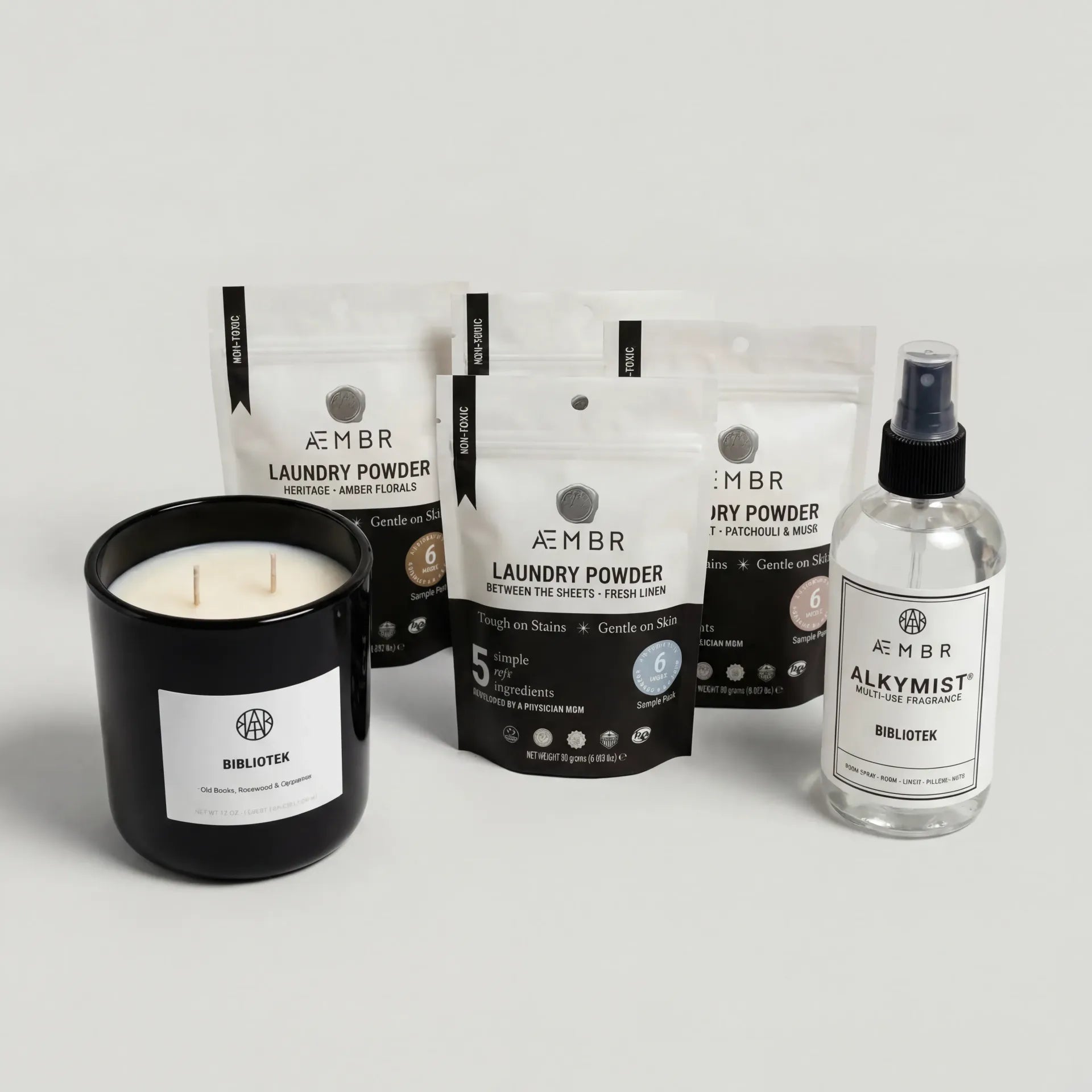
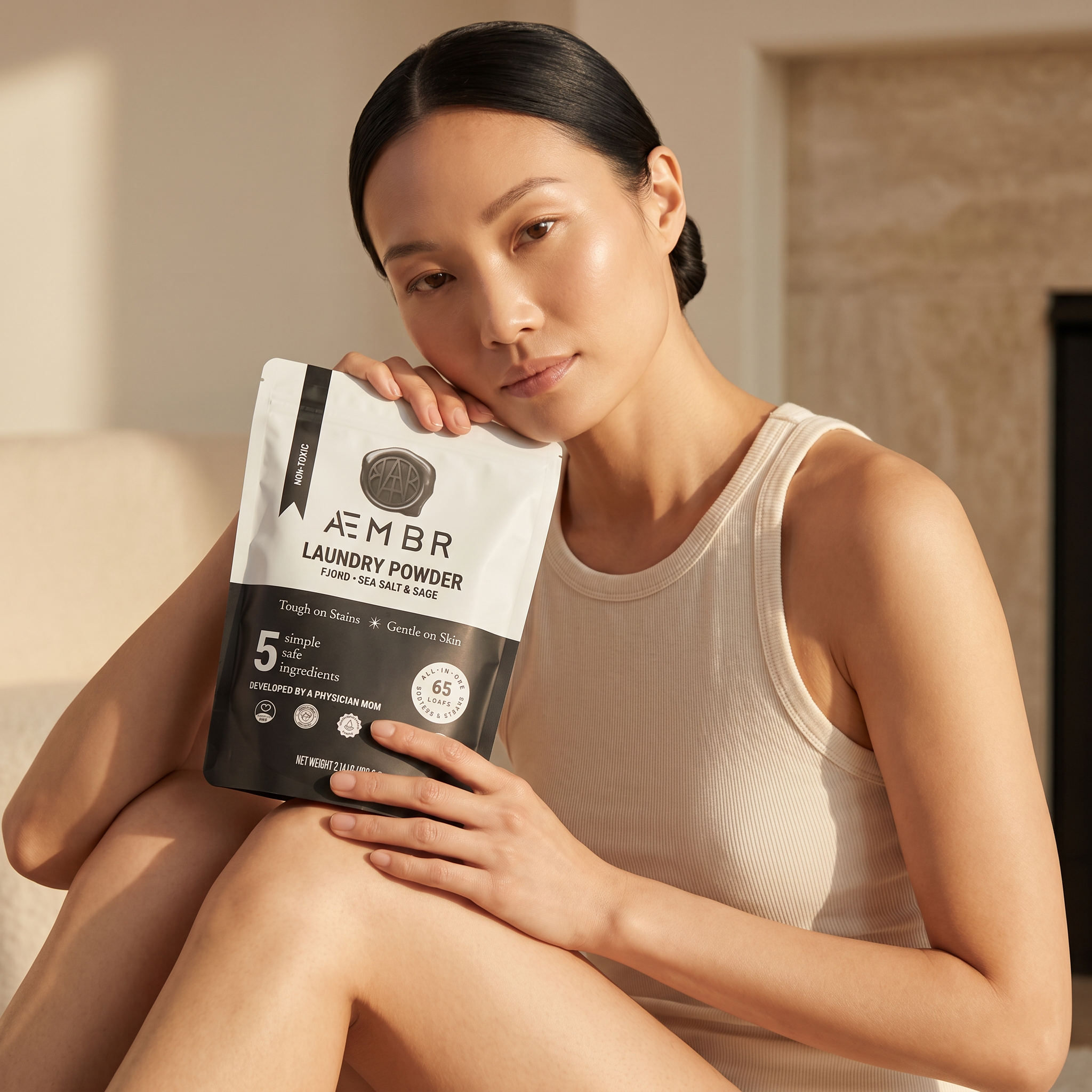
The approach I formulated into AEMBR Laundry Powder was specifically about surfactant and enzyme performance — actual soil and residue lift from fabric, not fragrance layering. The enzyme complex in the formula targets protein and starch residues that chemical finishes can bind to, and the plant-derived surfactants are effective at low temperatures, which matters for delicate fabrics you can't run hot. No optical brighteners added (no additional sensitizer layering). No synthetic fragrance masking. Clean through chemistry, not perfumery.
For new clothes with strong chemical odors, I recommend:
- Use a full dose — don't under-dose on a first wash of heavily treated fabric
- Use warm water if the care label allows
- Run a full cycle, not a quick wash
- If the smell persists after one wash, do a second before wearing
The Baking Soda and Vinegar Question
I get asked constantly whether baking soda or white vinegar will remove chemical smells from new clothes. Here's the honest answer:
Baking soda (sodium bicarbonate): Mildly effective as an odor adsorbent. It doesn't chemically neutralize formaldehyde, but it can adsorb some volatile compounds that contribute to odor. Adding half a cup to a wash cycle has a modest supporting effect — it's not a substitute for detergent, but it's a reasonable addition for a first wash of heavily treated fabric.
White vinegar: Also modestly useful as a rinse aid (half a cup in the rinse cycle). The mild acidity can disrupt some ionic residues and help with fabric softness. What vinegar is not is a disinfectant or a meaningful formaldehyde neutralizer at the concentrations used in laundry. The acetic acid content (5% in household vinegar) is too dilute to make significant chemical impact on resin-bonded finishing agents.
Neither is a primary solution. Both are reasonable additions if the smell is stubborn after a standard wash. Neither replaces a well-formulated detergent.
What About Dry Cleaning for Chemical Odors?
Here's a counterintuitive note: traditional dry cleaning uses perchloroethylene (PERC), a chlorinated solvent that is itself a volatile organic compound and a known carcinogen with chronic occupational exposure. If you dry clean a garment to address chemical odors, you may be introducing a new set of residues. Freshly dry-cleaned garments typically have a distinct solvent odor that also requires airing before wearing.
Wet cleaning (water-based professional cleaning) is a better option for items that require professional care. Or: follow the care label carefully and wash at home where possible.
How Many Washes Does It Take?
For most garments, a single wash followed by outdoor line drying will either eliminate the chemical smell entirely or reduce it to barely detectable. Here's a rough guide:
| Odor Intensity | Recommended Protocol |
|---|---|
| Mild (faint chemical smell) | 1 warm-water wash + line dry |
| Moderate (noticeable but not sharp) | Air 24h → 1 warm-water wash + ½ cup baking soda → line dry |
| Strong (sharp, eye-watering) | Air 48h → 2 warm-water washes (separate cycles) + ½ cup baking soda first wash, ½ cup vinegar rinse second wash → line dry in sunlight |
Line Dry vs. Machine Dry
Line drying in sunlight and moving air is meaningfully better for odor removal than tumble drying. The dryer traps volatilized compounds inside the drum — you're re-depositing them on the fabric as the air circulates. Outside, those volatiles disperse. Sunlight also has a mild UV-based oxidizing effect that assists with residue breakdown.
For clothes that must be machine dried: use a low heat setting and clean your dryer lint trap before the cycle. Residue from previous loads can transfer.
When to Be More Concerned
Most of the time, one or two washes before first wear is all that's needed and any residual risk is low. But there are situations where I'd pay more attention:
- Infant and toddler clothing: Babies' skin is thinner and more permeable. Formaldehyde sensitivity is disproportionately common in atopic (eczema-prone) skin. Always wash before putting new clothes on a baby — no exceptions.
- Known formaldehyde allergy: If you or someone in your household has documented contact dermatitis from formaldehyde (an allergist can confirm this with patch testing), opt for GOTS-certified organic cotton or other restricted-process fabrics and always wash before wear.
- Wrinkle-resistant bedding: You're in contact with it for 7-8 hours a night. Run a hot wash cycle (if care label allows) and a rinse cycle before the first use.
How to Prevent the Problem Upstream
The best long-term strategy is informed buying. A few markers that indicate lower chemical finishing load:
- GOTS certification (Global Organic Textile Standard) — restricts formaldehyde-releasing resins
- OEKO-TEX Standard 100 — third-party tested to limits on harmful substances including formaldehyde
- Avoid "wrinkle-resistant" or "permanent press" labels — these almost always mean formaldehyde-releasing resin finishing
- Natural, minimally processed fibers — raw linen, untreated wool, GOTS organic cotton tend to have lower chemical load
This doesn't mean avoiding all conventional clothing — that's an impractical standard. It means building a habit of wash-before-wear and being more selective when it comes to what's touching your skin eight hours a night (bedding) or a baby's skin all day.
The AEMBR Laundry Protocol for New Clothes
If you want a clean, simple protocol for new garments:
- Air the garment 24 hours before washing (outdoors or near an open window)
- Wash in warm water (hot if care label allows) with a full scoop of AEMBR Laundry Powder — plant-derived surfactants, no optical brighteners, no synthetic fragrance masking
- Add ½ cup baking soda to the drum for stronger odors
- Full cycle — skip the quick wash
- Line dry in sunlight and moving air if possible; machine dry on low if not
- If the smell persists: repeat step 2-5 once more before wearing
That's it. No complicated chemistry. No special products beyond a well-formulated detergent. The protocol works because it addresses the actual mechanism — surfactant lift and airflow — rather than masking the odor with more chemistry.
Summary: What You Need to Know
- Chemical odors in new clothes are primarily from formaldehyde-releasing resin finishes, dye fixatives, and mold inhibitors from shipping
- Wrinkle-resistant and permanent press fabrics carry the highest formaldehyde load; GOTS-certified organic fabrics carry the lowest
- Always wash before first wear — one warm-water wash removes 60–80% of free formaldehyde
- Baking soda and vinegar are useful additions but not replacements for a well-formulated detergent
- Dry cleaning doesn't solve the problem and may add solvent residues; line drying in sunlight outperforms machine drying for odor removal
- Strong odors or known formaldehyde sensitivity warrant a second wash before wear
- Infants and toddlers: always wash new clothing before the first use, without exception
The practice of washing before wearing is low-effort and high-return. It's one of the simplest ways to reduce your household's chemical exposure from a category that rarely gets discussed — new clothes.
— Kristina
Kristina Braly, MD is the founder of AEMBR, a physician-founded luxury clean fragrance and home care brand. AEMBR's Laundry Powder is formulated without optical brighteners, synthetic fragrance masking, or harsh processing chemicals. Explore the full Laundry Care collection.


