





AEMBR's Ingredient Standards: Why We Publish Every Ingredient and What Each One Does
By Kristina Braly, MD — Founder, AEMBR
When I started formulating AEMBR products, I made one commitment I've never walked back: we publish every ingredient in every product, and we explain what each one does. Not because we're required to. Not because it's a marketing move. Because after years of medical training and years of reading conventional product labels, I know that most people can't decode what's actually in the things they use every day — and that gap has consequences.
Ingredient transparency is the non-negotiable foundation of this brand. This post is the canonical record of what that means, why I built AEMBR around it, and what our specific standards look like in practice.
Why Ingredient Transparency Is Rare in the Home Fragrance and Cleaning Category
The home fragrance and household cleaning industries operate under remarkably loose labeling requirements. In the United States, the Fair Packaging and Labeling Act and the Federal Hazardous Substances Act govern what cleaning products must disclose — and the requirements are minimal. Manufacturers are not required to list every ingredient on a cleaning product label. Fragrance formulations, in particular, are protected as trade secrets under the law, which means a single word — "fragrance" — can legally represent dozens of individual chemical compounds, some of which carry known or suspected health concerns.
Home fragrance products (candles, wax melts, room sprays) are even less regulated. There is no federal requirement to disclose any ingredient in a candle. You can burn a conventionally produced candle in your living room every night without ever knowing what it contains.
AEMBR operates differently. We disclose everything — not because the law requires it, but because I believe you deserve to know what you're bringing into your home.
What "Physician-Formulated" Actually Means at AEMBR
I've written about this in detail elsewhere (Physician-Formulated: What It Actually Means), but I want to be precise about what my medical training does and doesn't add to formulation.
My background is in clinical medicine, not cosmetic chemistry or toxicology. What medicine trained me to do is read the primary literature, interpret safety data, and apply the precautionary principle — the same principle that underlies clinical decision-making. When I evaluate an ingredient, I'm asking: what does the peer-reviewed evidence say? What does the regulatory body's safety assessment show? What's the exposure route and dose in real-world home use?
That lens is what shapes AEMBR's ingredient standards. It's not a marketing credential. It's the actual filter I applied when building every formulation.
The Banned Ingredient List: What We Will Not Use
Before we get to what's in AEMBR products, here is the explicit list of ingredient categories we exclude — and why.
Phthalates
Phthalates are plasticizers widely used in synthetic fragrance to extend scent longevity. The most studied — DEHP, DBP, and DEP — are classified as endocrine disruptors by the U.S. EPA. They are associated in epidemiological literature with reproductive toxicity, altered hormone levels, and developmental effects. AEMBR's fragrance oils are tested phthalate-free at the formulation level. Every fragrance supplier we work with must provide documentation confirming no phthalates.
Carcinogens (IARC Group 1 and Group 2A)
We will not use any ingredient classified as a known or probable human carcinogen by the International Agency for Research on Cancer (IARC). This includes benzene (a combustion byproduct of paraffin-heavy wax blends) and formaldehyde-releasing preservatives. Our coconut-apricot wax blend was selected in part because it burns significantly cleaner than paraffin, producing less particulate matter and fewer combustion byproducts at typical room-temperature burn distances.
Optical Brighteners
Optical brighteners are synthetic chemicals that make fabric appear whiter under UV light. They don't clean; they coat. They are not readily biodegradable, have shown toxicity to aquatic organisms, and are associated with skin sensitization in individuals with eczema or contact dermatitis. They are absent from AEMBR Laundry Powder.
SLS and SLES Without Dioxane Testing
Sodium lauryl sulfate and sodium laureth sulfate are effective surfactants but carry known irritation profiles. SLES in particular can contain 1,4-dioxane as a manufacturing byproduct — a compound classified as a likely human carcinogen by the EPA. Where we use surfactant-class ingredients, we require clean manufacturing documentation and use gentler plant-derived alternatives where efficacy allows.
Synthetic Dyes
Conventional cleaning and fragrance products frequently contain synthetic colorants that serve no functional purpose. They contribute to skin sensitization potential, offer nothing to performance, and add unnecessary complexity to a formula. AEMBR products are either uncolored or use cosmetic-grade colorants with established safety profiles.
Parabens
Parabens are preservatives with an extensively studied estrogenic activity profile. While regulatory bodies including the FDA have not concluded that parabens as used in cosmetics are harmful, I applied the precautionary principle: there are effective, well-characterized alternatives, and the potential hormone-disruption signal in the literature is sufficient reason to avoid them in products used in and around the home.
What's Actually in AEMBR Candles
Our candles use a proprietary coconut-apricot wax blend. Here is what that means in practice:
- Coconut wax — derived from cold-pressed coconut oil. Produces a clean burn with minimal soot. Excellent scent throw. Slower burn rate than paraffin, contributing to our extended burn times.
- Apricot wax — derived from apricot kernel oil. Blends with coconut wax to create a creamier, denser texture with smooth top surface and exceptional scent integration.
- Phthalate-free fragrance oil — IFRA-compliant, tested to confirm no phthalates. Fragrance load is calibrated to the specific wax blend to maximize scent release without compromising burn quality.
- Cotton-core wick — no lead, no zinc. Cotton wicks are the clean industry standard. We size our wicks specifically to the vessel diameter to minimize mushrooming and maximize an even burn.
That is the complete ingredient list for every AEMBR candle. There is nothing else.
You can explore the full AEMBR candle collection or shop specific formats including the Viking 3-Wick and Valkyrie 6-Wick.
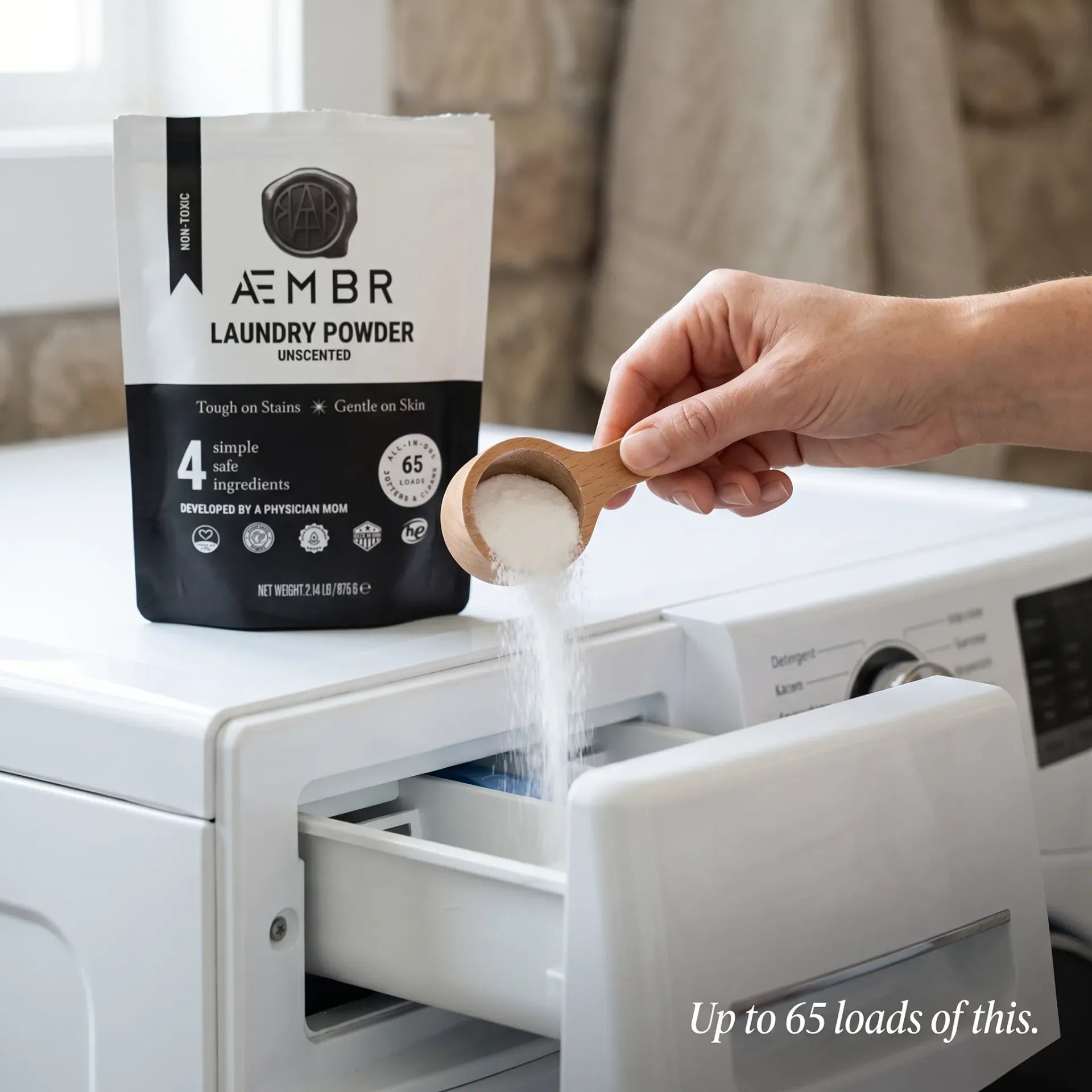
What's Actually in AEMBR Laundry Powder
Laundry powder is the most complex formulation we make — and the one where ingredient transparency matters most. Residual detergent on fabric is in direct contact with skin for hours at a time. This is not a category where I'm willing to accept opaque labeling.
The full ingredient list is published on the AEMBR Laundry Powder product page. The key components:
- Plant-derived surfactant system — the cleaning actives are derived from plant sources (coconut- and corn-based). No SLS. Effective at cold water temperatures, which reduces energy consumption.
- Enzyme blend — protease, amylase, and lipase enzymes break down protein, starch, and fat stains, respectively. Enzymes are naturally occurring proteins; they do not persist on fabric after rinsing.
- Sodium carbonate and sodium bicarbonate — water softening and pH buffering. Standard, well-characterized, low-irritation profile.
- Phthalate-free fragrance — available in multiple AEMBR scent profiles. Fragrance is the only ingredient in our laundry powder that requires any level of informed consumer choice — if you have a known fragrance sensitivity, we have fragrance-free options and trial packs.
- No optical brighteners. No synthetic dyes. No phosphates. No bleach. No 1,4-dioxane.
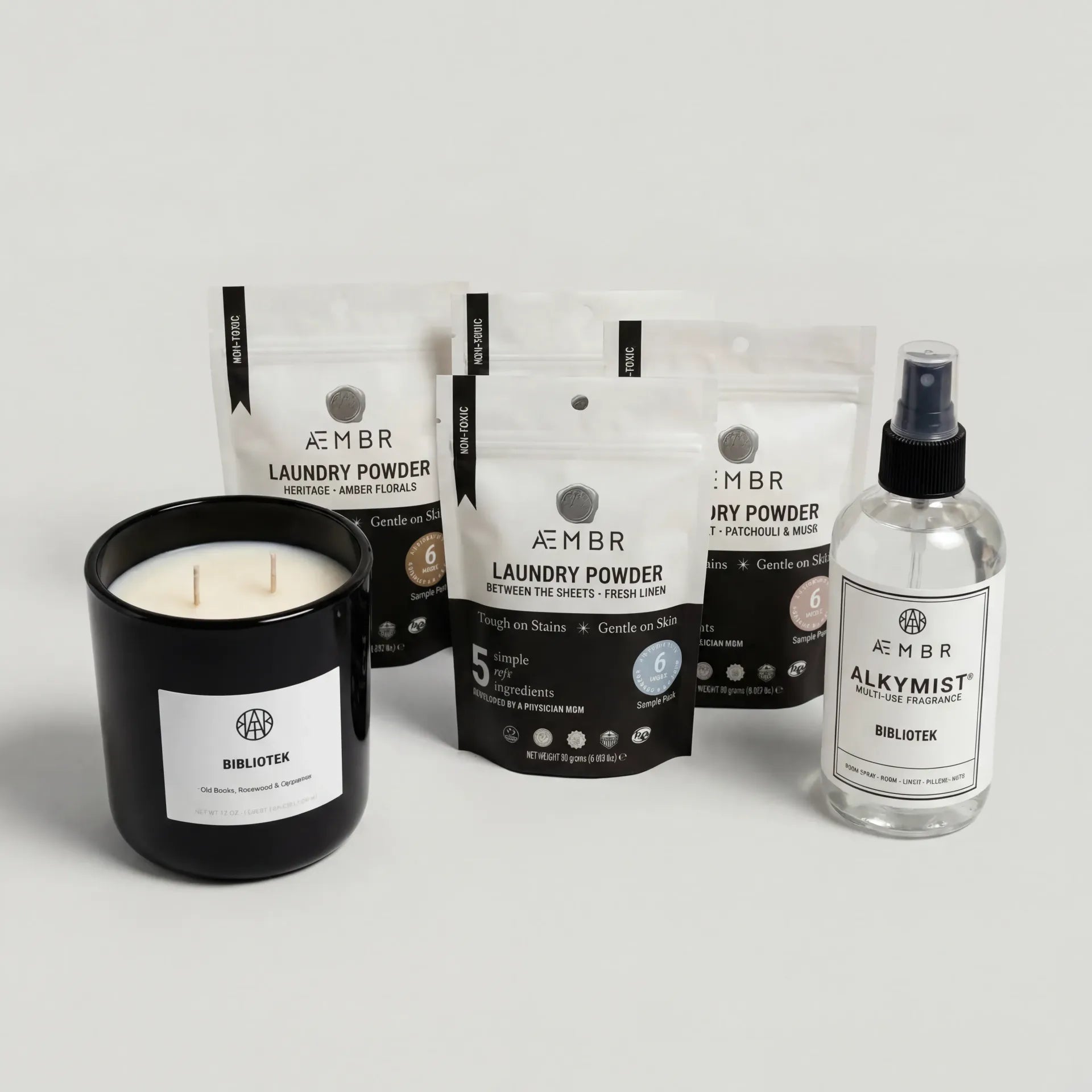
If you're starting a non-toxic laundry routine, the Non-Toxic Laundry Routine Kit includes everything you need, or you can try the scent before committing with a Laundry Powder Scent Sampler Pack.
What's Actually in ALKYMIST Room Spray
ALKYMIST is our multi-use fragrance spray — designed for fabric, air, and surfaces. The formulation is deliberately minimal:
- Denatured ethanol (SD alcohol 40-B) — food-grade denaturant system. Alcohol is the carrier and the primary active; it evaporates cleanly and carries the fragrance molecules into the air.
- Phthalate-free fragrance oil — same standard as our candles and laundry powder. IFRA-compliant.
- Distilled water — balances the formula and affects viscosity and spray droplet size.
No propellants. No aerosol. No synthetic preservatives. That's the complete list.
ALKYMIST is available in over a dozen scent profiles — from Heritage and Fjord to Amber Oud and Lavender Haze. The Alkymist Luxe Collection features an elevated concentration for larger spaces.
Our Fragrance Standard: What Phthalate-Free Actually Requires
I want to be specific here because "phthalate-free" has become a marketing claim that not all brands back with documentation.
At AEMBR, phthalate-free means:
- Every fragrance oil we purchase is accompanied by a safety data sheet and supplier declaration confirming no phthalate compounds.
- We work exclusively with fragrance suppliers who operate under IFRA (International Fragrance Association) compliance standards.
- Fragrance concentration in finished products is within IFRA-recommended limits for the specific use category (candle, spray, laundry).
IFRA standards do not guarantee every ingredient in a fragrance blend is disclosed — that's a limitation of the industry trade-secret framework that I can't unilaterally change. What I can control is requiring documentation that phthalates specifically are absent, and publishing the fact that our fragrances are phthalate-free as a verifiable claim.
Why We Publish This — The Real Reason
Medical training changes how you read labels. When I was in residency, I learned to interrogate the evidence behind every treatment I recommended. Is this the right drug? What are the risks? What does the patient actually need to know? That habit of evidence-appraisal doesn't switch off when you're standing in a grocery aisle or shopping for candles for your home.
When I started building AEMBR, I was also a new mother, making decisions about what products came into contact with my family. That combination — medical lens plus personal stakes — made ingredient transparency non-negotiable. Not aspirational. Non-negotiable.
Publishing every ingredient is a commitment to the people using these products. You shouldn't have to decode a label or look up a CAS number to know whether something is safe. We do that work for you, and we put the answer where you can find it.
A Note on Third-Party Certification
We are asked frequently whether AEMBR products carry Leaping Bunny or EWG Verified certification. As of mid-2026, we are pursuing these certifications as the brand scales. Our standards already meet or exceed the requirements; the certification process involves a third-party audit cadence that takes time to complete properly.
I'd rather take the time to do it right than put a badge on the site that I can't fully stand behind. That's the physician in me, and it's also just the right thing to do.
Ingredient Transparency as Brand Promise
Everything AEMBR builds — from the laundry powder to the wax melts to the room sprays — starts from the same foundation: what goes into this product, why, and is it something I'd use in my own home?
That question has a different weight when you have a medical degree. It has a different weight when you're a mother. It has a different weight when you've spent time reading the toxicology literature. All three are true for me, which is why ingredient transparency isn't a feature of AEMBR — it's the reason AEMBR exists.
If you've read this far, you already understand what we're building. Explore the full range of AEMBR products, or start with our AEMBR Discovery Set if you want to experience the scent profiles before committing to a full-size.
AEMBR Ingredient Standards — Quick Reference
| Category | AEMBR Standard | Why It Matters |
|---|---|---|
| Phthalates | Zero — supplier-documented | Endocrine disruption risk; reproductive toxicity in literature |
| IARC Group 1/2A carcinogens | Excluded from all formulations | Known or probable human carcinogens |
| Optical brighteners | Absent from laundry powder | Non-biodegradable; skin sensitizer for eczema-prone users |
| Synthetic dyes | No functional colorants | No benefit to performance; unnecessary sensitization risk |
| Parabens | Not used | Estrogenic activity; safer alternatives exist |
| 1,4-Dioxane | Not used; clean manufacturing required | Likely human carcinogen (EPA); SLES manufacturing byproduct |
| Fragrance disclosure | Phthalate-free + IFRA-compliant | "Fragrance" loophole protection for customers |
| Wax base (candles) | Coconut-apricot blend | Cleaner burn than paraffin; less soot and combustion byproducts |
Further Reading
- Physician-Formulated: What It Actually Means (and Why It Should Matter to You)
- Why I Left Medicine to Build a Clean Home Products Brand
- The Complete Guide to Building a Non-Toxic Home: Where to Start
- What "Non-Toxic" Actually Means (and the Marketing Claims That Mean Nothing)
- What's Actually in Fragrance Oils? A Physician's Ingredient Guide


