


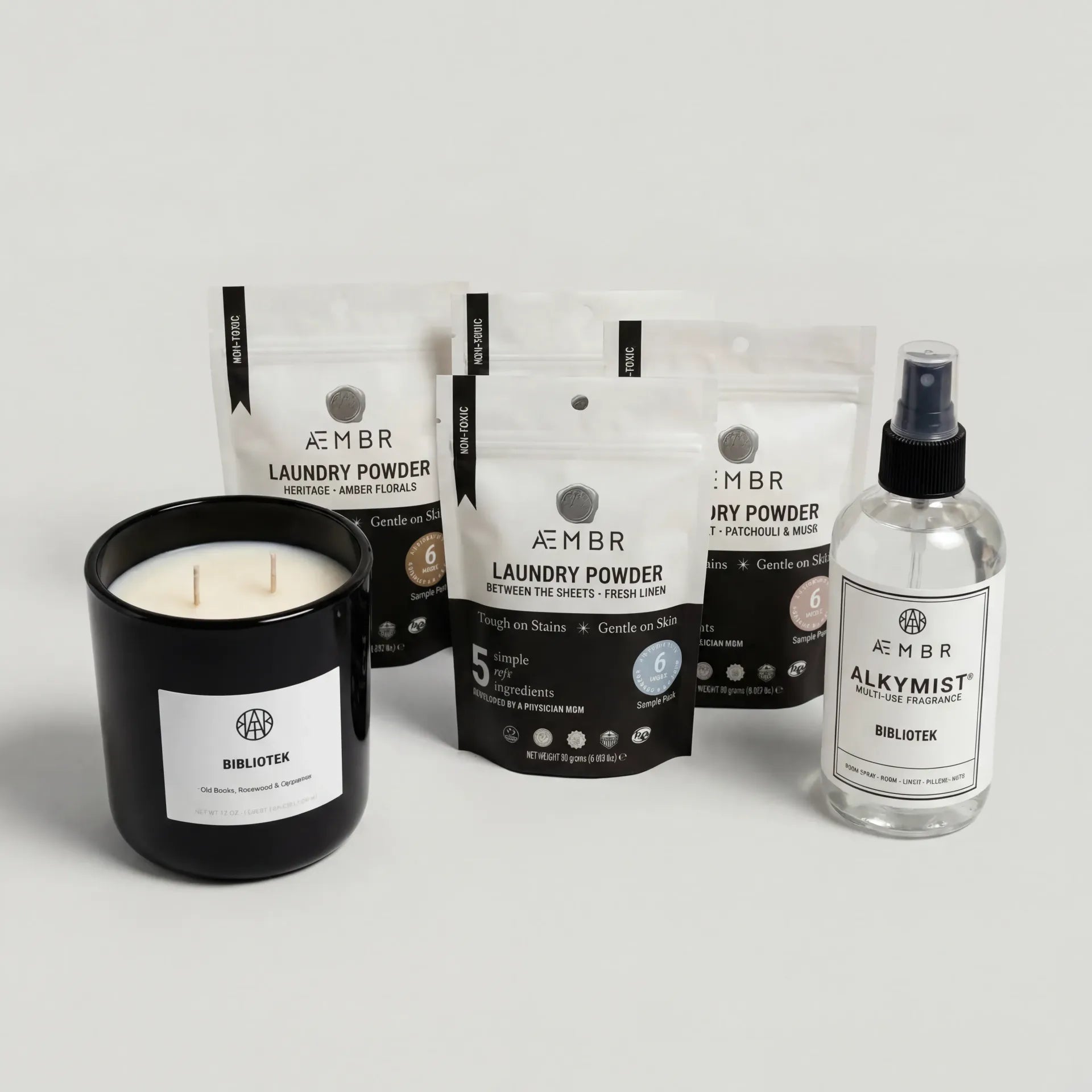

The next time you pick up a candle — at a boutique, a farmers market, or online — turn it over. If the label tells you almost nothing about what's actually inside it, that's deliberate. The candle industry has no requirement to disclose fragrance ingredients, wax sources, or wick materials at the product label level. Most brands rely on marketing language like "clean," "natural," and "non-toxic" without any regulatory definition or third-party verification backing those claims. Knowing how to read a candle label — and what to ask when the label goes silent — is the fastest way to protect your indoor air quality, your health, and your money.

As a physician and the founder of AEMBR, I've formulated our candles from the ground up. I chose every ingredient deliberately, and I can tell you exactly what's in them. But that experience also gave me a framework for evaluating any candle — and a clear-eyed view of what most brands don't disclose. This post is that framework.
Why Candle Labels Are So Uninformative
Candles are regulated as consumer products, not cosmetics or food. The Consumer Product Safety Commission (CPSC) oversees general safety, but there is no FDA-style ingredient disclosure requirement for candles. The Fragrance Research Foundation's IFRA standards set limits on certain known sensitizers in fragrance compounds, but compliance is voluntary and fragrance formulas remain proprietary trade secrets.
The result: a brand can label a candle "premium soy" when the wax is a 70/30 soy/paraffin blend. A brand can claim "phthalate-free" fragrance while still using other questionable synthetic compounds. A brand can print "all-natural" on packaging that contains synthetic fragrance oil. None of these are technically illegal. All of them are misleading.
Here's what to actually look for.
Expert guidance on clean ingredients, home fragrance, and living well — from our physician-authored blog.
Wax Type: The First Question on Every Label
Wax is the largest ingredient in any candle by volume, and it determines how cleanly the candle burns and how much fragrance it releases. These are the most common types:
| Wax Type | Source | Burn Characteristics | What to Know |
|---|---|---|---|
| Paraffin | Petroleum byproduct | Good scent throw, lower cost | Releases VOCs and soot at high temperatures; widely studied |
| Soy | Hydrogenated soybean oil | Slower burn, lower scent throw | Often blended with paraffin; "soy" on label may mean as little as 1% soy |
| Coconut wax | Cold-pressed coconut oil | Very clean burn, excellent scent throw | Premium; sustainably sourced; burns at lower temperature |
| Beeswax | Honeycomb secretion | Long burn, light honey scent | Not vegan; naturally purifying properties; high cost |
| Coconut-apricot blend | Coconut + apricot kernel oils | Exceptionally smooth burn, strong scent throw | Premium proprietary blends; used by AEMBR for clean performance |
What to look for: Brands that care about transparency will name the wax specifically — "100% coconut wax," "coconut-apricot blend," "pure beeswax." Vague descriptors like "natural wax blend" or "premium wax" are red flags. When the wax isn't named, assume paraffin or a paraffin blend until proven otherwise.
At AEMBR, we use a coconut-apricot wax blend across our entire candle line. We chose it because it burns cooler than paraffin, throws fragrance more evenly, and produces significantly less soot. We say that on every product page — not hidden in an FAQ.
Fragrance Load Percentage: The Number Brands Rarely Disclose
Fragrance load is the percentage of fragrance oil by weight in the wax. A candle at 6% fragrance load will perform very differently from one at 12%. Higher fragrance load generally means stronger scent throw — but only if the fragrance is formulated to work at that load in that wax type.
Most consumer candle brands don't list fragrance load. Artisan and transparent brands typically do. Here's a general reference:
- 6–8%: Light scent, appropriate for small rooms or subtle ambiance
- 10–12%: Strong scent throw — the standard for quality lifestyle candles
- Above 14%: Very intense; can cause fragrance pooling or wick performance issues in some wax types
When a brand claims "exceptional scent throw" without disclosing their fragrance load, take it with skepticism. Formulation matters as much as the number.
Phthalate-Free Claims: What They Mean and What They Don't
Phthalates are a class of plasticizing chemicals historically used in synthetic fragrance to improve adherence and extend scent longevity. Several phthalates — including diethyl phthalate (DEP) and dibutyl phthalate (DBP) — have been linked to endocrine disruption in animal studies. The EU has restricted multiple phthalates in cosmetics; the U.S. FDA does not currently require phthalate disclosure in candles.
The "phthalate-free" claim has become common in the clean candle space, and it's meaningful — but it's not the only ingredient concern in fragrance formulas. A candle can be phthalate-free and still contain:
- Synthetic musks with bioaccumulation concerns
- Known contact allergens like cinnamal or isoeugenol (at compliant IFRA levels, but still present)
- Undisclosed proprietary fragrance compounds the brand simply hasn't disclosed
The honest ask: Does the brand use a fragrance house that provides a full safety data sheet? Do they adhere to IFRA standards? Do they test their finished fragrance for restricted compounds? A brand that can answer these questions in writing has done the work. A brand that says "our fragrances are safe" without elaboration probably hasn't.
AEMBR candles use phthalate-free fragrance from a vetted fragrance house. Our formulas are designed with IFRA compliance standards as a floor, not a ceiling.
The Wick: Cotton, Wood, or Zinc-Core?
Wicks are often overlooked on labels, but they matter for both performance and safety. Here's a quick breakdown:
| Wick Type | Material | Performance | Safety Notes |
|---|---|---|---|
| Cotton (braided) | Pure cotton fiber | Consistent burn, self-trimming in quality candles | Clean-burning; standard in quality candles |
| Wood (crackling) | FSC-certified wood | Distinctive crackle sound, wide flame | Burns cleanly when properly treated; requires specific wax pairing |
| Zinc-core (legacy) | Cotton + zinc wire core | Rigid, stays upright | Releases trace zinc particles; largely phased out by responsible brands |
| Lead-core (banned) | Cotton + lead wire | N/A | Banned in the U.S. since 2003; avoid any vintage or unregulated imports |
What to look for: "Cotton wick" or "FSC-certified wood wick" are both clean choices. No disclosure of wick type is a yellow flag — particularly for mass-market candles made outside the U.S. Lead-core wicks have been illegal in the U.S. since 2003, but some imported candles still contain them; look for CPSC compliance statements on imported products.
Every AEMBR candle uses a cotton wick, chosen specifically for its compatibility with our coconut-apricot blend and its clean burn profile.
"Hand-Poured" vs. Machine-Made: Does It Matter?
Hand-poured candles are poured by a person — typically in small batches — rather than being filled by automated industrial equipment. This matters in two ways:
- Quality control: Small-batch pouring allows for more consistent attention to fill temperature, fragrance integration, and wick centering. Industrial lines optimize for throughput.
- Batch size and freshness: Hand-poured candles are typically made in smaller batches, meaning shorter warehouse time before they reach you. Fresh wax holds fragrance better than wax that's been sitting in climate-controlled storage for months.
That said, "hand-poured" is a marketing term, not a regulated certification. A brand can hand-pour 50,000 candles a week with a large production team, or 200 candles a week in a home studio. The meaningful questions are: what is the batch size, and what quality control does the brand have in place?
AEMBR candles are hand-poured in Houston, Texas in batches designed for freshness and consistency. We care about this not as a marketing claim but because it directly affects the quality of what arrives at your door.
Certifications and What They Actually Mean
The candle space has a handful of meaningful third-party certifications — and several meaningless ones. Here's the hierarchy:
- Leaping Bunny: Cruelty-free, including all suppliers. Third-party audited. Meaningful.
- USDA Certified Biobased: Percentage of biological content verified. Applies to specific ingredients, not full formulation safety.
- MADE SAFE: Full ingredient review against a known hazard database. High bar; rare in candle space.
- "Clean" / "Natural" / "Non-Toxic" without certification: Unregulated marketing language. Means nothing without documentation.
- IFRA Compliance: Not a certification — a voluntary industry standard for fragrance safety. Important, but not third-party audited at the brand level.
A candle brand that says "our ingredients are rigorously tested" without naming who is doing the testing is telling you nothing. Ask for specifics: what testing, by whom, against what standard?
What "Clean Burning" Actually Means
You'll see "clean burning" applied to everything from beeswax candles to poorly formulated soy blends. There's no legal definition. What it should mean — and what to look for — is:
- Low-soot output (coconut and beeswax generally outperform paraffin here)
- Fragrance load within range for the wax type (over-fragrancing causes incomplete combustion)
- Proper wick sizing (a wick that's too large creates a large, sooty flame)
- No synthetic dyes that contribute combustion byproducts
A candle that tunnels (burns straight down without creating a full wax pool) is also a sign of poor formulation — usually a mismatched wick-to-vessel ratio. It doesn't mean it's unsafe, but it does mean the brand cut corners in the development phase.
The Formulator Checklist: 8 Questions Before You Buy
- What type of wax? Named specifically — not "natural wax blend."
- Is the fragrance phthalate-free? Look for explicit statement, not implication.
- What type of wick? Cotton or FSC wood, not zinc-core.
- What is the vessel material? Glass or ceramic preferred; avoid low-grade metal with unclear alloy composition.
- Is it hand-poured, and in what batch size? "Hand-poured" + "small batch" together means something. Each alone is less meaningful.
- Does the brand disclose their fragrance house or fragrance standards? If not, ask directly — their response tells you a lot.
- What third-party certifications, if any? Leaping Bunny, MADE SAFE, USDA Biobased — name the specific standard.
- Does the brand have a real safety data sheet or IFRA compliance statement on file? Request it if you have serious sensitivities.
How AEMBR's Candles Answer These Questions
I'm going to walk through our own answers — not because I'm trying to close a sale, but because I think showing what full transparency looks like makes the standard concrete.
- Wax: Coconut-apricot blend. Both components named. No paraffin.
- Fragrance: Phthalate-free fragrance oils from a vetted supplier. IFRA standards applied.
- Wick: Cotton. No zinc core.
- Vessel: Heavy glass with wide mouth for even wax pool formation.
- Production: Hand-poured in Houston, TX in small batches.
- Dyes: We don't use synthetic dyes in our candle wax. The ivory color is natural to the wax blend.
You can smell the difference a clean formula makes. You can also see it — a AEMBR Fjord or Amber Oud candle burns with a clean, even wax pool and minimal blackening on the inside of the vessel. That's not luck — it's the result of matching the fragrance load, wax type, and wick diameter correctly during development.
A Note on Burn Time Claims
Burn time claims — "200 hours," "60+ hours" — are based on ideal burning conditions: trimmed wick, no drafts, burning for the recommended 2–4 hour session maximum. In real conditions, burn time will vary. What matters more than the stated number is whether the wax pool reaches edge-to-edge within the first burn (which protects against tunneling) and whether the fragrance remains consistent through the life of the candle, not just the first few burns.
A well-formulated candle at 60 hours is worth more than a poorly formulated candle rated at 100 hours. Look for reviews that mention consistent fragrance through the last third of the candle — that's the real test of formulation quality.
The Label Is a Starting Point, Not the Full Story
Reading a candle label well takes practice, but the core skill is knowing what's not there as much as what is. Brands that lead with aesthetics and marketing language and bury (or omit) formulation details are making a choice. That choice tells you something about their values — and it should inform yours.
If you want to go deeper on what's actually in your home fragrance products, these posts might be useful:
- How to Scent Your Home Without Toxins: A Physician's Guide
- Are Wax Melts Safe? What You're Breathing When You Use Them
And if you're ready to try a candle line built on the kind of transparency described above, our AEMBR candle collection is the place to start. Every formula decision I made is one I can defend in writing — because I'm a physician, and that's the only way I know how to work.


