




By Kristina Braly, MD — Founder, AEMBR
If you've ever stood in the cleaning aisle wondering whether that giant bottle of liquid castile soap can replace your dish soap, you're not alone. I get this question constantly — from patients, from customers, from people who've made the switch to cleaner products and are trying to rationalize their cabinet. My answer is always the same: it depends on what you're actually asking them to do. Castile soap and dish soap are both surfactant-based cleaners, but they're formulated for fundamentally different jobs. Confusing the two leads to either soap residue on your plates or a foamy mess in your dishwasher. Here's what you need to know.

What Is Castile Soap?
Castile soap is a plant-oil-based soap made through saponification — the chemical reaction between an oil (traditionally olive oil, hence the "Castile" name from the Castile region of Spain) and an alkali like sodium hydroxide (lye) or potassium hydroxide. The result is a true soap: a salt formed from fatty acids.
Modern liquid castile soaps, popularized by brands like Dr. Bronner's, use a blend of oils — coconut, hemp, jojoba, and others — to achieve different lather profiles and skin-feel characteristics. The key is that castile soap is always a true soap, not a synthetic detergent.
Key castile soap properties:
- pH: typically 9–11 (alkaline)
- Surfactant type: soap salts (fatty acid salts), not synthetic surfactants
- Biodegradable quickly
- Works best in soft water; reacts with hard water minerals to form soap scum
- Multi-use: body wash, hand wash, general surface cleaning, produce wash (when diluted)
- No phosphates, synthetic fragrances, or petroleum-derived surfactants in quality formulations
What Is Dish Soap?
Dish soap — the kind you use at the sink — is a formulated synthetic detergent, not a true soap. It's built around anionic surfactants like sodium laureth sulfate (SLES) or sodium lauryl sulfate (SLS), often combined with amphoteric surfactants like cocamidopropyl betaine for mildness and foam stability.
Expert guidance on clean ingredients, home fragrance, and living well — from our physician-authored blog.
The formulation goal for dish soap is specific: cut through cooking grease, oil, and food residue on non-porous surfaces (plates, pots, glasses) without leaving residue, in water of any hardness, in a reasonable amount of time. That requires a different chemistry than general-purpose cleaning.
Key dish soap properties:
- pH: typically 7–9 (near-neutral to mildly alkaline)
- Surfactant type: synthetic anionic and amphoteric surfactants
- Higher grease-cutting power per drop than castile soap
- Effective in hard water without scum formation
- Formulated for rinseability — residue is a key design criterion
- Often contains added fragrance, dyes, and preservatives
The Core Difference: Saponification vs. Synthesis
The real divide between castile soap and dish soap is how the surfactant is made.
| Property | Castile Soap | Dish Soap |
|---|---|---|
| Surfactant origin | Plant oil + alkali (saponification) | Petroleum or plant-derived synthesis |
| pH range | 9–11 (alkaline) | 7–9 (near-neutral) |
| Hard water performance | Poor — forms soap scum with calcium/magnesium | Good — chelators added to handle mineral ions |
| Grease cutting | Moderate (needs dilution management) | High (optimized for food grease removal) |
| Rinseability | Can leave film if undiluted or in hard water | Designed to rinse cleanly |
| Fragrance | Essential oils (quality brands) or none | Typically synthetic fragrance or fragrance-free |
| Biodegradability | Very high — breaks down rapidly | Varies by formulation; SLS/SLES are biodegradable |
| Best use | Body, hands, general household surfaces, produce | Dishes, pots, pans, greasy surfaces at the sink |
Why Castile Soap Struggles with Dishes
This is the one I see most often go wrong. People use undiluted castile soap for dishes, then wonder why there's a white film on their glasses. Here's what's happening:
Most U.S. households have moderately hard water — water with elevated calcium and magnesium ions. True soaps (like castile) react with these ions to form calcium and magnesium stearate — insoluble compounds that deposit as a white film on surfaces. This is soap scum. It's not harmful, but it's not clean either.
Synthetic detergents avoid this by including chelating agents (like citric acid or EDTA) that bind the mineral ions before they can react with the surfactant. The result is cleaner rinse performance in hard water.
If you want to use castile soap for dishes in hard water, you have a few options:
- Add a small amount of white vinegar to the rinse water (the acid breaks down the soap scum — but note that you should never mix vinegar directly into castile soap, as the acid will unsaponify the soap and break it down)
- Use filtered or softened water for the final rinse
- Accept a slightly lower standard for squeaky-clean glass surfaces
pH Matters More Than You Think
Castile soap's high alkalinity (pH 9–11) makes it effective against certain bacteria and great for cutting through dirt and body oils. But that same alkalinity is why you should never use undiluted castile soap on:
- Natural stone surfaces (marble, granite) — the alkalinity can etch the sealant over time
- Hardwood floors — dulls the finish with repeated use
- Silk or wool — alkaline pH damages protein fibers
- Waxed surfaces — strips the wax layer
Dish soap, formulated closer to neutral pH, is generally safer for these surfaces in diluted form — though nothing beats a pH-specific cleaner for sensitive materials.
When to Use Castile Soap (and How to Dilute It)
Castile soap is genuinely versatile — but only when used at the right dilution. Dr. Bronner's recommends the following ratios; these are a solid baseline:
- Hand soap: 1 part castile soap to 3 parts water (pump dispenser)
- Body wash: 1 part castile soap to 2 parts water
- All-purpose cleaner: 1–2 teaspoons per quart of water
- Floor cleaner: ½ cup per 3 gallons of water
- Produce wash: A drop in a bowl of water; rinse thoroughly
- Laundry (hand wash): A few drops in a sink of water — note that castile soap is not appropriate for machine washing without reformulation due to sudsing and potential residue
The biggest mistake people make is using castile soap undiluted in a spray bottle for surfaces. At full concentration, it's far too concentrated for most surfaces and will leave residue.
When to Use Dish Soap
Dish soap is the right tool for any job involving heavy grease, food oils, or food residue on non-porous surfaces:
- Washing dishes, glasses, and silverware by hand
- Degreasing cast iron pans (small amount, immediate rinse — not for long soaking)
- Cleaning greasy stovetops or range hoods
- Removing oil-based stains as a pre-treatment on fabric (a tiny amount, worked in before laundering)
- Any application where rinseability in hard water is non-negotiable
What dish soap is not good for: using as a body wash (too stripping for skin), as a hand wash in any quantity beyond incidental contact, or as a general all-purpose spray cleaner (it'll leave a sticky residue that attracts dust).
Can You Use Castile Soap as Dish Soap?
The honest formulator answer: in soft water, with proper dilution, castile soap can do a passable job on lightly soiled dishes. In hard water, expect soap scum on your glasses and potentially a film on your plates.
For a household in Houston (notoriously hard water — around 200–250 ppm hardness), I wouldn't recommend castile soap as a dish soap replacement without either a water softener or a finishing rinse strategy. I've tried it. The film is real.
Where castile soap earns its place in my kitchen: as a gentle hand wash at the kitchen sink, as a produce rinse, and as a component in a diluted countertop spray for light duty cleaning (non-stone surfaces only).
The Clean Ingredient Angle: What to Look for in Both
Not all dish soaps are equal from an ingredient-transparency standpoint. If you're switching to cleaner products, here's what to look for and what to avoid:
| Ingredient | Type | Concern Level | Notes |
|---|---|---|---|
| SLS (sodium lauryl sulfate) | Anionic surfactant | Low–Moderate | Effective but more irritating; EWG score 1–2 |
| SLES (sodium laureth sulfate) | Anionic surfactant | Low–Moderate | May contain trace 1,4-dioxane from ethoxylation process |
| Cocamidopropyl betaine | Amphoteric surfactant | Low | Coconut-derived, mild; potential sensitizer in high concentrations |
| Methylisothiazolinone (MIT) | Preservative | High | Known allergen; avoid in rinse-off products per EU limits |
| "Fragrance" / "Parfum" | Undisclosed mixture | Varies | May contain phthalates, musks, allergens — look for phthalate-free disclosure |
| Phosphates | Water softener/chelator | Environmental | Banned or restricted in many states due to algae bloom risk |
| Triclosan | Antibacterial agent | High | FDA-banned in hand soap; check dish soap formulations sold pre-2020 |
For castile soaps, the primary concern is fragrance — some brands add synthetic fragrance even to products marketed as "natural." Look for castile soaps where the fragrance comes from certified organic essential oils and the full ingredient list is disclosed on the label.
Where AEMBR's Cleaning Products Fit In
The AEMBR Multi Surface Spray is built for daily surface cleaning — think countertops, glass, tile, and sealed surfaces — using a pH-balanced, phthalate-free formulation. It's not a dish soap and it's not a castile soap: it's a purpose-formulated surface cleaner that doesn't require dilution or a hard-water workaround.
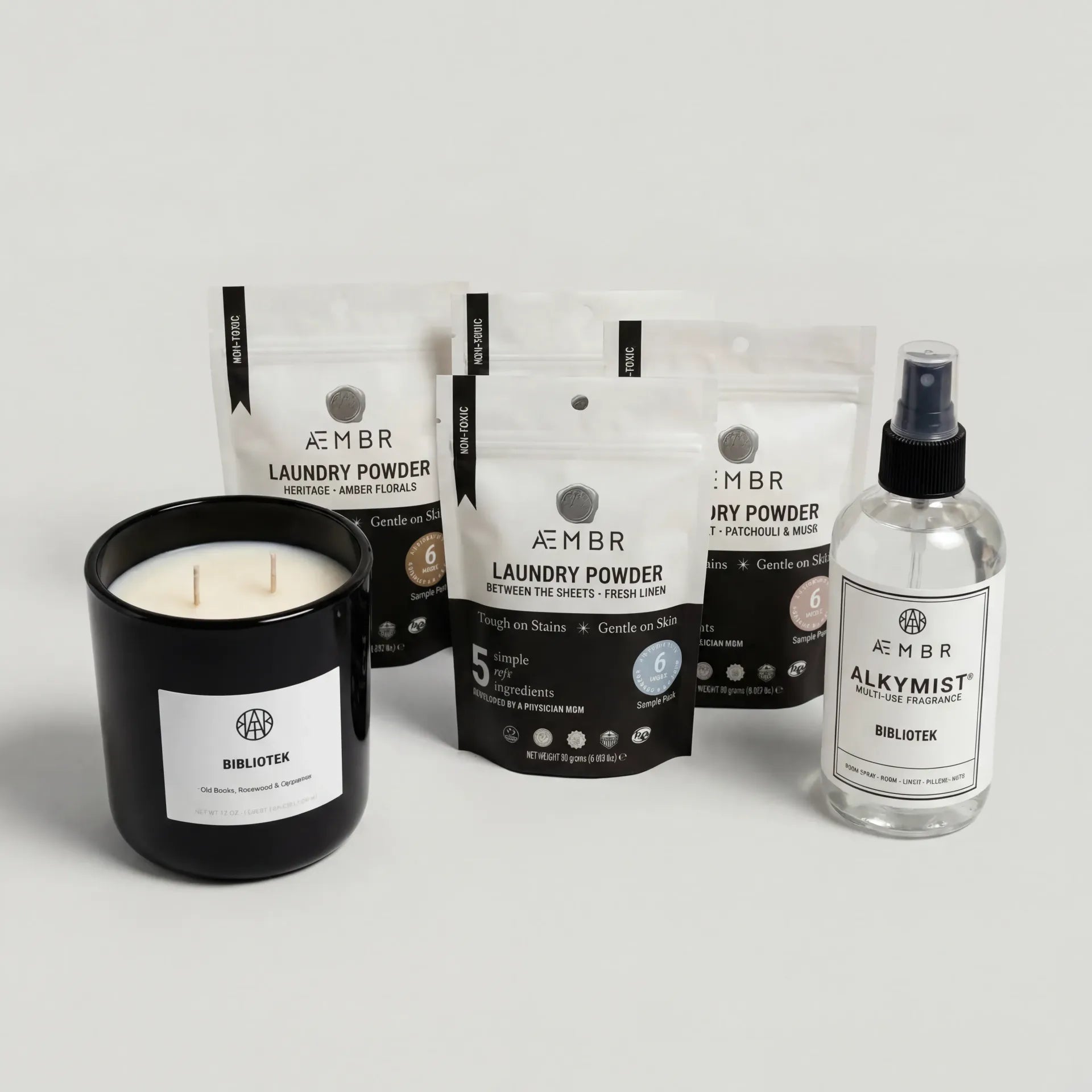
For laundry, the AEMBR Laundry Powder uses plant-derived surfactants in a different class entirely — engineered for fabric, not dishes. The surfactant chemistry that works beautifully in a washing machine is not what you want on your plates, and vice versa.
Browse the full Non-Toxic Cleaning Products collection if you're building out a cleaner household from scratch. The goal is always the same: purpose-formulated, ingredient-transparent, physician-reviewed.
Quick Reference: Which Soap for Which Job
✓ Use castile soap for:
- Hand washing (diluted 1:3)
- Body washing (diluted 1:2)
- Light surface cleaning in soft water (diluted spray)
- Produce washing (drop in water)
- Mopping (diluted)
✓ Use dish soap for:
- Washing greasy dishes, pots, and pans by hand
- Degreasing cooking surfaces
- Oil-stain pre-treatment on fabric
- Any dish-washing task in hard water
✗ Don't mix:
- Castile soap + vinegar (acid destroys the soap)
- Castile soap + lemon juice (same reason)
- Any soap + bleach (produces chloramine gas at concentration)
The Bottom Line
Castile soap and dish soap are not interchangeable — they're purpose-built for different jobs. Castile soap is a natural, oil-derived true soap that excels as a body cleanser and gentle general-purpose cleaner when properly diluted, especially in soft water. Dish soap is a synthetic detergent engineered specifically for food grease removal and clean rinseability in any water hardness.
You can build a coherent cleaning cabinet with both. What you shouldn't do is assume that "natural" automatically means "better for every application" — or that one product can do everything. Chemistry doesn't work that way. The goal is matching the right tool to the right job, and knowing exactly what's in each one.
That's the physician-formulator take. Both can be clean. Both can be effective. Know the difference.
Kristina Braly, MD is the founder of AEMBR, a physician-founded luxury clean home fragrance and household products brand based in Houston, Texas. She formulates AEMBR's cleaning products with the same rigor she applied to patient care: evidence-first, ingredient-transparent, and designed for real households.


