



By Kristina Braly, MD — Founder, AEMBR
"Clean fragrance" has become one of the most overused phrases in the wellness industry. Walk into any boutique retailer or scroll through any clean beauty roundup and you'll find the term applied to brands that still use undisclosed synthetic fragrance blends, rely on vague "natural" marketing, or provide zero meaningful ingredient transparency. As a physician who formulates fragrance products professionally, I find this frustrating — not because I'm defending one side of the synthetic-versus-natural debate, but because most "clean fragrance" claims are meaningless without a disclosure framework to back them up.

The best clean fragrance brands of 2026 aren't necessarily the ones using only essential oils or the ones avoiding all synthetic molecules. They're the ones telling you exactly what's in their products, how those ingredients were assessed for safety, and what they chose to exclude — and why. That's the standard I apply when evaluating other brands in this space.
Here's my formulator's breakdown of five brands actually worth buying — and three I'd skip.
How I Evaluate a "Clean Fragrance" Brand
Before I get to the list, it's worth explaining what I actually look for, because the framework matters more than the brand name. When I review a fragrance brand — including competitors — I apply the same questions I ask of my own formulations at AEMBR:
- Phthalate-free, stated explicitly? Not implied, not buried — explicitly disclosed. Phthalates (diethyl phthalate, dibutyl phthalate, and others) are used as fragrance fixatives and have documented endocrine-disrupting potential. Many brands claiming to be "clean" still use them because they aren't required to list fragrance components.
- Is the fragrance compound disclosed at any level? Full ingredient lists are rare due to trade secret protections, but a reputable brand should disclose whether the fragrance is IFRA-compliant, whether it's free of specific concerning materials (musks, nitro compounds, phthalates, formaldehyde releasers), and ideally what the key components are.
- Synthetic vs. natural — is the position honest? "Natural" fragrance is not inherently safer. Naturally derived materials like oakmoss and citral can be potent allergens. What I want to see is a brand that's honest about what they're using and why — not one that hides behind the word "natural."
- Third-party verification? EWG Verified, MADE SAFE, or a published IFRA conformity statement gives me something concrete to evaluate. Marketing language does not.
- Who's making the safety decisions? Is there a named formulator, toxicologist, or medical advisor? Or is this a marketing-first brand with contract-manufactured fragrance and no scientific accountability?
For more on what's actually inside most fragrance products — including what "fragrance" on a label legally allows brands to hide — read my earlier guide: What's Actually in Fragrance Oils? A Physician's Ingredient Guide.
Expert guidance on clean ingredients, home fragrance, and living well — from our physician-authored blog.
The 5 Clean Fragrance Brands Worth Buying
1. AEMBR — ALKYMIST® Room Spray
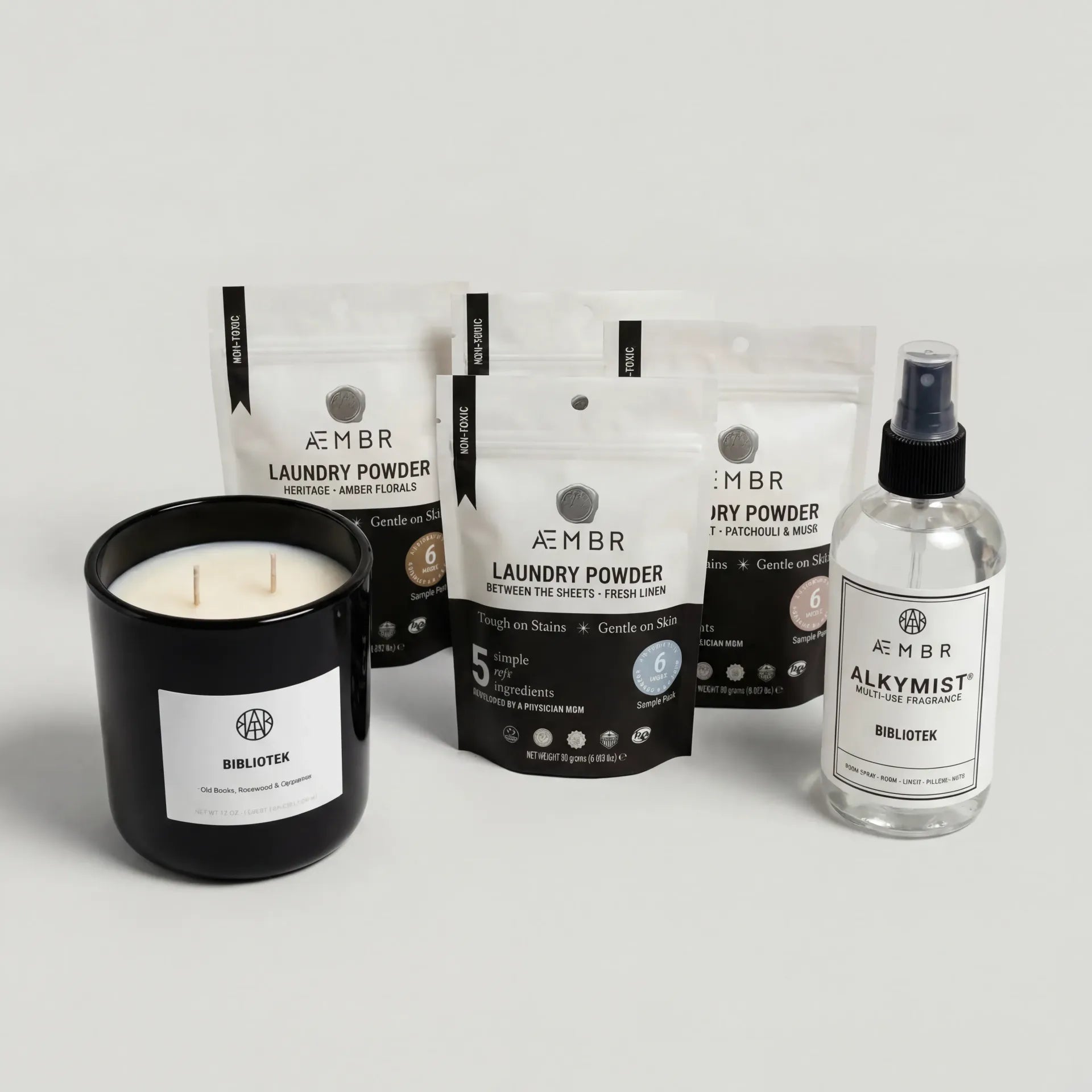
I'll start here because I built this brand, and you should know what you're getting — not because of marketing language, but because I can tell you exactly what I decided and why. ALKYMIST® is a phthalate-free multi-use fragrance mist formulated to deliver a true fine-fragrance character in a room spray format. The fragrance compounds I use are sourced from IFRA-member suppliers, the material safety data is reviewed for reproductive and respiratory toxicants before any ingredient is accepted, and the full formula is documented with that rationale.
What I deliberately excluded: phthalates (for endocrine concerns), nitro musks (persistent organic pollutants, aquatic toxicity), and undisclosed fragrance boosters that some brands use to inflate longevity at the cost of transparency. The scent architecture is built around each fragrance character — not around what's cheapest to stabilize.
2. Phlur
Phlur is one of the more credible players in the clean fine-fragrance space. They publish their "No" list prominently — phthalates, parabens, formaldehyde releasers, and a number of commonly questioned synthetic ingredients — and their IFRA compliance statement is accessible. Their fragrance compounds are still blended (you won't get a full component list), but the disclosure framework is materially better than most DTC fragrance brands. The aesthetic is also thoughtful and the performance is genuine. Worth the price for what they deliver.
3. Skylar
Skylar markets specifically to fragrance-sensitive consumers, which creates accountability. Their formulas are hypoallergenic-tested, phthalate-free, and they publish an ingredient list for each product (not just a category list — actual product-level transparency). That's rare. The fragrances themselves run lighter than a traditional eau de parfum, which is a deliberate choice for their audience and worth knowing going in. If you have true fragrance sensitivity, Skylar is a credible starting point. If you want rich, complex fragrance with genuine longevity, it may underwhelm.
4. Maison Louis Marie
Maison Louis Marie succeeds by being honest about what they are: beautiful, botanically-inspired fragrance that doesn't overclaim. Their ingredient disclosures are thorough, they use a mix of natural and synthetic components with transparency about that choice, and the IFRA conformity documentation is available. The fragrance architecture is sophisticated — No. 04 Bois de Balincourt in particular is a legitimate benchmark for what a transparent fragrance brand can produce. The pricing reflects real material costs, not just packaging.
5. Clean Beauty Collective
Clean Beauty Collective (CLEAN Reserve line in particular) was an early mover in fragrance transparency and still holds up. They publish their restricted ingredients list, operate under an internal "The Clean Standard" that prohibits phthalates and a list of specific suspect materials, and have third-party testing documentation available on request. The Reserve line uses sustainably sourced materials with supply chain documentation — that's more than most. Performance is strong for a transparent brand; longevity is genuine.
The 3 I'd Avoid — and Why
1. Brands Claiming "Natural Fragrance" Without IFRA Conformity
There is an entire category of boutique and DTC fragrance brands selling products labeled "natural fragrance" or "botanical fragrance" with no IFRA conformity statement, no allergen disclosure, and no published restricted ingredients list. "Natural" fragrance can legally contain naturals-derived isolates, carrier compounds, and processing aids that are as allergenic or more allergenic than many synthetic alternatives. Without a framework, the word means nothing. I'd skip any brand that can't tell you whether their formula is IFRA-compliant.
2. Mass-Market "Clean" Launches from Fragrance Conglomerates
Several of the major fragrance houses have launched "clean" sub-lines in response to consumer demand. The problem: these sub-brands are typically formulated from the same supplier libraries as their conventional counterparts, with a restricted ingredient list that is narrower than what's actually in question. The motivation is market positioning, not formulation philosophy. The resulting products often pass their own "clean" standard — which they define — while still containing materials I'd flag in a clinical context. When a $3B fragrance company launches a "clean" line, read the actual ingredient list, not the press release.
3. Fragrance Brands Without Named Formulators or Scientific Accountability
This applies across price points. If a brand's "about" page has a creative director and a brand story but no formulator, chemist, or scientific advisor named anywhere — and if their ingredient disclosures consist entirely of marketing language rather than actual lists — there's no accountability structure for the safety decisions being made. That doesn't mean the product is dangerous. It means you have no way to evaluate it. I wouldn't accept that standard in a pharmaceutical product, and I don't accept it in products I'm breathing inside my home.
Side-by-Side Comparison: Clean Fragrance Brands 2026
| Brand | Phthalate-Free (Stated) | IFRA Compliant | Ingredient Disclosure Level | Named Formulator / Science Advisor | Synthetic + Natural Mix Honest | Verdict |
|---|---|---|---|---|---|---|
| AEMBR | ✅ Explicit | ✅ Yes | Category + exclusions documented | ✅ Kristina Braly, MD | ✅ Yes | ✅ Buy |
| Phlur | ✅ Explicit | ✅ Yes | No list published, exclusions list robust | Partial (named perfumers) | ✅ Yes | ✅ Buy |
| Skylar | ✅ Explicit | ✅ Yes | Full per-product ingredient list | ✅ Scientific advisory | ✅ Yes | ✅ Buy |
| Maison Louis Marie | ✅ Explicit | ✅ Yes | Strong — per-product level | Named perfumer | ✅ Yes | ✅ Buy |
| Clean Beauty Collective | ✅ Explicit | ✅ Yes | The Clean Standard published | Partial | ✅ Yes | ✅ Buy |
| "Natural fragrance" boutique brands (unnamed) | ❌ Not stated | ❌ Not documented | Marketing language only | ❌ None | ❌ No | ❌ Skip |
| Mass-market "clean" sub-lines | Varies | Varies | Self-defined standard only | Not meaningful | Partial | ⚠️ Scrutinize |
| No-accountability DTC brands | ❌ Unverifiable | ❌ Not documented | None | ❌ None | N/A | ❌ Skip |
What "IFRA Compliant" Actually Means
The International Fragrance Association (IFRA) sets usage limits for fragrance materials based on dermal sensitization data, reproductive toxicity research, and environmental persistence studies. An IFRA conformity statement means a brand's formula has been checked against those limits for the product's usage category — rinse-off vs. leave-on, fine fragrance vs. home scenting, and so on.
IFRA compliance is a floor, not a ceiling. It tells you the formula meets minimum international safety thresholds. A brand can be IFRA-compliant and still use materials I'd prefer not to be around daily. But a brand that can't confirm IFRA compliance for a fragrance product is a brand I don't trust with the rest of their safety documentation either.
When I formulated the ALKYMIST® line, IFRA conformity was a starting requirement, not a finishing line. I then applied additional restrictions beyond IFRA — particularly around materials with reproductive toxicity flags and persistent bioaccumulative materials — because IFRA limits are set for typical exposure, not for the cumulative exposure of someone scenting their home every day.
The Synthetic Fragrance Question
A lot of clean fragrance marketing implies that synthetic = bad, natural = good. As a physician, I want to be direct: that framing is scientifically inaccurate and, in some cases, backwards.
Naturally derived fragrance materials include high-allergen compounds like cinnamal (cinnamon bark), eugenol (clove), citral (lemon/lime peel), and oakmoss — all of which have well-documented sensitization rates in clinical patch testing. Synthetic alternatives to some of these materials are actually lower-allergen because they're isolated molecules without the allergenic co-constituents that appear in the whole botanical extract.
The question isn't natural versus synthetic. It's: which materials are present, at what concentration, and in what use context? A brand that's honest about using carefully selected synthetic components — with IFRA data and toxicology review — is more trustworthy than one that claims "100% natural" without any documentation of what that actually means.
How to Verify a Brand's Claims Before You Buy
- Search "[brand name] + IFRA conformity" — this should return a document or a policy page, not a marketing article
- Look for a named restricted ingredients list — not just "free from synthetics" or "clean formula" but specific materials named
- Check EWG's Skin Deep database for any of the brand's products that have been submitted — the database is imperfect but provides a cross-reference point
- Find the formulator or scientific advisor — a real person with credentials who can be held accountable for the safety decisions
- Ask about phthalates explicitly — a brand that takes this seriously will have an immediate, specific answer, not a vague "we don't use anything harmful"
What to Look for in a Home Fragrance Brand Specifically
Home fragrance (candles, room sprays, wax melts, diffusers) sits in a different risk category than skin-applied fragrance. You're not absorbing the material dermally — you're breathing it. The relevant concerns shift toward respiratory exposure, VOC release at temperature, and cumulative indoor air quality impact rather than skin sensitization.
For home fragrance specifically, I look for:
- Phthalate-free fragrance oil (same principle as personal fragrance, but more important because heat volatilizes phthalates)
- Low-VOC wax base when applicable — coconut and soy wax have lower VOC profiles than paraffin at equivalent temperatures
- Fragrance load within reasonable limits — high fragrance loads in candles or room sprays increase concentration exposure in enclosed spaces
- No acetaldehyde, formaldehyde, or known respiratory irritants in the fragrance compound
Browse AEMBR's candle collection — each formula was built against this same checklist. The fragrance oils are phthalate-free, the wax blend is chosen for both performance and lower VOC characteristics, and the fragrance loads are calibrated for genuine home use rather than maximum throw.
The Bottom Line: How to Choose
The best clean fragrance brands share a few non-negotiable characteristics: explicit phthalate-free status, IFRA conformity, and a named person or institution accountable for safety decisions. Everything beyond that — whether the brand leans toward naturals, how transparent the full ingredient list is, whether they have third-party certification — represents a spectrum of quality. The brands I've listed in the "worth buying" category all clear the baseline. Some clear it more comprehensively than others, and the comparison table above helps sort that out for your specific priorities.
What I'd push back on is the instinct to equate premium pricing or beautiful branding with clean formulation. Some of the most aggressively priced "clean" fragrances in boutique retail have the least defensible transparency standards. The packaging is irrelevant to the chemistry. Read the documentation — or choose a brand where someone who reads the documentation did the work for you.
Quick Checklist: Is This a Trustworthy Clean Fragrance Brand?
- ☐ Phthalate-free — explicitly stated, not implied
- ☐ IFRA conformity documented or available on request
- ☐ Published restricted ingredients list (specific materials, not just categories)
- ☐ Named formulator, perfumer, or scientific advisor
- ☐ Honest about synthetic vs. natural composition
- ☐ For home fragrance: addresses VOCs, fragrance load, and respiratory exposure specifically
- ☐ Third-party verification preferred (EWG, MADE SAFE, or Leaping Bunny at minimum)
- ☐ Can answer direct questions about specific ingredients without deflecting to marketing language


