



By Kristina Braly, MD — Founder, AEMBR
Finding mold on laundry is one of those moments that triggers immediate alarm — and an instinct to grab the bleach. But if you're dealing with colored fabrics, wool, linen, or delicates, chlorine bleach isn't just unnecessary. It can permanently damage what you're trying to save. The good news: you can remove mold from laundry without bleach, and several alternatives are genuinely more effective for the fabrics you care most about.

As a physician and the formulator behind AEMBR's clean laundry line, I've spent time reading the actual science on mold spore elimination — what works on fabric, what's marketing theater, and what you should actually do when you pull a mildewed towel out of a forgotten gym bag. This post gives you the whole picture.
Why Mold Grows on Laundry
Mold and mildew spores are everywhere — they're part of the normal microbiome of your home environment. The problem on laundry isn't the spores themselves. It's the conditions that allow them to colonize fabric: moisture, warmth, and organic material (sweat, body oils, food residue).
The most common scenarios that create mold on laundry:
- Leaving wet laundry sitting in the washing machine drum for more than 30–60 minutes
- Stuffing damp towels or workout clothes into a hamper and not washing them for several days
- Washing clothes at low temperatures with inadequate detergent concentration — spores survive, reattach, multiply
- Residual detergent buildup in the drum creating a biofilm layer that mold colonizes
The visible sign — the gray, green, or black spotting, or the distinctively musty smell — is a sign the mold colony is already established. Removing it requires breaking down the mycelium (fungal threads embedded in the fiber weave) and killing the spores. Bleach does this through oxidation and chlorination. The alternatives I'll cover below work through the same oxidation mechanism — without the fiber damage or the chemical residue.
Expert guidance on clean ingredients, home fragrance, and living well — from our physician-authored blog.
The Case Against Chlorine Bleach on Laundry
I want to be clear: chlorine bleach (sodium hypochlorite) works. It's an EPA-registered antimicrobial agent and it will kill mold spores on fabric. The problem is what it does to the fabric in the process.
Chlorine bleach:
- Degrades elastic fibers and synthetic blends on repeated use
- Causes yellowing on certain whites over time (oxidation of optical brighteners)
- Cannot be used on wool, silk, leather, or most colors without immediate discoloration
- Leaves a chlorine residue that can irritate skin — particularly relevant for anyone with contact dermatitis or eczema
- Requires careful rinsing to remove from fabrics that contact skin
None of this means you should never use bleach on laundry. For white cotton towels and sheets, it has a clear use case. But for everything else — which is most of what you own — there are better options that work through the same oxidative pathway without the downsides.
Option 1: Oxygen Bleach (Sodium Percarbonate)
Oxygen bleach is the most effective mold-removal option for the broadest range of fabrics. When dissolved in water, sodium percarbonate releases hydrogen peroxide and soda ash — both of which attack mold spores through oxidation. Unlike chlorine bleach, the process is color-safe on most fabrics and leaves no chlorinated residues.
How to use it:
- Dissolve oxygen bleach powder in hot water (the hottest your fabric can tolerate — check care label) at the concentration specified on the product
- Submerge the affected garment and soak for 1–6 hours, or overnight for severe cases
- Wash normally in the machine with your regular detergent
- Do not put in dryer until the mold odor is completely gone — heat sets lingering mold smell
- Air dry or dry on high heat once you're satisfied the mold is eliminated
One important note: oxygen bleach activation is temperature-dependent. Cold water significantly reduces its efficacy. This is why the soak step works best with hot water, even if the subsequent machine wash cycle is cooler.
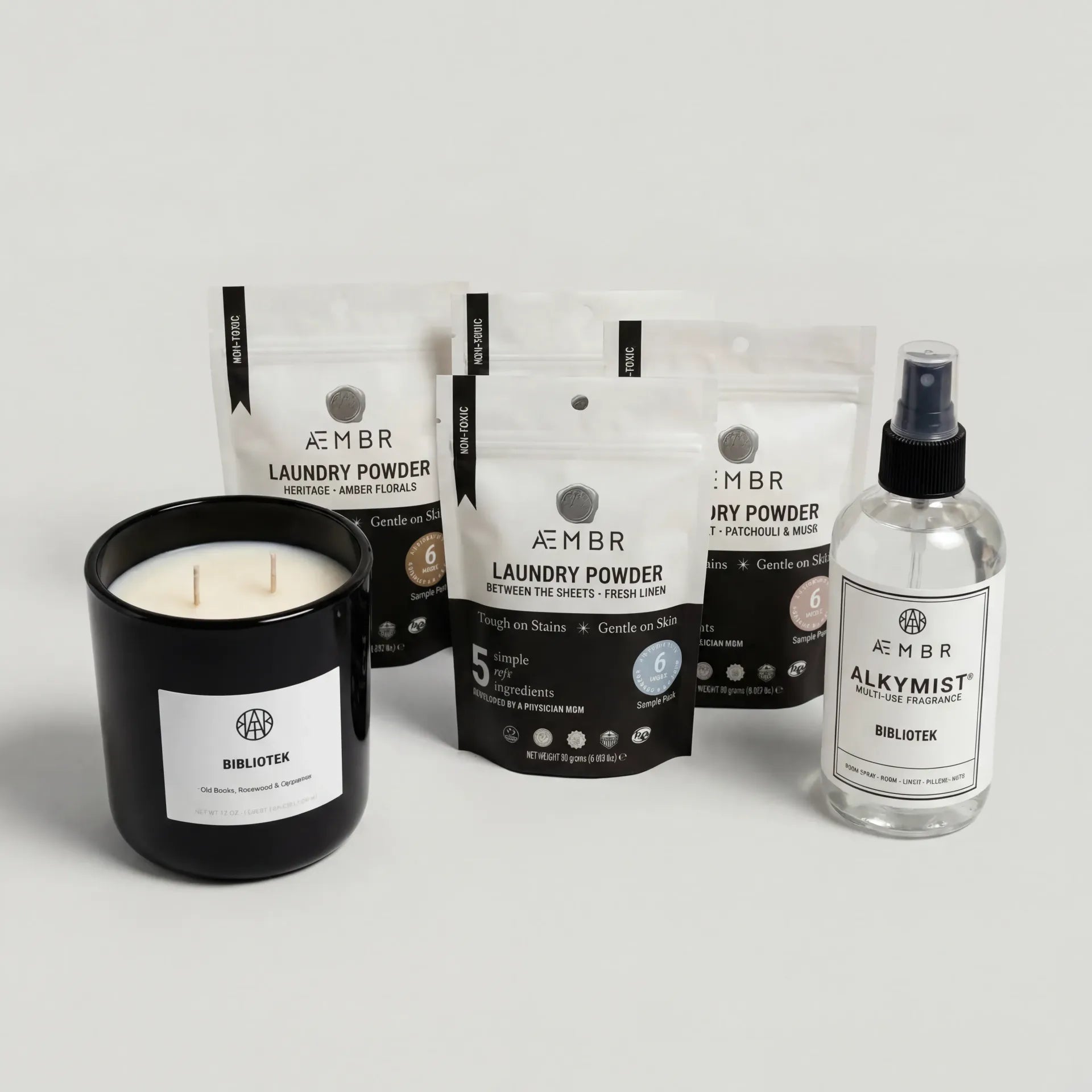
AEMBR's Oxygen Boost is formulated as a sodium percarbonate booster designed to work alongside the AEMBR Laundry Powder — the combination delivers both the oxidative mold-killing action and the enzymatic cleaning performance needed for a complete treatment.
Option 2: Hydrogen Peroxide (3% Solution)
Standard 3% hydrogen peroxide from the pharmacy is an underutilized laundry mold treatment. It's inexpensive, widely available, and effective on most white and light-colored fabrics. It works through the same oxidation mechanism as oxygen bleach — it's essentially the same active species — but in a more dilute, ready-to-use form.
How to use it:
- Pre-test on an inconspicuous area — hydrogen peroxide can lighten some dyes on darker fabrics
- Pour 3% hydrogen peroxide directly onto the mold-affected area and let it sit for 10 minutes
- Scrub gently with a soft brush to loosen the mold colony from the fiber
- Wash immediately in the hottest water safe for that fabric
For full-garment treatment (when the mold is widespread), add 1 cup of 3% hydrogen peroxide to the pre-soak or wash cycle. Do not combine with chlorine bleach — the reaction produces chlorine gas, which is genuinely hazardous.
Option 3: White Vinegar Soak
Distilled white vinegar (5% acetic acid) is the most commonly recommended home remedy for laundry mold — and it has real utility, though it's not the strongest option. Its mechanism is different: acidity disrupts the mold cell membrane rather than oxidizing the mycelium. It also neutralizes the musty odor effectively.
How to use it:
- Soak the affected garment in undiluted white vinegar for 1 hour
- For the washing machine cycle, add 1 cup of white vinegar to the drum (not the detergent drawer — it needs to contact the fabric directly)
- Wash on the hottest cycle safe for the fabric
Vinegar is most effective on mild mildew (the early-stage musty smell) rather than established mold colonies with visible spotting. For visible mold, combine it with an oxygen bleach soak — the vinegar step handles residual odor while the oxygen bleach addresses the fungal structure.
Important caution: do not add vinegar and detergent to the same load simultaneously. Vinegar's acidity can neutralize certain surfactants and reduce cleaning performance. Use vinegar as a soak or pre-treatment, then wash with detergent in a separate step.
Option 4: Boric Acid
Boric acid is an antifungal agent used in medical formulations (vaginal yeast treatments, ear drops for fungal infections) — which tells you something meaningful about its efficacy against fungal organisms. As a laundry treatment, it's less commonly used than the options above, but it's worth knowing about for persistent mold problems or for anyone who wants a non-oxidative approach.
How to use it:
- Dissolve 2 tablespoons of boric acid powder in 2 cups of hot water
- Soak the affected area for 30 minutes
- Wash normally
One note: boric acid is not safe for ingestion and should be kept away from children and pets during handling. At laundry-treatment concentrations that rinse out in the wash cycle, residual risk is low — but handle it with appropriate care.
The Role of Wash Temperature in Mold Elimination
Regardless of which treatment you use, wash temperature matters — significantly. Mold spores are heat-sensitive, and most are killed at temperatures above 60°C (140°F). The challenge is that most modern washing machines default to cold or warm cycles for energy efficiency, and most laundry detergents are marketed as effective in cold water.
For mold treatment specifically:
- Use the hottest cycle your fabric can tolerate (check care labels)
- A 60°C (140°F) or higher cycle will kill spores that survive in cooler water
- For wool, silk, or delicates that can't tolerate high heat, rely more heavily on extended chemical treatment (oxygen bleach soak) rather than temperature
- Never wash moldy laundry in cold water with only a standard detergent — you're likely redistributing spores rather than eliminating them
Drying: The Step Most People Get Wrong
The most important post-wash step isn't the detergent you used — it's how you dry the garment. Mold grows back in moisture. If you put a treated garment in the dryer while damp and pull it out still holding residual moisture, you've set the stage for recolonization within 24–48 hours.
Drying protocol for mold-treated laundry:
- Machine dry on high heat until completely dry — not warm, not slightly damp
- If air drying, hang in direct sunlight when possible: UV exposure is a natural antifungal
- Do not fold and store until fully dry — even slight residual moisture creates conditions for regrowth
- If the mold smell persists after washing and drying, repeat the treatment before wearing or storing
When to Give Up on a Garment
Some mold situations are not worth treating. The honest answer:
- If the mold has been present long enough to leave a black or green stain that persists after oxygen bleach treatment, the mycelium has likely penetrated deep into the fiber weave. The stain may be permanent even if the mold is dead.
- If the mold smell persists after two full treatment cycles (oxygen bleach soak + hot wash + complete drying), the fabric has likely retained spores or volatile organic compounds that won't release with further washing.
- For items with significant sentimental or monetary value, a professional textile cleaning service has access to treatments (ozone treatment, industrial antifungal protocols) beyond what's available at home.
Preventing Mold on Laundry — The Actual Fixes
Treatment is useful. Prevention is better. These are the changes that actually reduce mold recurrence:
- Wash wet items within 24 hours. Gym clothes, towels, swimwear — don't let them sit. The 24-hour window is when mold colonization begins in earnest.
- Don't leave wet laundry in the drum. Set a timer. 30 minutes is the outer limit before odor starts. Move it to the dryer or hang it immediately.
- Run a drum-cleaning cycle monthly. Detergent residue and biofilm in the drum are the substrate mold grows on. Oxygen bleach or citric acid cleaning cycle — once monthly — eliminates the growth medium.
- Use the right amount of detergent. Over-dosing creates residue. Under-dosing doesn't clean adequately. Both lead to buildup that feeds mold. Follow the measuring instructions on your detergent — and use a concentrated, low-suds formula in HE machines. AEMBR's Laundry Powder is designed to rinse clean without residue buildup.
- Leave the washing machine door open between cycles. Airflow in the drum prevents the sustained moisture that mold needs.
- Store laundry in a breathable hamper. Sealed plastic bins trap moisture. A ventilated fabric or wicker hamper lets air circulate.
Comparison: Mold-Removal Methods at a Glance
| Method | Mechanism | Best For | Color-Safe? | Strength |
|---|---|---|---|---|
| Chlorine bleach | Oxidation + chlorination | White cotton only | No | High |
| Oxygen bleach (sodium percarbonate) | Oxidation via hydrogen peroxide release | Most fabrics, colors | Yes (most fabrics) | High |
| Hydrogen peroxide (3%) | Oxidation | Whites, lights, spot treatment | Pre-test required | Moderate–High |
| White vinegar | Acid disruption of cell membrane | Mild mildew, odor | Yes | Moderate |
| Boric acid | Antifungal / cell membrane disruption | Persistent mold, non-oxidative preference | Yes | Moderate |
| Hot wash alone | Thermal kill | Early-stage mildew, heat-tolerant fabrics | Yes | Low–Moderate |
What About "Mold-Resistant" Laundry Detergents?
You may have seen detergents marketed specifically for mold or mildew in laundry. A few notes from the formulator side:
Most "mold-resistant" claims in laundry detergents refer to the product's ability to prevent mold odor in the wash cycle — not to treat established mold on fabric. They often contain antifungal fragrance additives or enzyme blends that target the organic residue mold feeds on.
These can be useful as a maintenance strategy. If you're dealing with an active mold situation, a dedicated treatment (oxygen bleach soak) is the appropriate first step — then maintain with a clean, effective detergent that doesn't leave the residue buildup that invites mold in the first place.
Quick-Reference Checklist
- ☐ Assess the severity: mildew odor only, or visible mold spotting?
- ☐ Choose your treatment: oxygen bleach for most fabrics; vinegar for mild odor; hydrogen peroxide for spot treatment on lights
- ☐ Soak in hot water with chosen treatment for 1–6 hours (overnight for severe cases)
- ☐ Wash on the hottest cycle safe for the fabric
- ☐ Confirm mold smell is completely gone before drying
- ☐ Dry completely — high heat or direct sunlight
- ☐ If smell persists, repeat before storing
- ☐ Implement prevention: wash within 24 hours, leave drum door open, clean drum monthly
Mold on laundry is recoverable in most cases — you don't need chlorine bleach to get there. Oxygen bleach's oxidative mechanism is just as effective for most fabrics, with far less collateral damage to the textiles you're trying to preserve. Pair it with the right wash temperature, complete drying, and a clean-rinsing detergent, and you'll eliminate the problem at its source.
For those building a non-toxic laundry routine from scratch, AEMBR's Non-Toxic Laundry Routine Kit includes the Laundry Powder and Oxygen Boost together — everything you need for both everyday cleaning and mold treatment.


