



By Kristina Braly, MD — Founder, AEMBR
The term "fragrance-free" appears on laundry products ranging from genuinely scent-eliminated formulas to products that simply lack a strong floral smell but still contain fragrance compounds. As a physician who formulates fragrance-free laundry products, I find this label confusion genuinely harmful — because people with eczema, asthma, contact allergies, or fragrance sensitivities are making real health decisions based on terminology that isn't regulated the way they assume it is. Here's exactly what "fragrance-free" means on a laundry label, where the definition breaks down, and how to evaluate a product with confidence.


The Regulatory Reality: No Federal Definition for "Fragrance-Free"
In the United States, the FDA regulates cosmetics but does not regulate laundry products as cosmetics — they fall under consumer product/household cleaner categories, which means they're largely governed by the Consumer Product Safety Act and FTC truth-in-advertising standards, not FDA labeling rules. The FTC's guidance on "fragrance-free" means that the product should not contain added fragrances intended to provide scent. But the term is not defined with the specificity of, say, "USDA Organic" or "EWG Verified."
In practice: no government agency performs pre-market verification that a product labeled "fragrance-free" is actually free of fragrance ingredients. It's a self-reported claim.
"Fragrance-Free" vs. "Unscented": Not the Same Thing
This distinction matters enormously and is widely misunderstood:
| Label | What It Typically Means | May Still Contain |
|---|---|---|
| Fragrance-free | No added fragrance ingredients intended to impart scent | Fragrance chemicals used as functional ingredients (solvents, preservatives); "natural" fragrance compounds |
| Unscented | No perceptible scent in the final product | Masking fragrances added to neutralize ingredient odors; can contain significant fragrance chemicals |
| Lightly scented | Fragrance is present but at lower concentration | All conventional fragrance allergens; just at lower dose |
| Natural fragrance | Fragrance from plant-derived sources | Terpenes (d-limonene, linalool) that are documented contact allergens |
The most important distinction: "unscented" products frequently contain masking fragrances — chemicals whose purpose is to cover the smell of surfactants and other raw materials, making the product smell like nothing. These masking agents are fragrance chemicals. They can trigger the same reactions as scented products. An unscented detergent is not a fragrance-free detergent.
Expert guidance on clean ingredients, home fragrance, and living well — from our physician-authored blog.
The "Fragrance" Loophole on Ingredient Labels
Under U.S. law, the word "fragrance" on an ingredient list can legally represent a proprietary blend of any number of individual chemical compounds — the manufacturer is not required to disclose what those compounds are, because fragrance formulas are protected as trade secrets. This single ingredient entry can encompass anywhere from a handful to hundreds of distinct chemicals.
The International Fragrance Association (IFRA) has a voluntary transparency initiative, and the Environmental Working Group's Skin Deep database flags the "fragrance" entry as a data gap specifically because full ingredient composition is unknowable from the label alone. For products claiming to be fragrance-free, this loophole means you have to look more carefully than just scanning for the word "fragrance."
Hidden Fragrance: What to Actually Look For
Fragrance chemicals can appear in ingredient lists under non-obvious names. Common ones to recognize:
- Linalool — naturally occurring terpene (lavender, bergamot); a documented fragrance allergen
- Limonene (d-limonene) — citrus-derived terpene; common allergen, also listed as a solvent in some formulas
- Benzyl alcohol — used as both a preservative and a fragrance; dual-function makes it easy to miss
- Eugenol — clove-derived; fragrance allergen
- Citronellol, geraniol — floral fragrance compounds, often from essential oils
- Hexyl cinnamal, amyl cinnamal — synthetic fragrance allergens flagged by EU regulators
- Hydroxycitronellal — synthetic muguet fragrance compound; documented sensitizer
Under EU cosmetics regulations, 26 specific fragrance allergens must be disclosed by name on ingredient labels when above threshold concentrations. The U.S. has no equivalent requirement for laundry products. This is a meaningful gap in consumer protection — the EU's list gives a practical reference point for what to watch for even here.
Why This Matters Clinically
Fragrance is the most common cause of allergic contact dermatitis from consumer products. The American Contact Dermatitis Society consistently ranks fragrance among the top three contact allergens identified on patch testing. For people with atopic dermatitis (eczema), asthma, or rhinitis, fragrance exposure — even from fabric — can be a trigger for symptoms.
Crucially, sensitization is cumulative. A person may tolerate a fragrance compound for years, then develop a contact allergy that renders them reactive to many products simultaneously. Once sensitized, the threshold for reaction drops significantly. This is why dermatologists recommend genuinely fragrance-free products for eczema-prone patients rather than "low fragrance" alternatives. I cover the eczema-specific picture in more detail in my post on laundry detergent as an eczema trigger.
How to Verify a "Fragrance-Free" Claim
- Read the full ingredient list. Not the claims panel — the actual INCI ingredient list. Look for any of the fragrance chemicals listed above.
- Look for "fragrance" or "parfum" anywhere on the list. If it's there, the product is not fragrance-free regardless of front-panel claims.
- Check EWG Verified status. EWG Verified requires full ingredient disclosure and prohibits fragrance without full disclosure. Not perfect, but a higher bar than self-certification.
- Look for third-party certifications. MADE SAFE, NSF/ANSI 305 (for natural cleaning products), and similar programs require ingredient transparency as part of certification.
- Research the brand's transparency practices. Does the company publish a full ingredient list online? Do they have a published fragrance-free policy? Brands that take this seriously will say so explicitly.
What "Free and Gentle" Usually Means (and Doesn't)
Many major detergent brands offer a "free and gentle" or "free and clear" line. These products are genuinely better than their scented counterparts — they typically eliminate added fragrance and dyes, which does reduce irritant and allergen load substantially. They are a meaningful improvement.
But "free and gentle" products often still contain preservatives (including MI in some formulas), optical brighteners, and residues of processing chemicals that aren't individually disclosed. They're not optimized for the most sensitive individuals; they're a general market improvement over standard formulas. For someone with chronic eczema, asthma exacerbations from laundry products, or confirmed fragrance contact allergy, "free and gentle" may not be sufficient.
Plant-Based and "Natural" Fragrances: A Special Note
The market has moved significantly toward "natural" fragrance as a perceived safer alternative. I want to be direct about this: there is no clinical evidence that natural fragrance is less allergenic than synthetic fragrance as a category. Individual compounds matter, not their origin. Linalool (from lavender) and benzyl alcohol (from jasmine) appear on European fragrance allergen lists alongside synthetic compounds. Tea tree oil, eucalyptus, and peppermint — all genuinely natural — are all documented sensitizers.
Natural fragrance is a marketing positioning, not a safety standard. When in doubt, "no fragrance" is safer than "natural fragrance" for sensitive populations. See also my post on phthalate-free laundry detergent for how the broader synthetic-vs-natural ingredient debate applies to laundry.
EU vs. US Standards: Why the Gap Matters
The European Union's cosmetics regulation bans or restricts more than 1,300 chemicals. Separately, EU detergent regulations require fragrance allergen disclosure above threshold levels. Neither framework applies to U.S. consumer laundry products. This regulatory gap means the same brand may offer a more restricted formula in European markets than in the U.S. — something worth noting when evaluating imports or when a brand claims international certification.
What True Fragrance-Free Looks Like in a Formula
A genuinely fragrance-free laundry product should:
- ✅ Contain no ingredient listed as a fragrance ingredient in the International Fragrance Association database
- ✅ Contain no masking agents (look for "fragrance" with a function note of "masking")
- ✅ Disclose the full ingredient list in INCI format
- ✅ Not use "natural fragrance" as a workaround
- ✅ Smell neutral to mildly soapy from surfactant base — not perfumed
- ⚠️ Note: a product that smells like nothing is not necessarily fragrance-free — verify the list
AEMBR's Position on Fragrance
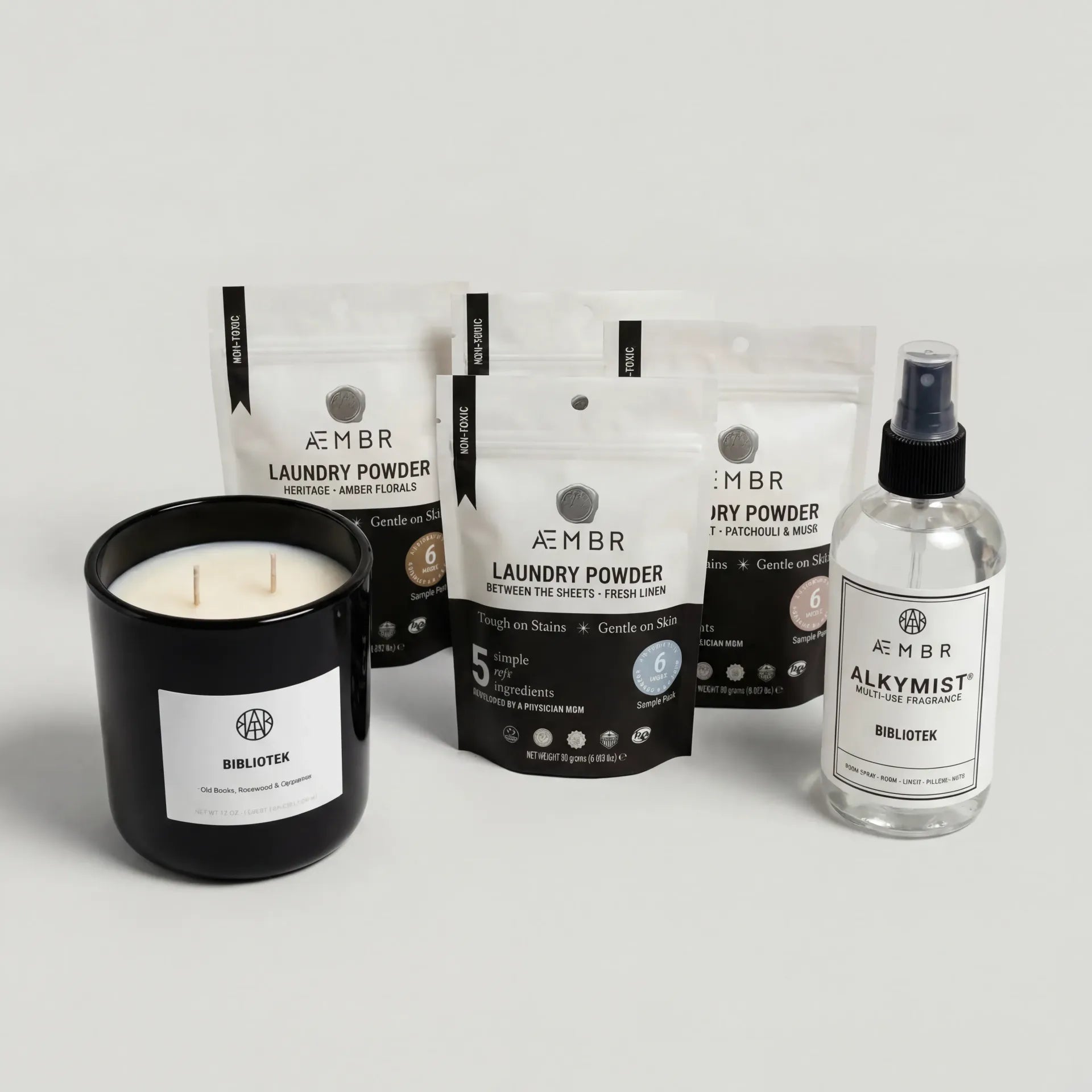
AEMBR Laundry Powder contains no fragrance ingredients — not synthetic, not natural, not masking agents. The full ingredient list is disclosed publicly. This is not a difficult commitment to make if you're building a formula from scratch with the intent of being genuinely safe for sensitive skin; it is a difficult commitment if you're trying to maintain a pleasant scent experience while claiming fragrance-free status.
I built AEMBR because the intersection of "clean ingredients" and "transparent labeling" was poorly served in the laundry category. "Fragrance-free" should mean what it says — and the way to ensure that is to read the ingredient list rather than trust the claim. For a deeper look at what's actually in your detergent, my post on laundry detergent ingredients walks through every major ingredient category with the same level of specificity.
Quick Reference: Fragrance Terminology Cheat Sheet
- Fragrance-free: No intentionally added fragrance — verify by reading the ingredient list
- Unscented: No perceptible scent — may still contain masking fragrances
- Natural fragrance: Fragrance from plant sources — still allergenic, not regulated differently
- Essential oils: Naturally derived fragrance ingredients — documented allergens
- Parfum / Fragrance (on label): Proprietary blend, ingredients undisclosed — avoid for sensitive populations
- EWG Verified: Third-party verified full ingredient disclosure — higher confidence


