



Are wax melts safe to breathe? It's a question I get often — from customers, from friends, and honestly from myself before I started formulating. You melt a scented wax cube over heat, it releases fragrance into your home, and you inhale it for hours. What exactly is going into your lungs? As a physician who has spent years thinking about indoor air quality and ingredient safety, I want to give you the honest, evidence-based answer — not the marketing version.

The short answer is: it depends entirely on what's in the wax and fragrance, and how your space is ventilated. Wax melts can be a lower-risk alternative to traditional candles, but they are not inherently "clean" or safe by default. Let me walk you through the science.
How Wax Melts Work — and Why It Matters for Safety
Wax melts are solid fragrance delivery systems. You place them in a warmer — either an electric plate or a tea-light-heated dish — and heat gently, typically between 150–175°F (65–80°C). At that temperature, the wax doesn't combust; it melts, and the fragrance compounds trapped in the wax become volatile enough to evaporate into the air.
This is meaningfully different from a burning candle, which generates combustion byproducts alongside the fragrance release. The absence of a flame removes soot, carbon monoxide, and incomplete combustion particles from the picture. But it does not remove VOCs from the fragrance itself — those are still going airborne, still entering your respiratory system, still interacting with the chemistry of your home.
What Are VOCs and Why Do They Show Up in Wax Melts?
Volatile organic compounds (VOCs) are carbon-containing chemicals that evaporate at room temperature or mild heat. They are common in paints, cleaning products, furniture off-gassing — and fragrance products, including wax melts.
Expert guidance on clean ingredients, home fragrance, and living well — from our physician-authored blog.
When a wax melt heats, the fragrance compounds volatilize. Some of those compounds are benign aroma molecules. Others — depending on the formula — may include:
- Phthalates — used as fragrance fixatives and carrier solvents; linked to endocrine disruption in animal studies
- Benzene and toluene derivatives — present in some synthetic fragrance formulas; classified carcinogens at sufficient exposure levels
- Formaldehyde precursors — certain fragrance aldehydes can off-gas formaldehyde at elevated temperatures
- Limonene and linalool oxidation products — naturally occurring aromatic compounds that, when oxidized indoors, generate secondary pollutants including formaldehyde
The critical variable here is concentration. Ambient exposure to low levels of many of these compounds during occasional wax melt use is generally not at a clinically significant threshold for healthy adults. But for people with asthma, fragrance sensitivity, or chronic respiratory conditions — and for children, whose respiratory rates are higher relative to body weight — even low-level chronic VOC exposure warrants attention.
Paraffin vs. Soy vs. Coconut Wax: Does the Wax Type Matter?
Yes — but perhaps less than you've been led to believe. The wax is the carrier; the fragrance is the primary source of VOC emissions. That said, wax type is not irrelevant.
| Wax Type | Derived From | VOC Considerations | Notes |
|---|---|---|---|
| Paraffin | Petroleum refining byproduct | Can release low levels of benzene and toluene when melted; more pronounced during burning than melting | Most common; lowest cost; some studies show higher soot and VOC output when burned vs. melted |
| Soy | Hydrogenated soybean oil | Cleaner melt profile than paraffin; VOCs mainly from fragrance | Lower melt point means fragrance releases at gentler temps; widely available but often blended with paraffin |
| Coconut wax | Coconut oil (hydrogenated) | Among the cleanest melt profiles; minimal wax-derived VOCs | Higher cost; superior scent throw due to lower melt viscosity; what AEMBR uses in its candle line |
| Beeswax blends | Beeswax + soy or coconut | Very clean; beeswax emits negative ions that may bind airborne particulates | More difficult to fragrance at high load; often used in unscented or lightly scented products |
Bottom line: a premium wax won't neutralize a poorly formulated fragrance. Look for clean fragrance first; wax type is secondary.
The No-Flame Question: Are Wax Melts Safer Than Candles?
From a fire and combustion standpoint — yes, definitively. Electric wax warmers eliminate open flame risk entirely, and tea-light warmers still reduce the surface area of combustion compared to a traditional candle. There's no wick, no carbon, no soot.
From an air quality standpoint — it's more nuanced. Studies measuring VOC output from paraffin candles vs. wax melts show that wax melts can actually release comparable or higher levels of certain fragrance-derived VOCs, because:
- The wax pool is larger in a melt dish, increasing surface area for evaporation
- Many consumers use wax melts continuously for 4–8 hours, vs. a candle burned for 1–2 hours
- The lower temperature of melting (vs. the ~300–400°F near a candle flame) means fragrance molecules don't thermally degrade as quickly — they volatilize more intact
This doesn't mean wax melts are dangerous. It means ventilation and fragrance quality matter as much as the wax format.
What Physicians and Researchers Say About Indoor Fragrance Exposure
The EPA categorizes indoor air quality as one of the top five environmental public health risks. Scented consumer products — including candles, air fresheners, and wax melts — are identified contributors to indoor VOC burden. A 2019 study published in Environmental Science & Technology found that fragrance products are responsible for approximately half of petrochemical-derived VOCs in consumer use environments (McDonald et al., 2019).
The American Lung Association recommends minimizing use of scented products indoors for people with asthma or respiratory sensitivities, and ensuring adequate ventilation when using any fragrance-emitting product (American Lung Association).
None of this means you need to ban wax melts from your home. It means you should choose them the same way I choose any product I bring into my house: with an eye on what's actually in them.
The Phthalate Problem in Wax Melt Fragrance
This is the most important thing I want you to understand about wax melt safety. The wax itself is largely inert at melting temperatures. The fragrance oil — and specifically the carrier ingredients used to dilute and fix the aroma compounds — is where the real risk lives.
Phthalates (diethyl phthalate, dibutyl phthalate) are commonly used as fragrance fixatives and solvents in conventional wax melt formulas. They help scent throw remain strong over long melt sessions. They are also:
- Classified as endocrine disruptors by the EPA
- Associated with reproductive and developmental effects in animal studies
- Listed as California Prop 65 chemicals (dibutyl phthalate)
- On the EWG's Chemicals of Concern list
At melting temperatures, phthalates volatilize alongside the fragrance. If you're melting phthalate-containing wax for 4–6 hours in a small bedroom, you are inhaling them. The cumulative exposure question is one the fragrance industry hasn't fully answered — which is reason enough for me to formulate without them.
What to Look for When Buying Wax Melts
Here's the checklist I use as both a physician and a formulator:
- ✅ Phthalate-free fragrance oil — non-negotiable for me
- ✅ Coconut wax, soy wax, or beeswax blend — not paraffin-primary
- ✅ No synthetic dyes — colorants add no functional value and some have their own toxicity profiles
- ✅ Fragrance load disclosed or ingredient transparency available — brands that tell you what's in their fragrance are doing something intentional
- ✅ Designed for electric warmer or low-temp tea light — lower temperatures = gentler volatilization
- ❌ Avoid: "fragrance" listed alone with no further disclosure
- ❌ Avoid: artificially colored melts (especially bright dyes)
- ❌ Avoid: phthalate-containing formulas (if brand doesn't disclose, ask)
Ventilation: The Variable Most People Ignore
Regardless of how clean your wax melt formula is, indoor air quality is a function of ventilation. VOCs accumulate in closed, unventilated spaces. A few practical rules:
- Don't use wax melts in a room with a closed door for 6+ hours — crack a window or door periodically
- Never use them in a car or very small space without ventilation
- Limit continuous burn sessions — 2–3 hours at a time is a reasonable ceiling for most people
- If you have asthma, chronic allergies, or chemical sensitivity — opt for electric warmers over tea-light warmers (lower heat = fewer VOCs released per session)
- Air out rooms after an extended session — especially before children sleep in the space
AEMBR Wax Melts: How I Formulate for Safety
When I developed AEMBR's wax melts, I approached them the same way I approach any formula — from the physician chair first, not the marketing chair. Every fragrance compound is phthalate-free by design. The wax base is coconut-apricot blend. We don't use synthetic dyes.
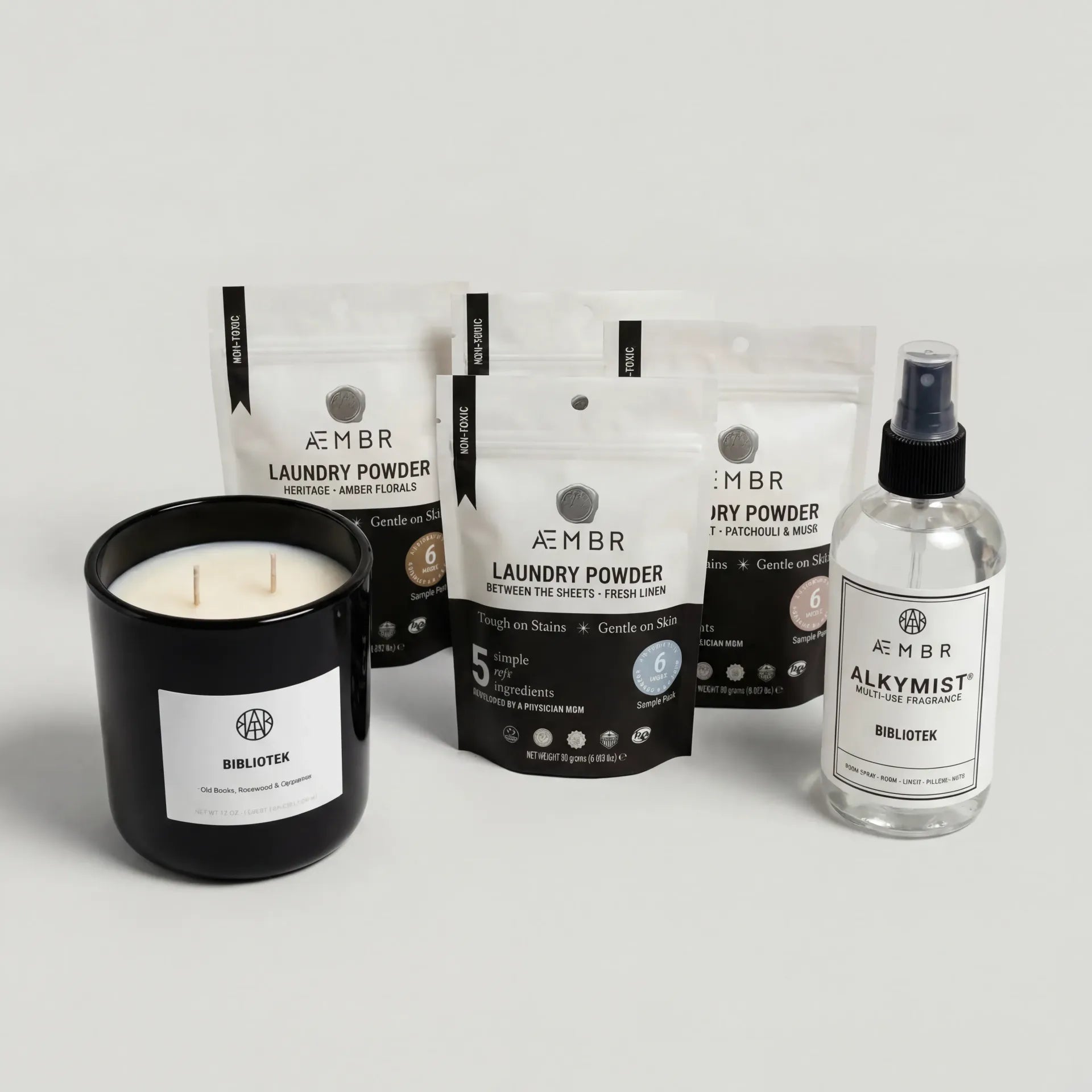
The result is that you get the scent throw and the sensory experience of a luxury wax melt without the fragranced compound categories I'd never put in my own home. The AEMBR core wax melt collection covers our most beloved scent profiles — from the leather-and-oak warmth of Bibliotek Wax Melt, to the sea-salt-and-sage freshness of Fjord Wax Melt, to the deep amber warmth of Amber Oud Wax Melt. Each one is formulated with the same level of scrutiny I apply to everything in the AEMBR line.
If you want to explore wax warming as a format, our Deco Wax Warmer is designed for electric-heat use — the lowest-temperature format and the one I'd recommend for anyone using wax melts daily in a bedroom or nursery.
Related Reading on Clean Home Fragrance
If this topic interests you, I've written a broader guide on how to scent your home safely without toxins — covering candles, diffusers, room sprays, and wax melts together in one framework. I also go deep on what makes a candle truly non-toxic, including how to evaluate wicks, wax, and fragrance load.
The Bottom Line: Wax Melts Can Be Safe — With the Right Formula
Wax melts are not inherently dangerous. But the category has very little regulation, and a significant portion of mass-market wax melts are formulated with cheap paraffin, synthetic dyes, and phthalate-containing fragrances. The potential for cumulative VOC exposure in small, unventilated spaces is real — and it is disproportionately relevant for children and people with respiratory conditions.
The path to safe wax melt use is straightforward: choose formulas made with clean fragrance ingredients, use electric warmers when possible, ventilate your space, and limit continuous burn time. You should not have to choose between a beautifully scented home and a safe one. That's the premise every AEMBR product is built on.
— Kristina Braly, MD


